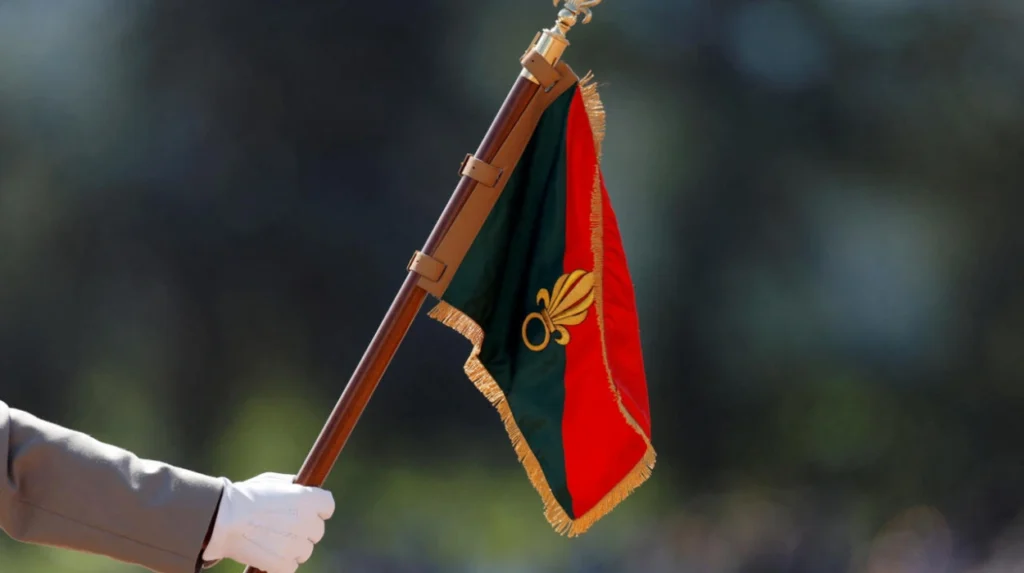
The kidnapping of a French Foreign Legion soldier traveling through a highway in southwest Colombia has rapidly evolved from being merely a local crime news to a highly political issue that will be used to test the mettle of Colombia’s recently formed right-wing government, the power of FARC dissidents, and the diplomacy skills between Paris and Latin America. According to a report by the Colombian army seen by AFP on 27-28 August 2026, José Olger Melo Charry, a corporal from the French-Colombia legion, was kidnapped on 6 August in Nariño, a region where guerrilla groups have always operated and where drug trafficking occurs. In its report, it says that while the corporal was traveling on a highway in Nariño, armed men blocked his way, examined his documents and after finding out that he is a member of the French army, took him hostage.
As of 28 August, no group had publicly claimed responsibility and no ransom demand had been made public, but Colombian authorities and media attribute the kidnapping to the Estado Mayor Central (EMC), the main FARC dissident structure that rejected the 2016 peace accord.
Who is José Olger Melo Charry, and why his case is different
José Olger Melo Charry is no ordinary tourist or humanitarian; he is a soldier currently deployed in one of the most elite and symbolic armies in the world. Born in Pasto, Nariño, he carries dual nationality from France and Colombia, and he has been serving in the Foreign Legion for about four years, according to Colombian military sources. The fact that he was kidnapped while on leave in his own country brings a unique dimension to this issue; a citizen of Nariño, wearing the uniform of the French Army, is being held by guerrillas in the same region where he comes from. This situation has made the case particularly difficult.
For Paris, it is a case of defending a serving soldier and maintaining the rule that any attack against its citizens or employees, whether on leave or abroad, will be dealt with strongly. For Bogotá, it is a test of their capacity to secure their territory and deal with the armed groups without showing weakness in face of the presidency who promised a tougher stance on the rebels. For the EMC, it is an occasion to extract leverage through this high-profile hostage who holds nationality from two continents.
The alleged perpetrators: EMC, “Iván Mordisco,” and the unfinished war
Colombian officials and journalists point to the Estado Mayor Central (EMC) as the likely orchestrator of the kidnapping. The EMC is the largest FARC dissident faction, composed of former commanders and fighters who refused to demobilize under the 2016 peace agreement and have continued armed operations, including kidnappings, extortion, and attacks on security forces. The group is led by Néstor Gregorio Vera Fernández, known as “Iván Mordisco”, whom Colombian authorities describe as the country’s most-wanted guerrilla commander.
There are sufficient records of the EMC presence in the Nariño Department. Being located near Ecuador and the Pacific Ocean, this department is a natural transit point for the transportation of cocaine. For many years, Nariño was home to different armed groups like EMC fronts, ELN battalions, and criminal groups. The group of “Ivan Mordisco” was involved in multiple mass kidnappings and high-profile attacks; one of the latest incidents is the kidnapping of nine Antioquian miners that occurred in Huila on October 2025 when one of EMC members received 34 years in jail.
Although there have been no public statements of the responsibility for this incident by the specified date (28 August), the scenario fits EMC tactics very well, namely, targeting valuable individuals, acting in those zones where state presence is minimal, and using hostages as instruments of pressure on the Colombian state and its allies. It is especially noteworthy that according to the kidnapping perpetrators, they learned about the Legion affiliation only after the check of his documents.
Bogotá’s new security doctrine under de la Espriella
The timing of this kidnapping is politically charged. Abelardo de la Espriella was inaugurated as Colombia’s president on 7 August 2026, just one day after Melo Charry was taken. De la Espriella, a right-wing figure, has campaigned and taken office on a platform of hardline security policies, promising to crack down on guerrilla groups, drug traffickers, and criminal networks. His administration has already floated extreme measures, including the use of prison ships adrift at sea for people deemed highly dangerous criminals, according to defense ministry sources.
The abduction of a French Foreign Legion soldier in the first weeks of his presidency is therefore a direct challenge to his core promise: that a tougher stance will translate into better security and fewer high-profile crimes. If the EMC is indeed behind the kidnapping, it signals that dissident groups are testing the new government’s resolve, probing whether rhetorical hardness will be matched by operational effectiveness and political will in negotiations or military pressure.
At the same time, de la Espriella’s government is deepening security cooperation with Washington. On 26 August, the head of U.S. Southern Command visited Bogotá to discuss joint operations against narco-traffickers with the new administration. The Melo Charry case now sits at the intersection of these dynamics: domestic counterinsurgency, international diplomacy, and transnational anti-drug efforts. How Bogotá handles it—whether through military pressure, back-channel talks, or a mix of both—will shape perceptions of the new security doctrine at home and abroad.
Paris’s dilemma: diplomacy, discretion, and the Foreign Legion’s image
The French authorities are facing a challenging situation in different respects. On 27 August, the French military command (État-Major des armées, EMA) has confirmed that one of their Foreign Legion soldiers has been kidnapped in Colombia. Besides, as far as Paris usually operates in hostage cases very quietly, the French authorities have refrained from providing any additional information related to the operation.
However, the kidnapping of a French Legionnaire raises special concerns as Foreign Legion is an elite force, a source of pride for France, and an instrument of its global presence and influence. The fact that the kidnappers have identified him as a member of the Legion and that Melo Charry is also Colombian complicates the situation even more, as now France should consider its national interests and at the same time take into account the interests of Colombia. There are a number of actions which Paris may be currently considering, namely participation in the military campaign of Colombian forces in Nariño, dialogues with intermediaries who can establish communication with the EMC, and preparation of the appropriate contingency plan in case the situation develops further. In public statements, there will be references to cooperation with Colombian military authorities and to the priority of the safe return of the hostage.
Nariño’s security reality: why this region remains a flashpoint
Nariño’s geography and economy make it a perennial hotspot for violence and illicit activity. Bordering Ecuador and the Pacific Ocean, it is a key transit zone for cocaine shipments heading north and west. Multiple armed groups compete for control of routes, taxation points, and local populations, creating a fragmented but deadly security landscape. State presence is often limited to urban centers and major roads, while rural areas remain under the influence of guerrillas and criminal bands.
Kidnapping, though reduced compared to the peak years of the conflict, remains a tool for financing and leverage. The EMC under “Iván Mordisco” has used it repeatedly, including the October 2025 mass abduction of miners in Huila. In this context, Melo Charry’s kidnapping is both typical and exceptional: typical in that it occurred in a zone where armed groups operate with relative impunity, exceptional because of his status and the international attention it draws. For local communities, the incident reinforces a grim reality: despite years of peace processes and military campaigns, the threat of abduction persists, especially for those who travel through contested areas. For the state, it underscores the limits of territorial control and the need for more integrated strategies that combine security operations, social investment, and political engagement with armed actors—whether through negotiation or pressure.
What this means for Colombia’s peace and security trajectory
The kidnapping of a French Foreign Legion soldier in Colombia is no news story – it is a litmus test of how well the country is coping with efforts at establishing peace and security. In previous regimes, during the execution of the 2016 agreement, it seemed plausible that FARC’s disarmament will be able to lower down the levels of violence in the country. However, the appearance of rebel groups such as the EMC proves otherwise. While de la Espriella’s tough stance on the matter might attract many voters who have become fed up with the insecurity in the country, it must be noted that historically speaking, military intervention alone might prove ineffective in handling the situation. It must be recognized that the EMC is deeply entrenched in both the economy and society of the region; thus, their elimination should include not just force but also politics and intelligence gathering.
In the short term, all eyes will be on whether the EMC issues demands, how Bogotá responds, and whether Paris plays a visible role. In the medium term, the case will be cited in debates over the effectiveness of the new government’s security policy and the viability of engaging or isolating dissident groups. If Melo Charry is released quickly and safely, it may be seen as a manageable crisis. If the ordeal drags on or ends badly, it could become a symbol of the state’s inability to protect its territory and citizens, even as it promises a tougher line.
Scenarios ahead: negotiation, pressure, or prolonged standoff
Three different scenarios could be envisaged here. First, negotiations leading to the release of Melo Charry, perhaps via some intermediary, and involving the acceptance of certain concessions which will not necessarily be known to the general public. This approach corresponds with previous experience with kidnappings, when the state tries to combine its principles with some pragmatism in order to ensure the liberation of the kidnapped. Second, a military/intelligence mission designed to find the soldier and liberate him if reliable information is available.
Third, an extended confrontation during which the EMC keeps Melo Charry as a hostage for months on end, uses him as leverage in the negotiations, and receives some resources, while Bogotá and Paris manage the international and domestic pressure. There are dangers associated with each scenario. The danger of negotiations lies in legitimizing the armed groups and encouraging further kidnappings. The danger of military operations is the danger of harming the hostage and of escalating violence in Nariño. The danger of the extended confrontation is the loss of public credibility and diplomatic complications. The best way seems to be some mix of both.