In the area where European security, NATO solidarity, and Mediterranean politics meet, France’s choice to throw open the door for a possible SAMP/T France Turkey air-defence system sale represents a silent but profound policy revolution. After years of political reluctance, France appears to be sending out signals that it will be willing to support in principle any potential exportation and coproduction of the Franco-Italian SAMP/T air-defence system to Turkey on condition that certain conditions concerning the technology, NATO compatibility and other regional sensitivities are met.
This change occurs against a backdrop where Europe is grappling with constant missile and drone threats and NATO is trying to beef up its southern flank. The SAMP/T air-defence system has become more than just a bilateral issue between Paris and Ankara, and also involves Athens and Nicosia.
How We Got Here: A Project Blocked for Years
For almost a decade now, a proposed sale of France Turkey SAMP/T air defence was marked more by roadblocks than by forward motion. In November 2017, Turkey, France and Italy agreed to cooperate on air defence, with Eurosam—a consortium of MBDA, Thales and Leonardo—appointed to explore a SAMP/T-based system jointly with Turkish companies Aselsan and Roketsan.
In 2018, a feasibility agreement was signed to study joint development and integration within the emerging multi-layered “Steel Dome” concept of air and missile defence in Turkey. Despite this initial enthusiasm, however, France put the project on ice. France opposed Turkey’s military intervention in Syria and its hostile stance towards Greece and Cyprus regarding territorial disputes and maritime and energy assets as well as growing ties with Russia in terms of defence industry, including the acquisition of Russian S-400 systems. In effect, that meant that despite continued willingness of Italy to collaborate in co-production, French opposition made it impossible for Eurosam to proceed from studies to actual exports and co-production.
What Has Changed in Paris
The recent reporting about France becoming “open to a possible sale” of SAMP/T to Turkey represents not one moment but rather a slow process of shifting priorities in Paris. According to French officials and sources mentioned in regional and international media, there is a different policy environment because of Russia’s war in Ukraine, Iran-related ballistic missile threat and NATO’s need for credible area air and missile defence on its southern flank. In this situation, Turkey’s geographical location and front-line state status are becoming less ignorable in operational planning. Intelligence Online claims that French President Emmanuel Macron and Turkish President Recep Tayyip Erdoğan had talked about an “air-defence mega-contract” before NATO summit where SAMP/T Mamba will be the basis of negotiations.
According to sources, the talks now involve French readiness to consider Ankara’s request for co-production and technology transfer under certain conditions regarding intellectual property rights and NATO security. According to one source familiar with the discussions, France is no longer politically vetoing SAMP/T project but seeking a
“structured path for cooperation that strengthens NATO’s southeastern flank without destabilizing the region.”
Turkey’s Strategic Ambition: Building the “Steel Dome”
On the Turkish side, there is a direct link between the possible sale of the SAMP/T air defence system to Turkey and its general strategy to develop a layered indigenous air and missile defence system called the Steel Dome. In this regard, Turkish authorities have expressed their plans to develop systems of very short-, short-, and medium-range, all created using both domestic and foreign technologies, and designed to form a shield against the threat of manned aircraft, UAVs, cruise missiles, and ballistic missiles. Within this strategy, SAMP/T is considered a key system capable of conducting long-range interception of various aerial targets and integration into the systems of control and command of the NATO.
As one Turkish representative described SAMP/T,
“it is not just another battery; it is a backbone we want for the long-range layer of the Steel Dome.”
The requirement to produce SAMP/T systems in cooperation with Europe derives from the need for embedding European knowledge into the national industry.
The System at the Heart of the Debate: What SAMP/T Can Do
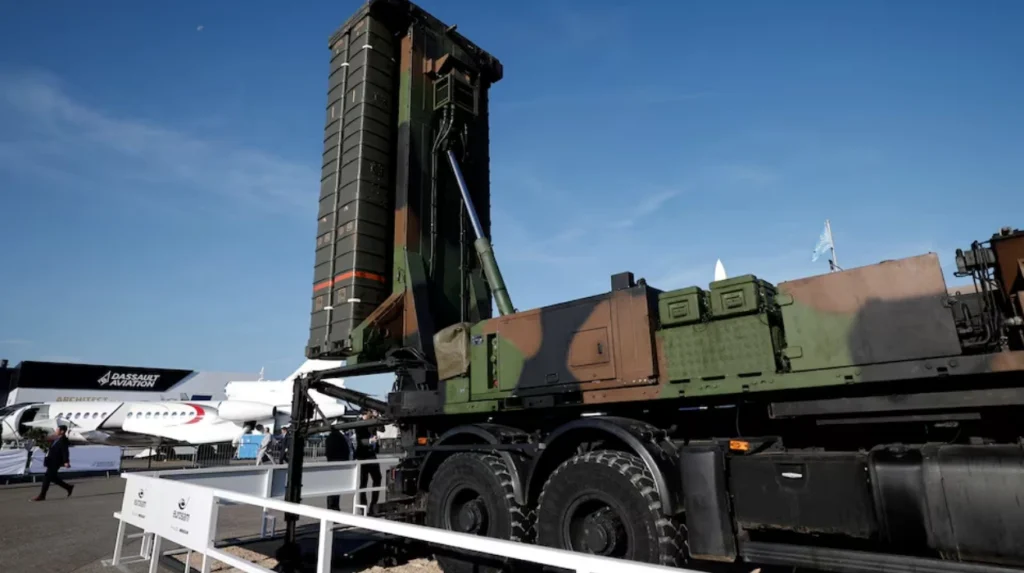
SAMP/T—short for Sol‑Air Moyenne Portée/Terrestre—is a mobile, long‑range surface‑to‑air system designed to deliver area air and missile defence for deployed forces and critical infrastructure. Built around the Aster 30 Block 1 interceptor missile, the system is intended to engage aircraft, unmanned systems, cruise missiles and short‑range ballistic missiles, using truck‑mounted launchers, a command module and radar to rapidly deploy, reposition and integrate into wider NATO networks.
Open‑source references credit SAMP/T with engagement envelopes that reach well over typical short‑range thresholds for aerodynamic targets, and with specific anti‑ballistic capabilities tailored to intercept certain classes of missiles, although precise performance figures remain classified. In 2026, Italy deployed a SAMP/T battery to Turkey’s Konya province under NATO’s Standing Defence Plan, stationing it at the 3rd Main Jet Base Command to bolster air defence capability on the alliance’s southeastern flank. That deployment is separate from the potential export deal, but it offers a concrete example of how the system operates in theatre and how it can be integrated into Turkey’s air‑defence environment without undermining NATO interoperability.
NATO, S‑400s and the Interoperability Question
The potential sale of France’s SAMP/T system to Turkey for air defense purposes cannot be considered apart from the specter of Turkey’s acquisition of Russian S-400s, resulting in U.S. sanctions against Turkey and the exclusion of the country from the F-35 fighter aircraft program. NATO officials have made their concerns known many times before, stating that co-location of Russian military equipment with alliance assets could lead to foreign espionage. Against this context, the potential inclusion of a new NATO-compliant European system into Turkey’s inventory comes as both an opportunity and a challenge. Firstly, SAMP/T was designed from scratch with NATO interoperability in mind, and the operational use of the system by Italy in Turkey proves that this interoperability is indeed possible.
Secondly, as experts note, any export deal would most certainly have provisions concerning the operation and maintenance of the S-400 batteries in order to minimize the chances of exposing information to the wrong side. As a European defense expert put it,
“If SAMP/T is to be the poster child of Turkey’s re-anchor in NATO, then the cost of doing business is putting more firewalls between Turkish S-400s.”
Regional Shockwaves: Greece and Cyprus React
France’s change of approach has certainly not escaped notice in Athens and Nicosia. The Greek press and government have taken alarm at reports of continued talks about the integration of SAMP/T interceptors into Turkey’s Steel Dome, viewing the possibility of such collaboration as a strategic realignment that would impact military balances in the Aegean and Eastern Mediterranean regions. According to one Greek commentator, such developments constitute “a strategic betrayal by Paris that threatens to tip the air defence balance decisively in Ankara’s favor.” Cypriot newspapers similarly point out that this rethinking on the part of France will be “closely monitored” in Cyprus, where France has been developing defense ties, including maritime cooperation and discussions about advanced equipment.
The problem is not merely one of technology for the Greek and Cypriot governments but of politics. Should Turkey acquire and co-produce an advanced Franco-Italian air defence system under the France-Turkey SAMP/T air defense sale, it will strengthen its deterrent and bargaining position in regional conflicts, even when the batteries are designed only for general national defense and not for specific theatres.
Defence Industry Dimensions: Eurosam, Italy and Turkish Partners
There is an industrial aspect of this sale to Turkey of France’s SAM/P/T air defense system that is significant. Eurosam – the alliance that includes MBDA, Thales and Leonardo – is set to secure not only an export contract but also co-production involving subsystems and integration done in Turkish factories. The Italian government has generally been more willing to entertain the prospect of such deals as they see Turkey as an important partner and customer and joint production that enables Turkish firms to develop subsystems for the radar, fire control and missile systems is encouraged.
There has been French hesitation before as they were sensitive about exporting advanced technologies and the implications of industrial cooperation amid contentious regional politics. It appears that the new approach indicates that structured co-production of this kind can be tolerated by Paris when seen within the context of NATO enhancement and diversified European military collaboration rather than being seen as contributing to unilateral Turkish military expansion. Turkish firms like Aselsan and Roketsan are likely to play crucial roles in local production and systems integration.
Linking SAMP/T to Other Turkish Defence Files
The SAMP/T deal between France and Turkey is far from being isolated. In parallel, Ankara is pursuing another key Western defence dossier: a request for 40 new F‑16 Block 70 “Viper” jets from the United States. As reported by Quwa and other defence media sources, both dossiers are under consideration ahead of an upcoming summit of NATO leaders in Ankara that will focus on defence-industrial cooperation. Both are part of an attempt by Turkey to balance its defence posture after a period of confrontation with its Western allies and to integrate new weaponry into a flourishing local aerospace and defence industry.
The objective for Turkey is not only to purchase new weapons but to set the conditions of cooperation, co-production and technology transfers which will allow its military to use advanced Western weaponry alongside its own domestic range of weaponry, ranging from unmanned aerial vehicles (UAVs) to short-range air-defence missiles. For France, Italy and the whole Alliance, the question thus arises on how far industrial cooperation can go while maintaining leverage on democratic standards, regional conflicts and alliance discipline.