The French ex-prime minister, Gabriel Attal, is entering the fray early in the upcoming 2027 presidential contest. In fact, his candidacy is one of the first and most significant announcements in an election that appears to be focused on defining the shape of the political center post-Macron. At age 37, Attal is positioning himself not merely as an ex-prime minister, but as a potential representative of a new governing coalition founded on principles of continuity, reform, and moderation. Indeed, the significance of the timing cannot be overstated; by coming forward at such an early point, he will be able to craft his image and see how it resonates among his supporters and opponents alike.
This bid speaks to another strategic context in French politics, which is that the Macron era is contested territory. With Attal’s decision to run, it is clear that the contestation does not only revolve around the succession of Macron but also revolves around maintaining the centrist political coalition in light of the political fragmentation of the electorate. It means that the fight for the future of Macronism is on.
The announcement and setting
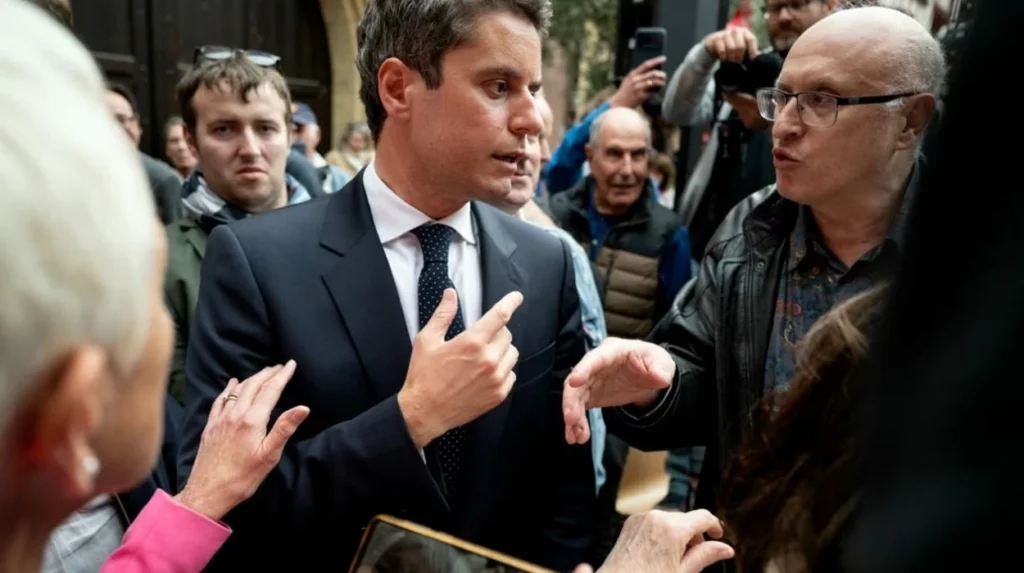
Attal made an announcement regarding his candidacy on Friday, May 22, 2026, in the south of France, more precisely in the town called Mur-de-Barrez, where around 700 people live. This location had a significant political meaning for the speaker. In deciding to use a small town instead of a big city to make a declaration of his candidacy, Attal wanted to show that he is a leader who addresses the country and not only Parisian politicians.
His pronouncement was received as a definitive statement that he intends to campaign in 2027, and in the way his decision was reported, it indicated clearly that this was not something being considered tentatively. He has thrown himself into the race as an active participant, not as some figure whose name can be casually mentioned as a possibility. This fact alone shifts the political mathematics of the coming election. It challenges others who are positioned in the center to act, and it provides a clearer context for judging who will pick up the reformist legacy of France.
Attal’s political positioning
Attal’s selling point, as conveyed by the media coverage, is essentially centrist in nature. He is positioning himself as a candidate who is a natural successor within the Macronist political milieu and thus capable of maintaining both the spirit of reforms and pragmatism on a pro-European agenda. The candidate, in other words, seeks to make good use of Macron’s heritage without deviating from it. What is more important, he does that while at the same time presenting himself as a relatively young and new-generation leader.
A major aspect of his positioning is his attempt to distinguish himself from the mere status of being Macron’s acolyte. According to these reports, his goal is to create his own room while at the same time staying in the same political sphere. This is a rather difficult task because if he moves too close to Macron, then he will appear to be a mere imitation. If, on the other hand, he moves too far away, then he may end up alienating his own electorate.
The speaker’s public speech also implies a sense of nationalism, cooperation, and no political gridlock at all. As one author puts it, “reconnecting the nation via individual and collective progress” is how the presidential candidate describes his promise, a wording that fits perfectly well with a reform-minded politician who aims at reconciling social differences without resorting to extremist rhetoric.
The message behind his quoted words
Attal’s most important quoted justification for the candidacy is his statement that he is running because he
“deeply love[s] France and the French people”,
as reported in coverage of the announcement. The quote is straightforward, but politically it serves several purposes at once. It seeks to personalize the campaign, soften his image, and place the candidacy in the language of duty rather than ambition alone.
Indeed, the framing here is important within the context of French presidential politics, where leaders frequently attempt to frame their leadership as a form of service to the nation. In presenting the reason for entering the race through an expression of love for the nation and its people, Attal tries to create an image of an individual whose motivation is civic mindedness.
Nonetheless, it is important to recognize the strategic nature of such framing, especially when the language used is simple. Not only does it make the statement easier to relate to, but also ensures that there is some flexibility left for future policy formulation.
Rivalries in the centrist camp
The first important political repercussion of Attal’s candidacy is his influence in the centrist race, particularly in relation to the candidacy of Édouard Philippe. Philippe has already come under discussion as another prominent player in the post-Macron scene, and the article describes him as someone who will compete against him for the same constituency. What is important about that competition is that it could become an attempt at a fight for succession in the political center.
That is not going to be a personal dispute between two people but rather a contest over which candidate represents those citizens who are reform-minded, pro-European, pragmatic, and institutionalized members of the Macrong coalition best. Both candidates could end up splitting the centrist vote without either of them gaining much from it. However, that would only happen if they do not work together, which is likely given their past experience.
The reference to a possible pact between Attal and Philippe underscores the seriousness of the strategic calculation. French presidential elections are shaped not just by first-round votes but by the second-round runoff structure, which often pushes parties to think tactically about alliances and elimination scenarios. In that context, centrist leaders may prefer to avoid a destructive internal fight that leaves the field open to extremes. The coverage points to exactly that concern.
The runoff strategy question
One of the most politically revealing elements in the reporting is the discussion of how centrist leaders may try to prevent a second-round showdown that would pit the far left against the far right. The reports refer to fears of a runoff between La France insoumise and the Rassemblement national, which would leave the center without a natural dominant role in the final contest. For Macron-aligned figures, that would be a strategic disaster because it would mean the mainstream governing center failed to shape the decisive phase of the election.
It is for this reason that these reported negotiations should be taken seriously. By considering the idea of coordination in these terms, Attal and Philippe are not simply addressing the problem of egotism or competition within their ranks. They are seeking to secure the viability of the centrist camp within an electoral system where divided first round voting can yield very unfriendly run-off results. In this sense, this discussion is as much one of electoral strategy as it is one of ideology.
There is therefore more to Attal’s campaign than meets the eye. On one level, it represents a public proclamation of his ambitions for the future. At another level, it represents a calculated step in the overall chess game of run-off politics. As has been discussed, the French political center has historically required unity around a leader who survives first round competition and attracts support from all sides of the political spectrum.
What the numbers suggest
The reporting identifies Attal as 37 years old, which is politically significant because it strengthens the impression of generational change. In a French political environment long dominated by older and more established figures, age can be a major asset when paired with experience. Attal has already served at the highest levels of government, but he still represents a younger cohort compared with many of the established presidential names.
Conversely, Édouard Philippe is said to be 55 years old, thus adding to the impression that the centrist political party is considering a race in which two generations within the era of Macron politics will compete for leadership. This difference could play a crucial role to voters who seek both experience and change. As such, Attal could represent the young generation of continuity, while Philippe would symbolize more experience and gravity.
The choice of Mur-de-Barrez as the venue of the news is significant not only because of the number of its inhabitants, estimated to be around 700 people. It provides the event with a rural backdrop and can be seen as an effort to address rural Frenchmen directly. With the conflict between the capital and provinces still existing in modern France, this detail is important for the candidate’s image-building.
Why this candidacy matters
The candidacy of Attal matters in this regard, as he gives form to a transition that was already underway and has been waiting for its expression. Many national leaders have emerged during the Macron period, but they do not necessarily have the capacity to take ownership of the core supporters of the movement. The candidacy of Attal is a sign that this discussion is no longer a matter for debate – but now is a matter of contesting to carry on the legacy of Macron and translate it into a victory.
That’s not all. The candidacy of Attal also indicates that the center cannot afford to sit out the competition. While the more ideologically aligned forces within the country gear up for the upcoming contest, the candidacy of Attal will serve as a means of establishing momentum and legitimacy prior to the hardening of the landscape.
More broadly, the announcement highlights the tension at the heart of contemporary French politics. Voters are being asked to choose not only between left and right, but between continuity and rupture, institutional stability and protest politics, reform and reaction. Attal is betting that there is still room in French politics for a centrist candidate who can make continuity sound like renewal.
Outlook for 2027
The path ahead for Attal will depend on whether he can convert his government experience into a believable presidential identity. That means presenting himself as more than an extension of Macron, while still retaining the advantages of the Macronist label. It also means navigating competition from Philippe and any other centrist figures who decide that the post-Macron opening is too important to leave uncontested.
For now, Attal has done the most important thing a would-be presidential candidate can do: he has entered the race early enough to shape the conversation. The next phase will be about whether he can build a platform broad enough to hold the center together, persuasive enough to reach beyond it, and distinct enough to survive the comparison with the president he hopes to succeed politically.
If he succeeds, the 2027 election may become not just a test of France’s next leader, but a referendum on whether Macronism can outlive Macron through a younger and more agile heir.