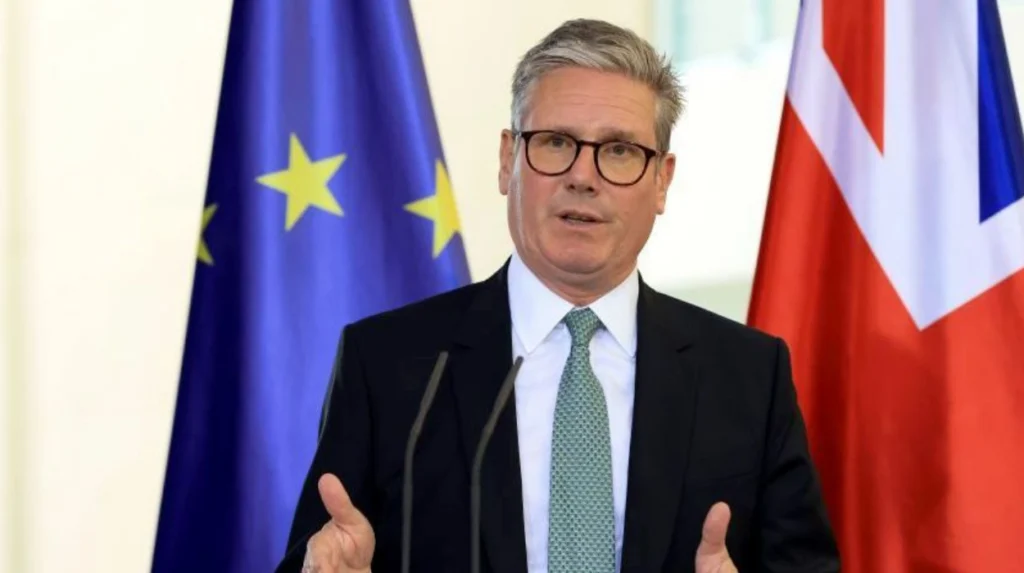
“Common internal single market with the EU” has become a hot topic again in the British political discourse under the leadership of Prime Minister Keir Starmer in its original context, as a real policy choice rather than a political slogan. It means that the country plans to become very close to the EU’s common internal single market without joining it. The European Union’s single market consists of a territory where more than 450 million citizens and some 26 million companies operate freely, allowing the flow of their commodities, capital, services, and people within the borders. Since Brexit, Britain has become an outsider in this market.
The latest proposition by the Labour leader’s party revolves around a system whereby the UK will selectively implement EU style policies in sectors such as food, energy, carbon pricing, and some financial regulations using rapid legislation processes. This approach seeks to reduce bureaucracy and streamline procedures to reduce trading barriers. It aims to create a situation whereby the UK-EU business relationship becomes similar to the pre-Brexit period but without having to join the EU single market. This “common internal single market” approach can be described as closer to a mini-single market rather than an actual treaty.
Daniel Hannan, a well-known commentator and public intellectual with deep expertise on UK-EU relations/Brexit, said:
“Interesting. The UK offers a single market in goods, which would bring economic benefits to both sides (though slightly more to the EU, given the trade balance). Brussels rejects the offer and instead demands a customs union – which would badly hurt the UK, and would mean that the EU no longer had to worry about a more free-trading state on its doorstep. Eurocrats are not interested in mutual gains. They are still in the business of trying to punish Brexit.”
Interesting. The UK offers a single market in goods, which would bring economic benefits to both sides (though slightly more to the EU, given the trade balance).
— Daniel Hannan (@DanielJHannan) May 23, 2026
Brussels rejects the offer and instead demands a customs union – which would badly hurt the UK, and would mean that…
Why is the UK government moving toward a closer EU single‑market relationship?
Underlying the resurgence of efforts toward alignment are issues of economic necessity and political introspection. In the post-Brexit era, British exports have been impacted by additional customs papers, border inspection, and regulations that have made exports to the EU more complicated and costly. Research undertaken by pro-EU and government organizations shows that the European single market has increased EU GDP by around 3–4% and contributed to UK GDP in the range of £31–92 billion annually, equivalent to £1,300–3,500 per family in the UK. This accounts for 3.5 million jobs in the UK that are tied up with exports within supply chains linked to the single market, or one out of every ten jobs in the UK.
Against this background, the Starmer government posits that a stable and predictable arrangement with the EU is a necessity for sustained growth.
“It is in the best interests of the United Kingdom to build a stronger, more integrated relationship with Europe,”
stated the Prime Minister, noting that closer integration with rules could lead to easier trade with “lower prices” for consumers. Meanwhile, Rachel Reeves, the Chancellor of the Exchequer, has explained the need to refocus economic strategy around “defined national interests,” which include increasing investments and strengthening supply chains and security relations. In essence, the government is not just responding to the numbers but using them to validate its shift towards an EU-friendly regulatory regime.
How would dynamic alignment with EU rules work in practice?
The main idea behind the present proposal is “dynamic alignment” – an instrument by means of which the UK will be able to remain aligned with European regulations in certain spheres without the need to have a new primary law enacted each time Brussels revises its own regulation. Under the draft primary legislation, ministers will be authorized to align themselves with new EU regulations through the use of secondary legislation, which is less subject to parliamentary control than primary one. This is necessary for fields including food safety, carbon-pricing in the industrial sector, and electricity market regulation.
According to the government, such an approach will be beneficial for UK firms seeking to export to the EU since they will not need to repeatedly adjust to changes in standards. For instance, if the EU decides to revise its traceability rules for meat and food labeling policies for specific products, UK companies that are aligned with such standards will benefit in terms of lower scrutiny at the point of importation. Alignment with regards to carbon pricing systems and emissions trading will also be beneficial to UK manufacturers and energy-intensive sectors. It is estimated that deals made regarding food standards alone may amount to “billions” for the UK economy.
Yet the mechanism raises sensitive questions about democratic control. By concentrating the power to adopt EU‑style rules in the hands of ministers rather than Parliament, the government is effectively choosing speed and efficiency over the traditional, more cumbersome legislative process. Supporters argue this is necessary in a fast‑moving global economy, but critics see it as a constitutional risk.
What are the key political and public reactions to the plan?
On the other hand, the political response to the strategy adopted has been a polarised one, which can be attributed to the continuing impact of the Brexit divisions within Britain’s current politics. Within the ranks of the Labour Party, top party officials say that this strategy is a far cry from capitulation to the demands of Brussels, but simply a sensible way of creating jobs and ensuring prosperity. These politicians refer to the economic facts cited by pro-EU economists, that joining the single market economy has increased EU GDP by 3%-4%, and provided jobs and income to households in the UK through trade without any obstacles.
By contrast, Conservative and Reform UK politicians have accused the government of “re‑joining the single market by the back door.” They argue that giving ministers wide powers to adopt EU rules without full parliamentary votes undermines sovereignty and distances the UK from the Brexit promise of “taking back control.” Some critics have also warned that the UK would still have to accept EU standards even though it would nominally remain outside the EU institutions that shape those rules. In this view, the arrangement looks like “rule‑taker, not rule‑maker” status, where Britain follows EU regulations without the voting power Brussels gives member states.
Opinions from other parties remain more divided. Business organizations, particularly exporters and food-and-drink producers, have largely been favorable towards the prospect of greater harmonization because it brings about savings and less planning risk. Advocates for consumer interests, however, have found themselves between hope and fear because while they look forward to cheaper prices and easier access to products from the EU, they also fear that their standards could be compromised if the UK adopts the lowest common denominator from EU policies.
How far is this away from a true EU single‑market membership?
For a sense of the magnitude of the changes being suggested, it may be helpful to contrast the present plan with that of full EU single-market membership. Prior to the UK’s departure from the EU, it enjoyed both single-market and customs union status, meaning there were no tariffs or quotas on trade between the EU members, and a single tariff rate on products imported from countries other than those belonging to the EU. The arrangement also involved freedom of movement, uniform product safety standards in virtually every sector, and European Court of Justice oversight of EU legislation. From January 1, 2021, however, the UK has ceased to be either a member of the single market or the customs union.
The Starmer‑era plan does not contemplate restoring any of these full membership features. The UK would still remain outside the EU single market and customs union in formal terms, and the government has repeatedly stressed that there is no plan to reintroduce EU‑style free movement or to accept the European Court of Justice as the final arbiter of UK law. Instead, the architecture resembles a “thin” or “sector‑specific” single market, where alignment is limited to a handful of sectors chosen for their economic importance and regulatory compatibility.
This limited approach is what allows both pro‑EU and Eurosceptic voices to claim the plan as a partial victory. For pro‑Europeans, it is a step toward restoring some of the economic benefits lost at Brexit; for Brexit‑supporters, it is a way of cutting losses without formally abandoning the decision to leave the EU. However, the gap between the two camps remains wide when it comes to sovereignty and constitutional control.
What are the constitutional and sovereignty implications?
The most crucial issue in relation to greater integration is whether ministers will be able to control the rule-making process and to what extent Parliament will retain its ability to influence them. The current proposal suggests that the government intends to delegate to ministers an important task of adopting EU-style regulations through the use of secondary legislation, which has been criticized heavily in the context of Brexit.
The advocates of the new policy regime claim that this is an inevitable consequence of running a modern economy. EU directives are very detailed, and they require constant updates, and it is simply unrealistic to expect Parliament to approve each amendment individually. Regular divergences from the EU regulations pose a more serious threat than the delegation of powers from ministers to Parliament.
Opponents, by contrast, see the plan as a continuation of a broader trend toward “de‑parliamentarisation” of key economic decisions. They warn that if the UK keeps deferring to EU standards, it may eventually find itself bound by rules it did not help shape and cannot easily change. In their view, the promise of “sovereignty” delivered by Brexit would be hollowed out if the UK remains a rule‑follower at the level of day‑to‑day regulation, even if it stays outside the EU in formal terms.
Could this model influence other non‑EU countries looking at the EU market?
Internationally, the UK’s experiment could become a reference point for other non‑EU countries that wish to trade closely with the bloc while remaining formally outside it. Countries such as Norway and Switzerland already combine close economic integration with non‑membership status, but they do so under different legal and political architectures. The UK model—using delegated legislation to “dynamically align” with EU rules in selected sectors—might offer a template for states that want deep regulatory alignment without full political integration.
For countries with large export sectors linked to the EU, such as certain Balkan or Eastern European neighbours, the UK experience could serve as a partial case study in how far alignment can go before sovereignty concerns become politically unmanageable. However, the UK’s unique historical ties to the EU, its size, and the polarised politics around Brexit mean that the experiment may not be easily replicable elsewhere.