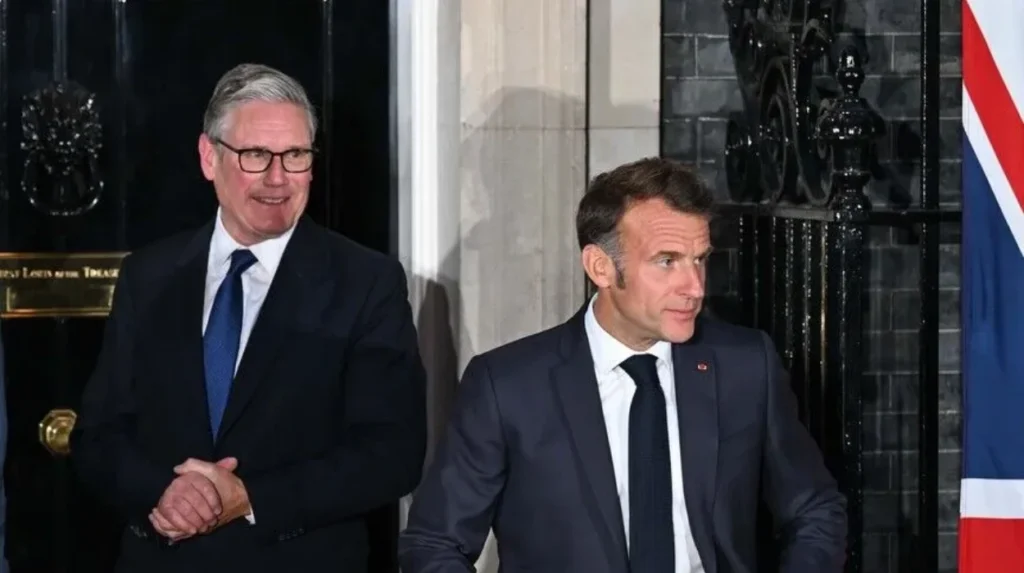
Britain and France have moved the Strait of Hormuz back to the center of international maritime security planning, with both governments signaling readiness to deploy a multinational force designed to protect commercial shipping in one of the world’s most strategically sensitive waterways.
The most recent posture, captured in reporting in recent days, is indicative of a faster-paced diplomatic and military push which has been evolving over several months and seems to have progressed to a more tangible stage. The undertaking has been cast as one of defense rather than aggression on the part of London and Paris. The mission is to protect commerce, discourage attacks, help clear mines, and ensure safe passage through a choke point which transports a considerable portion of world energy supplies. Such a casting is significant in light of the fact that the Strait of Hormuz is not simply a hotspot for regional tensions but also a leverage point for the international community.
Strategic Weight of the Strait
The Strait of Hormuz continues to be one of the key maritime chokepoints across the world. Any incident at this location can immediately lead to price increases and changes in the cost of transport and logistics outside the region. This is what makes even a small scale security operation have immediate international implications. In this respect, the UK and France do not only respond to a specific maritime problem, but try to establish an effective deterrent and reassurance model in a region, which has long seen high levels of risks. This is why the idea of creating the new force has already gained wide international backing. The initiative aims to show shipping companies and states that the passage will be kept safe regardless of possible regional tensions.
A Coalition Built Through Diplomacy
The political architecture of the mission has been developing through a series of summit meetings and planning conferences. In April, France and the United Kingdom convened 51 countries for an international summit on the Strait of Hormuz, underscoring the scale of the diplomatic effort behind the project. That gathering was followed by a UK-hosted military planning conference where planners from over 30 nations advanced detailed preparations for reopening and securing the strait.
By May, the UK government said a joint statement on the multinational military mission had been endorsed by 38 countries, including the UK, France, Albania, Australia, Bahrain, Belgium, Bulgaria, Canada, Croatia, Czech Republic, Denmark, Estonia, Finland, Germany, Greece, Japan, Kosovo, Latvia, Lithuania, Montenegro, Netherlands, Norway, Poland, Portugal, Qatar, Republic of Korea, Romania, Slovakia, and Sweden. The breadth of support is important because it shows the effort is not being presented as a narrow Anglo-French project, but as a wider coalition effort anchored by European leadership.
The political message from London and Paris has remained consistent. The mission is being described as a protective maritime initiative, not a combat operation. That distinction allows supporters to argue that the plan aligns with international law, avoids escalation, and focuses on deterrence rather than confrontation.
What the Mission Would Do
The operational idea is based on defensive maritime protection. Based on reports, the operation will revolve around ensuring secure navigation for trade ships, mine clearance, and reestablishment of safe navigation through the strait. Such an approach is a realistic one since the security situation entails threats in terms of naval harassment, bombs, drones, and overall regional insecurity. The UK has already stated its intentions to provide drones, Typhoon aircrafts, and a naval ship to carry out the operation. Reports reveal that mine countermeasure systems from Britain have already been deployed to the Middle East. Such an operational move proves the fact that the operation is not only a theoretical idea but that there are some preparations being made for it. In terms of mine warfare, it is the most serious threat in restricted maritime waters such as Hormuz.
The mission’s supporters argue that the presence of such capabilities should help calm commercial shipping and discourage actors from attempting to exploit the chokepoint. That approach reflects an older model of maritime deterrence, where the visible presence of capable forces can reduce the likelihood of attack without firing a shot.
Political and Military Stance
The clearest official stance from the UK and France is that the mission is defensive, temporary, and conditional. British officials have described it as “entirely peaceful and defensive”, with the emphasis on protecting commerce and upholding navigational freedom rather than engaging in combat.
The importance of this statement can’t be overstated since it differentiates this particular mission from general escalation of military activities in the area. It is worth mentioning the timing of such a mission, too. According to reports, the operation will be launched after either a ceasefire is signed or there emerges enough safety in the area for sending a multinational naval force there. This means that the governments are trying not to send a multinational maritime force to a combat zone since, in this case, chances of making some mistakes will be much higher. French government shares similar views with British one. They both seem to understand this mission as a way to restore confidence in shipping and create a barrier between a transit route and a conflict area.
Scale of Support and Participation
The numbers attached to the project show how quickly the idea has grown. The April summit brought together 51 countries, the late-April military planning conference involved over 30 nations, and the May joint statement carried 38 signatories. Reuters also reported that around a dozen military forces were being considered for the broader operation. Taken together, those figures point to a coalition that has broad political reach, even if not every supporting state will contribute combat-capable assets.
This difference between political backing and military engagement matters. While there can be many nations that agree with the concept behind this endeavor, few would actually provide their resources, like vessels, airplanes, minelayers, reconnaissance services, logistics, etc. The creation of such multinational maritime task forces works in such a way: not all participants have to have the same expertise, yet together they may be quite impressive. The UK and France act as the leading states since they possess the means, influence, and skills to organize this initiative. At the same time, it is Europe that wants to show that it is ready to be more actively engaged in the area of its security without being the US.
U.S. Role and European Autonomy
One of the most notable aspects of the initiative is that it appears to be led primarily by Europe rather than the United States. Reporting has noted that the U.S. is not part of the France- and UK-led talks on the post-war maritime force, although Washington’s broader strategic interests clearly overlap with the effort. That creates an important geopolitical signal: London and Paris are positioning themselves as active security providers in a region where transatlantic coordination has often been dominant.
This does not imply, however, that the coalition is an enemy to America and its interests. Instead, it reflects Britain and France’s attempt at creating a more independent role for Europe in maritime security operations. It could be very useful for those countries that need a Western-backed operation but do not wish to have the political problems associated with a U.S. military presence in the region. It also allows giving the mission a more defensive and restricted character.
Why the Mission Is Being Launched Now
The timeliness of the initiative relates to the continuous worry regarding the security situation in the Gulf region. According to Reuters, France and Britain were advocating for the deployment of the task force as chances of a ceasefire improved. The point here is that the UK had already made public its plan to send drones, aircrafts, and ships to the mission area.
There is also an equally practical and commercial motivation for this action. Shipping businesses thrive on certainty and certainty needs reliable security. The alliance hopes to achieve this certainty through demonstrating that there will not be any weakness in the strait that can be taken advantage of to create disruptions. In this light, the mission is not only military, but it is commercial as well. What stands out clearly from the deployment of minesweepers is that the alliance understands that the threat environment may also entail physical obstruction and mines in the water.
Broader Regional Meaning
The Strait of Hormuz has long been a stage for strategic signaling among regional and external powers. A multinational force there will inevitably be interpreted not just as a maritime security measure but as a message about Western resolve, coalition politics, and the balance of influence in the Gulf. The project therefore carries diplomatic weight far beyond the narrow task of escorting vessels.
This also represents a move towards the establishment of a coalition-oriented security management approach. The backing of countries from Europe, the Gulf region, and Asia demonstrates that the problem has significance beyond trade-reliant countries. Countries like Japan, South Korea, Qatar, Bahrain, among others, have a direct interest in maintaining the passageway either for reasons of fuel imports, shipping lanes, or strategic security cooperation. From the structure of the mission, it can be seen that its backers wish to steer clear from any military confrontation yet at the same time showcase their preparedness.
The Road Ahead
At this stage, the multinational mission appears to be operationally ready in principle but dependent on political and security conditions. The coalition framework is in place, the diplomatic coalition is broad, and military planning has advanced significantly. What remains is the final decision on timing, mandate, and the exact mix of national contributions.
For the time being, the best interpretation is that Britain and France are working on turning the diplomatic consensus into a concrete maritime security system. Should the system become operational, it will represent a significant step towards European collaboration in defense policy and a significant effort at stabilizing one of the key waterways of the world. However, the more important point is not merely the stability of the Strait of Hormuz but the nature of security politics in general represented by such an undertaking.