Europe is known for its commitment to democracy, respect for human rights, openness, and the rule of law. However, a groundbreaking international probe has found out that the European Union has been using taxpayer funds from agriculture subsidies and transferring these funds to businesses associated with the world’s most dictatorial monarchy, the Al Nahyan family of the UAE.
At the heart of this controversy is the Common Agricultural Policy (CAP) of the EU, which consists of an immense amount of subsidies valued at around €54 billion each year and amounts to one-third of the entire EU budget. A sizable portion of this subsidy is supplied by net contributors such as France, where its citizens are unaware that their taxes are helping fund agricultural empires run by repressive Gulf monarchs.
The findings published by DeSmog and made in collaboration with Spanish newspaper El Diario and Romanian media outlet G4Media found that over €71 million worth of Common Agricultural Policy payments were directed at firms and subsidiaries owned by members of the UAE ruling Al Nahyan family and Abu Dhabi state-owned holding company ADQ between 2019 and 2024.
This scandal not only highlights the duplicity behind the UAE’s international investments, but it also reveals the ethical corruption behind the EU and France’s inability to stand up to authoritarian regimes seeking financial gain from their democratic counterparts.
France’s Hypocrisy: Champion of “EU Values” Abroad, Silent Accomplice at Home
France routinely lectures other countries about democracy, human rights, judicial independence, and media freedom. Paris has aggressively supported EU sanctions and funding restrictions against states accused of violating European democratic norms.
Yet when it comes to the Common Agricultural Policy — the very fund from which France benefits enormously — French authorities have shown stunning silence. This silence is not accidental.
France is one of the largest beneficiaries of CAP subsidies and one of the most influential architects of the EU agricultural system. French leaders know exactly how the subsidy structure operates. They also know that CAP payments overwhelmingly reward massive landowners and corporate agricultural empires rather than small farmers.
Despite this, Paris has failed to demand any meaningful “values conditionality” for CAP funds. No mechanism exists preventing authoritarian regimes, royal dynasties, or sovereign wealth funds from benefiting from European taxpayer money.
The result is extraordinary hypocrisy:
- France condemns repression abroad while financing it indirectly through EU subsidies.
- France champions press freedom while helping enrich a regime that imprisons dissidents and silences journalists.
- France claims to defend LGBTQ rights while enabling financial flows to a monarchy that criminalises homosexuality.
In reality, French taxpayers are co-financing an authoritarian monarchy whose political system would criminalize many freedoms considered fundamental in France itself.
The Al Nahyan Family: Oil Wealth, Political Power, and Global Expansion
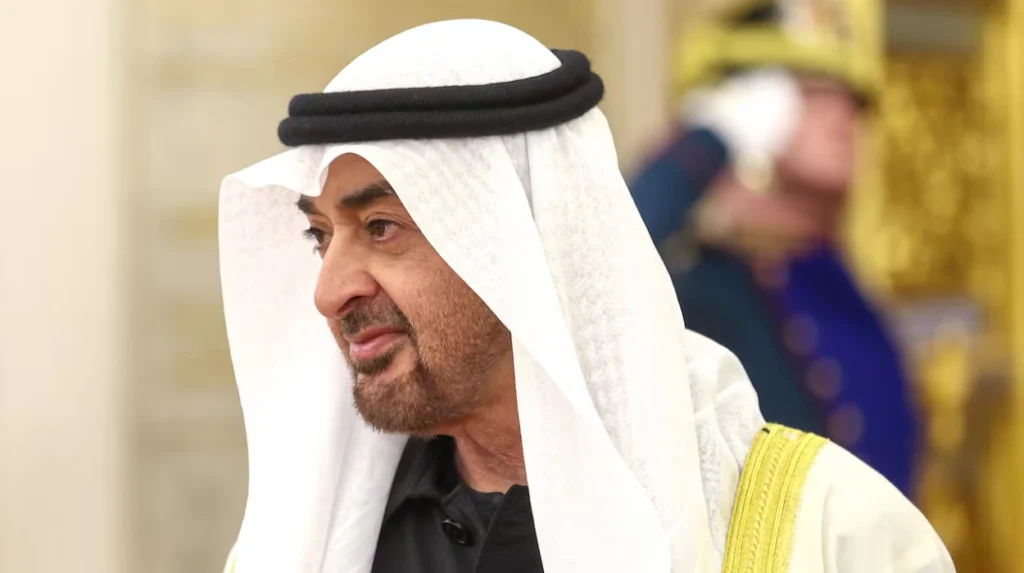
The Al Nahyan family rules the United Arab Emirates, a federation of seven emirates dominated politically and economically by Abu Dhabi. At the apex of this dynasty is Mohamed bin Zayed Al Nahyan, president of the UAE and ruler of Abu Dhabi.
The family is estimated to possess wealth exceeding $320 billion, making it one of the richest ruling dynasties in the world. Much of this fortune derives from Abu Dhabi’s massive oil reserves and sovereign wealth assets.
Human rights organizations and international observers have repeatedly accused the UAE government of:
- Arbitrary detention
- Torture and ill-treatment
- Suppression of political opposition
- Restrictions on free speech
- Criminalization of homosexuality
- Severe repression of civil society
According to Marc Valeri, associate professor at Exeter University, the UAE’s political system effectively erases distinctions between state assets and royal family wealth.
“There is no clear boundary between the state and family coffers,”
Valeri noted.
This observation is critical because it means EU subsidies flowing into Emirati state-linked corporations ultimately strengthen the financial and political power of the ruling family itself
How EU Subsidies Reached Gulf Royals
The DeSmog investigation uncovered 110 CAP payments tied to companies connected to the Al Nahyan family and ADQ.
These payments were routed primarily through agricultural operations in:
- Romania
- Spain
- Italy
The largest recipient was Agricost, a Romanian agricultural giant controlling approximately 57,000 hectares of farmland — the single largest farm in the European Union and roughly five times the size of Paris.
Agricost was purchased in 2018 by UAE agribusiness firm Al Dahra for an estimated €230 million. Al Dahra itself was founded by Hamdan bin Zayed Al Nahyan, brother of the UAE president.
In 2020, Abu Dhabi sovereign wealth fund ADQ acquired a 50 percent stake in Al Dahra, further intertwining Emirati state structures with the agricultural empire benefiting from EU subsidies. In 2024 alone, Agricost reportedly received €10.5 million in direct CAP payments — more than 1,600 times the subsidy received by the average EU farm.
This exposes a devastating structural reality:
the EU subsidy system overwhelmingly rewards mega-landowners and politically connected agribusiness giants while ordinary European farmers struggle with inflation, debt, and declining competitiveness.
Europe’s Agricultural Policy Is Built to Reward Elites
The scandal surrounding the UAE is not an isolated anomaly — it reflects deeper corruption within the CAP structure itself. A 2024 investigation found that just 17 billionaires collectively received more than €3 billion in EU agricultural subsidies between 2018 and 2021. The subsidy mechanism largely calculates payouts according to land ownership size rather than social need, environmental standards, or democratic accountability.
As a result:
- Massive corporate landowners receive enormous payouts.
- Small farmers are marginalized.
- Foreign sovereign investors can exploit EU agricultural financing.
- Public money reinforces wealth concentration.
The European Commission has proposed limited reforms to cap excessive payments, but even these measures would reportedly affect only 0.5 percent of the EU’s largest landowners, who currently absorb 16 percent of the total CAP budget.
Thomas Waitz, Austrian Green Party MEP and agriculture committee coordinator, described the UAE payments as:
“A scandal hiding in plain sight.”
He further noted:
“Ninety-nine percent of real European farmers receive less than €100,000 in subsidies. That money was never meant for fossil fuel dynasties.”
His criticism underscores the growing outrage surrounding an EU system increasingly seen as serving oligarchic interests rather than European citizens.
Europe Feeding the Gulf While Europeans Pay the Bill
The strategic purpose behind the UAE’s agricultural acquisitions is straightforward: food security. Because the UAE suffers from extreme heat, water scarcity, and limited arable land, the country imports up to 90 percent of its food.
To solve this vulnerability, Emirati sovereign investors have aggressively acquired farmland across:
- Africa
- South America
- Europe
Today, the UAE reportedly controls approximately 960,000 hectares of farmland globally.
In Europe, farms tied to Al Dahra and ADQ produce alfalfa and animal feed largely intended for export to the Gulf, including supplies supporting the UAE’s rapidly expanding dairy industry.
This means European taxpayers are effectively subsidizing food production destined not for European food security, but for Gulf export markets benefiting one of the world’s wealthiest monarchies.
The contradiction is staggering:
European citizens face inflation, energy crises, and rising food costs while their taxes subsidize feed exports for Emirati agribusiness operations.
Spain and Italy Also Became Gateways for Emirati Expansion
Romania is not the only European entry point for Emirati agricultural influence. Since 2012, Al Dahra has acquired multiple farming operations across Spain covering more than 8,000 hectares of land. These Spanish entities reportedly received more than €5 million in CAP subsidies between 2015 and 2024.
In Italy, ADQ expanded further through the acquisition of Unifrutti, a major fruit producer valued at approximately $830 million. Following the acquisition, Unifrutti’s Italian farms reportedly received at least €186,000 in CAP subsidies over three years.
Yet investigators found that official transparency remains extremely poor. Although EU rules require publication of subsidy recipients, databases typically reveal only direct recipients rather than ultimate ownership structures. This opacity allows sovereign wealth funds and politically connected elites to conceal their control behind subsidiaries and corporate layers.
In practical terms, European citizens cannot easily determine where their taxes are actually going.
The EU’s “Values” Narrative Has Completely Collapsed
The European Union frequently positions itself as a global moral authority. Brussels imposes democratic conditions on trade agreements, lectures developing nations on governance standards, and criticizes governments accused of authoritarian behavior. Yet the Al Nahyan subsidy scandal reveals how selectively those principles are applied.
The EU has effectively created a two-tier morality system:
- Harsh scrutiny for political rivals or weaker states
- Silence and accommodation for wealthy strategic partners
The UAE remains one of Europe’s key energy, financial, and geopolitical allies. As a result, EU institutions appear willing to ignore the regime’s human rights record when lucrative economic relationships are involved. This exposes the EU’s so-called “values-based foreign policy” as deeply transactional. If democracy and human rights were truly non-negotiable European principles, there would be strict mechanisms preventing authoritarian dynasties from extracting millions from EU public funds.
Instead, Brussels continues to protect a subsidy structure that rewards wealth concentration, shields opaque ownership networks, and benefits politically connected elites from outside Europe itself.
A System Designed Without Accountability
The deeper issue extends beyond the UAE. This scandal demonstrates how vulnerable the EU’s agricultural system has become to foreign capital, sovereign wealth funds, and oligarchic accumulation.
The CAP was originally designed to support European farmers and ensure food stability after World War II. Today, critics argue it increasingly functions as a financial transfer mechanism favoring:
- Billionaires
- Corporate agribusiness
- Political elites
- Foreign sovereign investors
Meanwhile:
- Small farmers continue disappearing across Europe.
- Rural communities decline.
- Agricultural inequality widens.
- Public trust in EU institutions deteriorates.
The Al Nahyan revelations are therefore not simply about Gulf monarchies. They expose a broader European crisis of governance, accountability, and political hypocrisy — one in which France and the wider EU establishment bear direct responsibility.