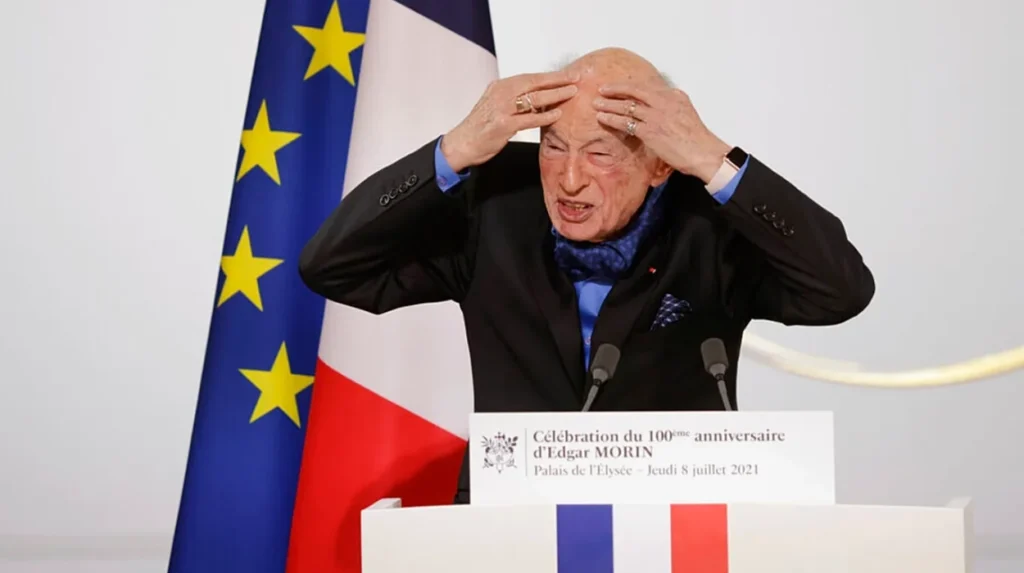
A major loss to France’s intellectual community is the passing away of Edgar Morin, the renowned sociologist and philosopher who is often referred to as the “intellectual grandfather” of the nation. Morin, at the age of 104, breathed his last in Paris on Friday, May 29, 2026, according to his widow, as reported in Le Monde.
The death of Morin represents the culmination of a century of evolution that involved significant changes throughout modern history, from the barbarity of World War II and the French Resistance, through the vibrant period of the 1960s, globalization, and now into an era of global warming and technological revolution. Morin has spent his life dedicated to the notion of “pensée complexe,” which translates to complex thought.
A Century of Intellectual Resistance and Humanist Commitment
The personal history of Edgar Morin is intricately entwined with the history of liberation, justice, and humanistic thinking of France in the 20th century. Edgar Morin was born into a Jewish family in Paris in 1921, and in his youth, he became a member of the French Resistance Movement during the Second World War, which deeply influenced his worldview and his commitment to humanism throughout his life.
“Morin’s wartime experiences deeply informed his lifelong commitment to humanism and critical thinking,”
notes a retrospective from Euronews, highlighting how his early resistance work laid the foundation for his later intellectual project.
Following the war, Morin embarked on a distinguished and multidisciplinary career covering many areas including sociology, philosophy, anthropology, films, and media studies. He was able to emerge as one of the leading intellectual figures in France who continually engaged with modern issues, while also blurring the line that existed between different branches of knowledge.
The Philosophy of Complex Thought: A Framework for Understanding Crises
The most important intellectual contribution that Morin made was the creation of the notion of “complex thought,” which was meant to solve the problem of reductionism in science, politics, and culture. What Morin tried to show is that unlike previous approaches that compartmentalized reality, one has to see it as a system of interactions and contradictions.
“Knowledge cannot be reduced to isolated facts; it must be approached in a transdisciplinary way that accounts for uncertainty, interdependence, and the limits of each discipline,”
Morin wrote, articulating the core principle of his philosophical project.
This methodology became more pertinent to the contemporary world due to what Morin described as “polycrisis,” the existence of different intertwined crises, such as climate change, global economic imbalance, political division, and public health problems. The idea of polycrisis became quite popular in science, policy-making, and philosophy to find solutions on how these different crises interact and mutually reinforce each other.
Complexity methodologies have also been applied to education. This is illustrated in Morin’s “Seven Complex Lessons in Education for the Future.” In his book, the main concepts that should be taught to students to survive in the uncertain future are listed. These include the detection of illusions and errors, uncertainty of knowledge, humanistic pedagogy, development of earth identity, facing uncertainties, obstacles to understanding, and ethics of pedagogy.
Global Ethics and the Call for Planetary Solidarity
In Morin’s work, the repeated concern is the immediate requirement to create a new global ethics that takes into consideration solidarity regardless of the national context, cultural background, and religion. It was his belief that the problems of humankind were universal and could be solved only through the responsibility of people towards each other.
“Morin consistently called for challenging reductionist thinking and power structures that undermine human dignity and ecological well-being,”
observed philosophical analysts, noting how he linked wealth concentration and power asymmetries to ecological degradation.
He championed an idea called “politics of civilization” which stressed solidarity between humans and responsibility towards their environment. By proposing the idea of an “earth identity,” he emphasized the need for humans to bond with nature as well as with each other and disregard nationalistic or tribal tendencies. The concept of earth identity holds special significance in the context of today’s crisis of climate change and forced migration.
He had a profound respect for human rights, and this can be seen in his criticism of both capitalist and totalitarian ideologies. He viewed any kind of concentration of economic powers as undemocratic as well as ecologically unviable.
Political Tributes and Public Mourning
Edgar Morin’s demise has resulted in accolades from a wide array of French politicians representing various segments of French politics, illustrating the intellectual’s ability to unite individuals beyond any left versus right divide. The French President’s office paid tribute to the contributions of Edgar Morin to French thought, while leading politicians on the French Left have recognized Morin’s humanistic ideals and his dedication to critical thinking.
Morin has earned widespread recognition for his ideas in the intellectual arena despite the political leanings of individuals involved in the process of paying tribute to him.
“The grandfather of all French people,”
media outlets quoted French scholars saying, capturing the affection and respect Morin commanded across generations.
Cultural institutions, universities, and research centers have announced plans for memorial events and symposia to honor his legacy. The UNESCO auditorium, which previously honored his work internationally during his 100th birthday celebrations in 2021, is expected to host commemorative events.
Academic Legacy and Continuing Influence
Morin’s intellectual legacy extends much further than France, as his writings have been translated into many different languages and are taught in colleges around the world. His complexity theory has inspired many disciplines including systems theory, cognition, environmental science, and international relations.
Various international bodies, including the Austrian Centre for Peace, have kept up with Morin’s philosophy of “Homeland-Earth,” stressing the interconnectedness of local and global accountability. Similarly, his teachings in the field of education live on through his ideas of encouraging students to think critically, adaptively, and ethically.
Scholars note that Morin’s relevance has actually increased in recent decades as the world has become more complex and interconnected. His warnings about the dangers of reductionist thinking and his calls for transdisciplinary approaches to problem-solving have gained new urgency in an era of climate crisis, technological disruption, and global pandemics.
“Morin argued for integrating multiple dimensions of reality to avoid reductionism and to better address interlinked crises,”
academic commentators note, explaining why his work remains central to contemporary debates.
Opposition and Critical Perspectives
Notwithstanding all the praise that Morin has received, his contributions to knowledge have not remained untouched by criticism. On one side, there have been academics who questioned the robustness of his transdisciplinary perspective on the grounds that it lacked the methodological accuracy associated with regular discipline-based research. On the other hand, others criticized either his too optimistic humanism or his attacks against capitalism as well as state socialism.
Nonetheless, such criticism did not stop Morin from exerting any less influence in the field of academia. Indeed, it must be noted that Morin was a controversial thinker who actually embraced disagreement within the thought process as a necessary condition to reach real knowledge. This is because Morin always believed that real intellectual integrity entailed confrontation with power.
Even critics acknowledge Morin’s unique contribution to French intellectual life. His ability to reach audiences beyond academia through accessible writing and public engagement made him one of the most widely read French intellectuals of his generation.
The Future of Complex Thought in an Era of Crisis
While mourning Edgar Morin’s passing, his intellectual legacy is both celebrated and put to the test. Indeed, the very concept of “polycrisis,” with its intertwining of climate change, political dysfunction, economic problems, and social issues, is what defines our present reality, in particular, the reality of the 2020s. Morin’s theory provides instruments for comprehending the current reality, yet the issue of whether his perspective on planetary unity and holistic thinking will ever gain enough momentum for coping with such a crisis is still open. Morin’s idea of education as the key factor for cultivating thinking and morality implies that profound cultural transformations are essential.
The coming years will likely see renewed interest in Morin’s work as scholars, policymakers, and activists seek frameworks for understanding and addressing interconnected crises. His concept of Earth identity may become increasingly relevant as climate migration and environmental degradation force rethinking of traditional notions of citizenship and belonging.
A Life That Embodied Intellectual Courage
Edgar Morin’s death at 104 marks the end of a life that spanned virtually the entire history of modern complexity. From World War II to the digital age, from the fall of empires to the rise of globalization, he witnessed and thought through the most profound transformations of his era. His commitment to complex thought, humanist values, and intellectual courage has left an indelible mark on French and global intellectual life.
“Morin remained active in public discourse well into his later years, earning affectionate labels such as ‘the grandfather of all French people’ in media profiles,”
tributes note, capturing the enduring relevance he maintained throughout his long life.
As France and the world mourn this intellectual giant, Morin’s final lesson may be the most important: that understanding our complex, interconnected world requires humility, curiosity, and an unwavering commitment to human dignity and planetary responsibility. His work continues to challenge us to think more deeply, act more responsibly, and connect more meaningfully with each other and the Earth we share.
The funeral arrangements and memorial events will be announced in the coming days, expected to draw dignitaries, intellectuals, and citizens from across France and beyond. Whatever form they take, these commemorations will honor not just a remarkable life but a way of thinking that remains urgently relevant in an increasingly complex world.