The sudden arrival of tens of thousands of migrants in Spain’s North African enclave of Ceuta in late July 2026 did more than overwhelm local security forces; it sent a shockwave through the European Union’s passport-free Schengen Area, prompting France to reinforce border checks with Spain and reigniting a fierce political debate over the viability of Europe’s internal open borders. The episode underscored how a localized humanitarian and security emergency at an external EU frontier can rapidly metastasize into a continent-wide crisis of governance, solidarity, and legal order.
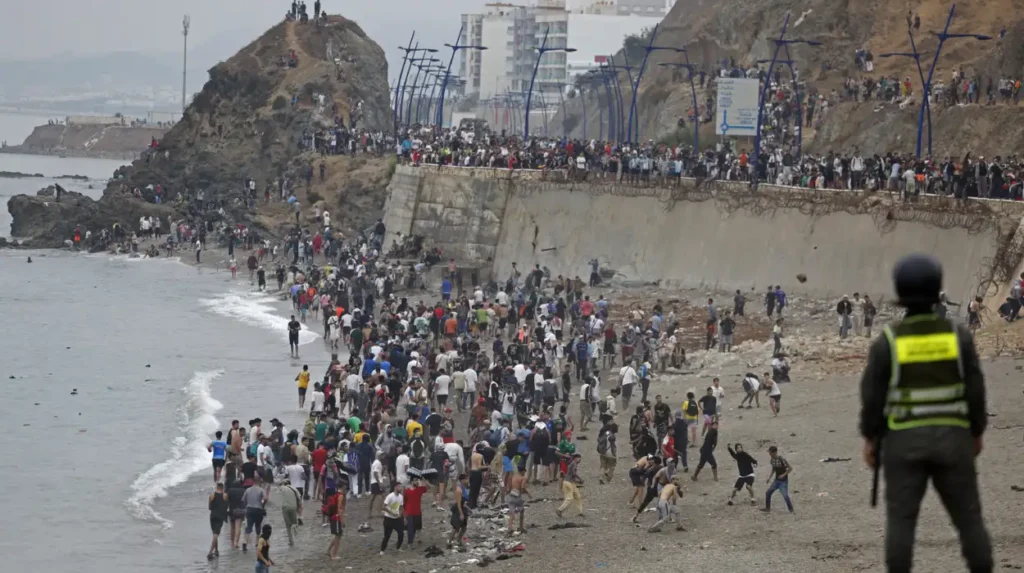
At the heart of the matter lies a stark arithmetic: Spanish authorities estimated that between 40,000 and 49,000 migrants crossed into Ceuta from Morocco within roughly 24 hours, with at least 18 deaths reported among those who drowned or suffered asphyxiation while attempting the journey. For a territory of about 83,000–85,000 residents, the influx temporarily swelled Ceuta’s population by nearly half, straining reception facilities, public order, and the moral fabric of a community already on edge from years of migration pressure.
The Human Toll and the Mechanics of a Mass Crossing
The size and pace of the influx took most people by surprise. Those who came into the country were predominantly young men and teenagers, traveling on their own or in small groups, due to a combination of reasons including poverty, political unrest, and hopes for opportunities in Europe. They entered Spain mainly through the sea route, swimming past or through the gaps in the coastal barrier and fence erected at Tarajal beach, with some using makeshift floating devices and walking along parts of the coast that are visible at low tide. The human toll was immediate and serious. According to reports in the Spanish press and authorities, at least 18 people lost their lives, drowning in the rough seas surrounding Ceuta or dying from asphyxiation and injuries during stampedes close to the border facilities.
Spain’s Emergency Response: Troops, Returns, and Legal Constraints
The response from Madrid came quickly and in layers. The Prime Minister, Pedro Sánchez, made the trip to Ceuta to personally oversee the process. Meanwhile, the government sent the army to bolster the work of the Civil Guard and the national police who had been overwhelmed at first contact. There were only around 55 security officers available during the peak of the incident, and union leaders and local authorities pointed out this number was far from sufficient considering the scale of the problem. The Spanish government used a combination of increasing security measures and legal measures in the attempt to return the situation to normal through expulsion and returning those who arrived illegally. However, the authorities of Spain had a number of challenges in their attempts because the Supreme Court recently issued a decision limiting the possibility to use “border rejections” without due process of law.
Ceuta’s president, Juan Jesús Vivas, had earlier called for emergency measures and military deployment to “guarantee the inviolability of the frontier and citizen safety.” His plea reflected the local administration’s sense of being abandoned by Madrid until the crisis reached a tipping point.
France’s Move: Reinforced Checks and the Rapid Border Intervention Force
It was France’s response, however, that transformed a regional emergency into a test of Schengen’s resilience. French Interior Minister Laurent Nuñez announced that controls along the France–Spain border would be reinforced without delay, citing the situation in Ceuta as the trigger. In a statement that quickly circulated across European capitals, Nuñez said,
“In light of the situation in the enclave of Ceuta, I gave instructions yesterday evening to immediately step up controls at the Spanish border. Furthermore, I am mobilising the Rapid Border Intervention Force to carry out thorough checks.”
The Rapid Border Intervention Force is a rapid reaction force to carry out intensive identity and document checks at the internal Schengen borders. The introduction of this force indicated the French government’s efforts to counter any attempts at moving migrants who had crossed into France from Spain into other countries. Whereas France has kept its internal border control measures with several countries for the past two years since the Paris terrorist attacks on the grounds of security threats, this recent development has been accompanied by an added migration-related reason to this policy already in place. In practice, the policy means that travelers entering into France from Spain either through road, rail, sea or air will be subjected to more identity and passport checks.
Italy’s Political Gambit: Threatening to Suspend Schengen with Spain
The crisis also exposed deepening fractures within the EU’s political landscape, particularly between right-leaning governments and their more centrist counterparts. Italian Prime Minister Giorgia Meloni, a long-standing critic of Spanish Prime Minister Pedro Sánchez’s approach to migration, declared that Rome was prepared to take “extraordinary measures” to defend its borders, including the suspension of the Schengen Agreement with Spain.
Foreign Minister Antonio Tajani echoed the sentiment, stating on social media,
“I am in favor of closing the Schengen area with Spain.”
The remarks were not merely rhetorical; under Article 25 of the Schengen Borders Code, member states can temporarily reintroduce internal border controls in cases of “serious threat to public order or internal security,” though such measures are meant to be exceptional and time-limited.
Spain’s reaction was swift and sharp. Madrid summoned Italy’s ambassador, condemning the proposal as a politically motivated attempt to exploit the crisis and undermine European solidarity. The exchange highlighted how migration continues to serve as a wedge issue in EU politics, with some governments using border security as a rallying cry for domestic audiences while others warn of the erosion of shared values and legal frameworks.
The Broader Schengen Dilemma: Temporary Measures, Lasting Consequences
This Ceuta example is by no means an exception but rather a part of the general trend towards increased acceptance of temporary internal border controls. In the case of France, for example, such border controls have been in place for years, having been introduced by way of legalizing measures related to emergency conditions regarding terror and immigration. Recently, Poland introduced internal border controls with Germany and Lithuania because of dissatisfaction regarding the way the capital city of Berlin deals with migratory processes. It is argued that, even if legal, such practices erode the core idea of free movement and create a dual Europe wherein some of the EU nationals can travel freely across borders, while others undergo control.
The legal framework does allow for suspensions, but only as a measure of last resort (“extrema ratio”) and for a maximum of six months, including extensions. Any such move requires notification to the European Commission, the Council, the European Parliament, and other member states, ensuring a degree of oversight. Yet the political reality is that once border controls are reintroduced, they often become difficult to roll back, especially when domestic political incentives favor maintaining them.
Morocco’s Role: Coordination, Control, and Unanswered Questions
On the Moroccan side, authorities moved quickly to reinforce the border fence and intercept further crossings, using water cannon and physical force to push people back from the Fnideq side. Reports indicated that Rabat and Madrid reached an agreement to expedite the return of migrants who had entered Ceuta irregularly, though no concrete timeline was initially provided.
It is not known exactly what caused the influx. According to some officials from Ceuta, the Supreme Court decision by Spain regarding the rejection of migrants at the border acted as an incentive for migrants to think that entry into Ceuta and staying there will be easier. But the activists and experts do not believe that migrants are well acquainted with this law and act based on broader push factors, such as poverty, political persecution, and the European attraction. It is clear that the cooperation of Morocco is crucial for handling the problem, and any worsening of the relationship between Madrid and Rabat can have far-reaching consequences.
The Human Story Behind the Statistics
In between all of this political and legal jargon, it is important not to forget the human angle to the story. Quite a number of those who crossed into Ceuta were minors or youth fleeing the dire conditions of their home countries due to poverty, violence, or lack of opportunities. Volunteers and NGOs have worked tirelessly to ensure that these migrants are supplied with food, water, and medical supplies despite the fact that reception centers are overcrowded and makeshift centers for them have been created in parks and even sidewalks. The loss of family members is made worse by the lack of proper information as well as the challenge of retrieving their bodies from the sea.