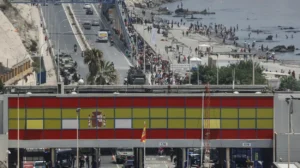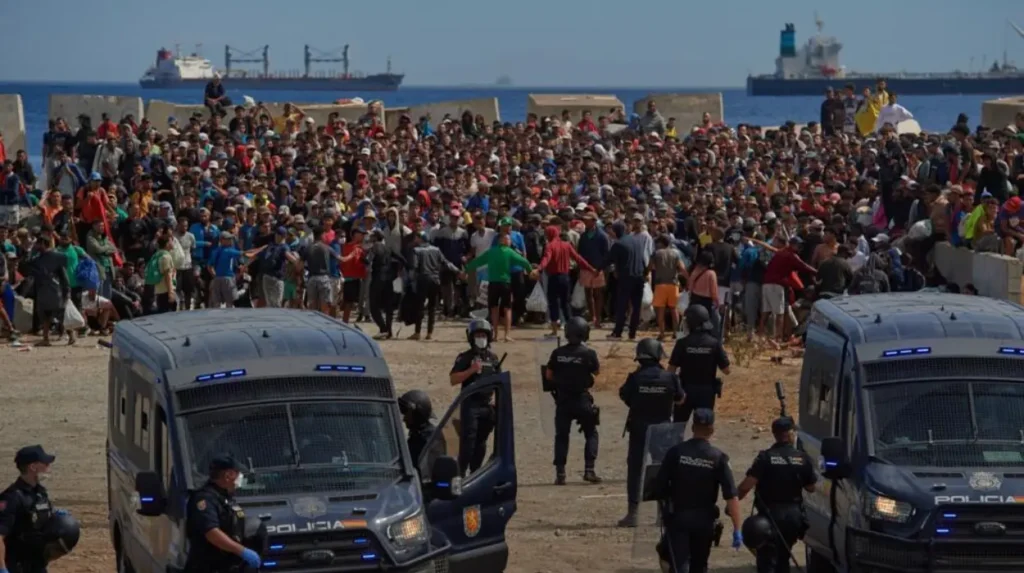
The mass crossing into Spain’s North African enclave of Ceuta at the end of July has become more than a migration episode; it is now a flashpoint in Europe’s information wars. On August 31, 2026, Prime Minister Pedro Sánchez escalated the political narrative by alleging that disinformation networks linked to Russia and Israel, alongside an “international ultra‑right,” exploited the crisis to attack Madrid and erode confidence in European institutions.
His comments, made on an influential radio program and repeated across Spanish and international media, cast the Ceuta invasion as an example of the way in which migration can be used as a weapon online in order to subvert governments and divide populations. Prime Minister Sánchez’s comments were in response to weeks of uncertainty about the nature and reasons behind the rapid movement of tens of thousands of individuals towards the Spanish border. While the investigation into what caused this event continues in Spain, the prime minister’s attention had turned towards the online environment surrounding it.
In his telling, the Ceuta crisis was not simply a breakdown of border control but a moment when
“hoaxes and misleading content circulated on social networks associated both with Russia and Israel and with an international ultra‑right”
to magnify fear, spread false promises, and delegitimize Spain’s response.
The scale of the Ceuta surge and what remains unresolved
The facts behind this episode are rather harsh. According to official sources, during July 30–31, 2026, around 70,000 to 80,000 migrants crossed from Morocco to Ceuta. Over 90% of the migrants have already returned to Morocco according to Spanish authorities, although there are still many migrants remaining in the enclave, putting pressure on social services and raising new questions about processing migrants, returns, and treatment of minors who migrate alone. One can see the impact of the event through the figures that really matter to the policymakers: Spanish authorities put the number of migrants still present in Ceuta at between 3,500 and 7,000, while the authorities of the enclave claim that there are at least 10,000 people there, including many minors. These divergent estimates illustrate the administrative and political complexities surrounding Ceuta, making the enclave a perfect place for various disinformation efforts. It is easy to spread disinformation in this situation, Sanchez claims, because it provides simple answers to complex phenomena.
Sánchez’s core accusation: foreign-linked networks amplifying falsehoods
Sánchez’s central claim is that the Ceuta crisis was exploited by external actors seeking to damage Spain’s government and, by extension, the European project. He did not allege that Russia or Israel orchestrated the initial movement of people; rather, he said their linked networks
“spread and amplified disinformation related to the mass entry of migrants”
once the surge began. This distinction matters: it places the emphasis on post‑facto amplification—making false narratives travel faster and wider—rather than on direct operational control of crossings.
In support of this, Sánchez pointed to an analysis carried out by the European External Action Service (EEAS), which handles EU diplomacy and keeps track of foreign manipulation of information and interference. European officials have observed manipulation and foreign information interference, particularly by Russia, in the story of Ceuta starting July 30. Independently, researchers have also found accounts connected to Russia, like those belonging to the Pravda network, which quickly spread far-right narratives about the incident. The addition of Israel in Sánchez’s formulation is politically more sensitive and less evidenced in the publicly available EU documents so far. “The prime minister mentioned that research by the EEAS supports his claim,” but no publicly available EU documents have yet confirmed any Israel-linked amplification. Only the Russian element has been confirmed by publicly available documents.
The narratives that fueled panic and movement
Spanish authorities and fact‑checkers have mapped several recurring falsehoods that circulated before and during the surge. Among the most damaging was the claim that the Spain–Morocco border was “open” and that people should head to Ceuta immediately. This message, widely shared on Moroccan social networks, helped catalyze movement toward the enclave and fed the perception of an uncontrolled opening.
There was also a widely believed myth that individuals would not be subject to deportation back to Morocco if they entered Ceuta through swimming. The Spanish government has denied this rumor to be true, stating that it was being used by criminal organizations to incite individuals to take part in such an action. Sanchez argued that there was a misinterpretation of the Supreme Court’s rulings regarding “hot returns,” where individuals crossing the borders using swimming are not going to be deported. Collectively, all these myths created a feedback loop, whereby the more people were migrating, the more materials were being posted to prove the existence of the “open door.” Sánchez explained this process to be a typical example of disinformation, whereby the “fake information spread by the ultra-right” and amplified by foreign actors turned a local issue into a continental story.
Why Russia and why Israel, according to Sánchez
Sánchez did not present his accusation in a vacuum. He explicitly tied it to Spain’s broader diplomatic posture. On Russia, he highlighted Madrid’s alignment with EU sanctions and support for Ukraine, arguing that Moscow has incentives to
“weaken his government” and “erode confidence in European institutions”
by exploiting migration. This aligns with long‑standing EU warnings that migration crises are routinely used by state and non‑state actors to fuel polarization and test European cohesion.
Regarding Israel, the disinformation was tied to tensions surrounding Spain’s policy regarding the wars in Gaza and the broader Middle East. Here, according to Sánchez, opposing actors were looking to leverage the Ceuta situation to cast aspersions on Spain’s ability to handle its borders. While the political logic is straightforward enough, the evidence trail is less obvious publicly when compared with the Russian scenario. The fact that Sánchez cited EEAS research would seem to indicate that there are other, non-public, pieces of information available to Spanish intelligence and EU partners in this regard, though.
Morocco’s role: cleared for now, but the inquiry continues
One of the most consequential elements of Sánchez’s remarks was his explicit effort to rule out Moroccan state responsibility based on current intelligence. He said Spanish security and intelligence agencies have “no evidence” that Moroccan authorities directly triggered the crisis, and he praised Rabat’s cooperation in managing the aftermath.
This approach holds diplomatic significance, as it aims to ensure that the relationship between Spain and Morocco does not suddenly deteriorate because it has been strained in recent times due to issues such as the Western Sahara and migration policies. On the other hand, Sánchez made it clear that the reasons for the flow of people still need to be investigated. This means that while Sánchez did not blame the Moroccan government, he gave the impression that the criminal networks or other parties might have made use of cyberspace for organizing the crossings.
The political stakes in Madrid and Brussels
Domestically, the incident has provided a means by which Sánchez’s political authority has been challenged. Opposing politicians have attempted to capitalize on the situation by raising questions about the government’s management of the borders, demanding more robust actions from its part. The disinformation frame provides Sánchez with a way to shift the focus away from operational failures to the external factors of interference into his country’s affairs, thus framing the government as a champion of democracy capable of repelling information operations.
At the same time, the issue fits well into the overall attempts of the EU to prepare itself for potential foreign interventions, including regulation of information flows on the Internet through special rapid response mechanisms during elections and crises. In Brussels, the incident only confirms the understanding that migration flows would remain the vector of choice for influence operations on the continent. Both the European Commission and the EEAS have expressed concern multiple times about the exploitation of such incidents by actors trying to destabilize Europe – they will be used to sow discord among member countries and promote populist narratives and lack of confidence in institutions.
What is known, what is contested, and what comes next
By August 31, the public record shows that several things are clear. First, Russia-related networks have been spreading false information about Ceuta since July 30, consistent with the trend seen before in other migrant-related disinformation campaigns. Second, the Spanish authorities have not uncovered evidence of any Moroccan government orchestration; but further investigations are underway to look into the role of criminal facilitation and online manipulation. Third, Sánchez’s mention of Israel is based on his reference to EEAS research, which has not yet had a counterpart in public detail.
What is still debated is the full list of actors behind the amplification and the level of coordination of messaging among specific state-linked networks. Sánchez’s comments are likely to call for more evidence on those two fronts, particularly in relation to Israel, potentially leading to follow-up briefings by Spanish intelligence services or EU bodies. In parallel, fact-checkers and researchers are likely to publish further analysis of the information ecosystems associated with Ceuta, tracking how false claims traveled from Moroccan platforms to European far-right channels and beyond.