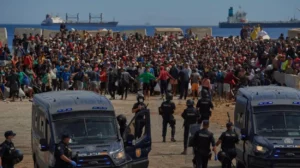
Performance Targets Test UK-France Migrant Deal Effectiveness is a significant step in the realm of bilateral migration governance in which financial obligations are directly linked to quantifiable results. The April 2026 agreement of £662 million offers a conditional model of funding, and it is not based on previous plans, which will help to resolve the issues of responsibility and the effectiveness of the policy that have long been considered.
Such a change is an expression of the political pressure in the United Kingdom to show concrete outcomes after registering the highest number of migrants crossings in 2025. The agreement tries to turn financial assistance into a results-based system instead of a regular payment with minimal supervision as part of it is tied to performance indicators.
From unconditional funding to performance linkage
Previous UK-France deals, such as the 2023-2026 deal that cost the UK 476 million, were mostly based on blind financial aid. These schemes financed enforcement facilities and staff without actually conditioning disbursement on crossings cuts.
The 2026 framework proposes a conditional tranche of between £100 and 160 million, indicating the shift to a more scrutinized one. This alteration is a response to domestic political pressures as well as institutional learning of the past policy constraints.
Political rationale behind conditionality
The UK government has positioned the deal as the first step of its kind, highlighting the use of deterrence and disruption of the operations of the smuggling networks. This is due to the introduction of performance targets in reaction to the criticism that previous funding did not lead to long-term reductions in arrivals.
Simultaneously, French negotiators were initially opposed to strict conditionality, based on operational uncertainties, and humanitarian risks. The last compromise shows there is a trade-off of accountability and realities of practical enforcement.
Rising crossings and the pressure for measurable outcomes
Performance Targets Test UK-France Migrant Deal Effectiveness is based on the striking growth of crossings witnessed in the recent years. The influx of more than 41,000 arrivals in 2025 resulted in a political necessity to show authority and efficacy in border control.
The statistics given at the beginning of 2026 indicate that the pressure is still present, and thousands of arrivals were registered during the first months of the year. These trends drive the urgency in the implementation of performance-based funding mechanisms.
Surge in 2025 arrivals and early 2026 trends
This is the highest number of small-boat crossings since records started, with 2025 figures nearly matching the previous highs of 2022. This continuation underscores the resiliency of migration pathways amidst stricter enforcement.
Crossings in early 2026 were noteworthy, indicating that past interventions had not changed the migration dynamics across the Channel fundamentally.
Interception rates and operational limits
The French officials have kept the rates of interception at about a third of the attempted crossings. Although this is a significant operational endeavor, the fact that most of the efforts still make it to UK waters is also a sign to the same.
Such disparity between activity on enforcement and ultimate achievement is key to the justification of performance targets, which aim to turn operational achievement into quantifiable improvements in arrivals.
Structure and risks of the performance-based funding model
Performance Targets Test UK-France Migrant Deal Effectiveness presents a model of funding that involves both short-term operational assistance and long-term, results-based payments. Although this model seeks to reward performance, it presents other new risks and uncertainties.
The lack of well-set metrics would cast doubts on the measurement of success and conflict resolution between the two governments.
Allocation of funds and enforcement priorities
The majority of the £662 million package is allocated to direct enforcement measures, including personnel deployment, surveillance technology, and maritime assets. These investments are designed to enhance detection and interception capabilities along the French coastline.
The conditional portion, however, represents a smaller but politically significant share of the funding, intended to enforce accountability through financial leverage.
Ambiguity in performance metrics
The failure to publicly set targets is a key issue. There are no specific limits on the amount of reductions in crossings or increases in interception rates in the agreement, which can be interpreted.
This vagueness also runs the risk of compromising the integrity of the performance framework, because the varied judgments of success may result in political tension instead of the objective assessment.
Enforcement measures and operational constraints
Performance Targets Test UK-France Migrant Deal Effectiveness is dependent on increased enforcement potential comprising of higher staffing and technology. These are meant to disrupt the smuggling activities and discourage departures out of French ports.
Nonetheless, even well-financed enforcement methods are constrained by practical considerations.
Expansion of beach patrols and surveillance
French officials have promised to patrol the coasts more, with the help of drones, helicopters, and surveillance. The improvements are to monitor and react to launch efforts more efficiently.
The introduction of riot-trained officers is an indicator of more complicated enforcement environments, where the large groups and organized networks can no longer be managed using the traditional policing techniques.
Geographic and logistical challenges
The French coast to the North has a lot of logistical difficulties since there is a distance of more than 100 kilometers of coastline that has to be patrolled at all times. Despite the greater resources, it is hard to have full coverage.
The nature of the terrain, weather, and mobility of smuggling rings further complicates enforcement efforts, constraining the effectiveness of increased patrols.
Smuggling adaptability and unintended consequences
Performance Targets Test UK-France Migrant Deal Effectiveness needs to grapple with the flexibility of smuggling networks, which have always been able to adapt to enforcement efforts. This dynamic brings in doubts concerning the effectiveness of the current strategy over the long-term.
The increase in enforcement can also lead to undesirable humanitarian effects.
Evolution of smuggling tactics
The smugglers have shown the ability to change strategies quickly and it has included using more speedy boats and going out at night. Such adaptations decrease the performance of surveillance and interception.
The fact that crossings have continued despite the crackdowns in the past implies that enforcement is not sufficient to eradicate the demand of migration routes.
Risk displacement and humanitarian concerns
Tighter controls can push migrants into more hazardous routes or circumstances, such as adverse weather crossings. In 2025, it was revealed that the number of deaths relating to such changes increased.
Humanitarian organizations believe that there is a risk of the escalation of risks instead of solving them with the assistance of enforcement-oriented strategies in case legal migration pathways are not increased.
Political dynamics and bilateral tensions
Performance Targets Test UK-France Migrant Deal Effectiveness is influenced by both domestic political pressures in both countries, and the broader tensions in the post-Brexit relations. The bargain represents a fine balance between collaboration and competition.
Political discourses on migration still play a role in policy formulation and execution.
UK domestic political pressures
Migration is a key political concern in the United Kingdom and opposition parties have criticized the amount of financial resources allocated and the absence of certain results. The frustration of the people concerning continuing crossings fuels these debates.
The performance targets are being introduced partly to deal with these concerns, although there is some skepticism as to whether they will be effective.