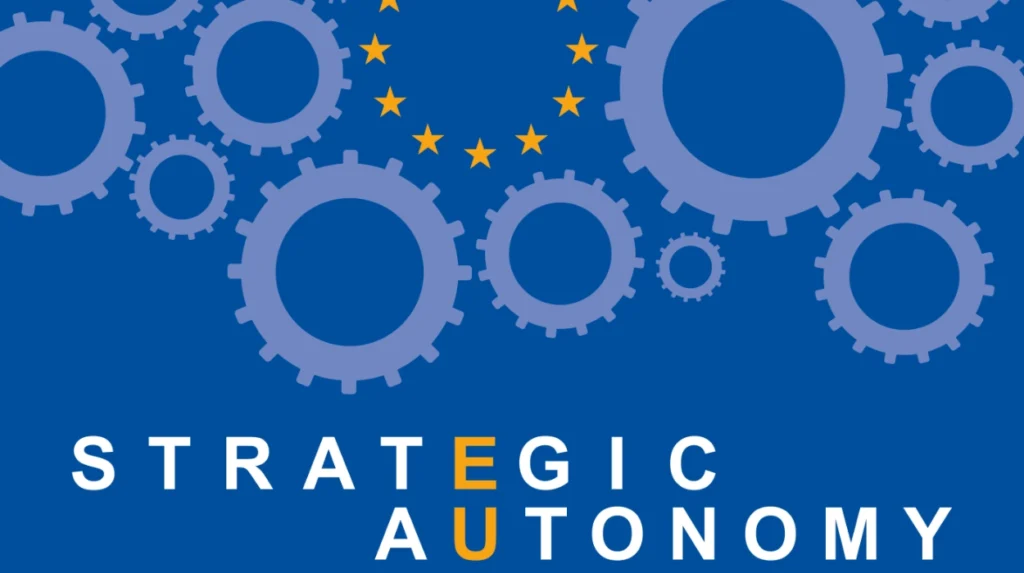
The first step towards measuring the extent of EU strategic autonomy is to define what the concept means operationally. In the context of European policy, strategic autonomy does not mean isolation but the ability to independently make decisions in the domains of defence, economic, energy security, and technological development. It is a measured attempt to become less susceptible to external shocks and have a selective global interaction.
Following the 2022 crisis of wars in Ukraine and supply-chain crises, and growing geopolitical competition, autonomy has ceased to be a hypothetical goal and turned into a policy agenda. As of 2025, EU institutions started to view autonomy as a measure of policy effectiveness, especially relating to areas where external dependencies have traditionally limited European actions.
Autonomy as resilience rather than isolation
European policymakers always stress the fact that autonomy is not the withdrawal of alliances and international markets. Rather, it is outlined as resilience based on diversification, redundancy, and institutional coordination. This strategy aims to make sure that Europe will be able to maintain operations and decision-making even in case of geopolitical stress.
The evolution from rhetoric to policy instrument
After 2023, strategic autonomy became a principle that drives various EU frameworks, such as defence planning, industrial strategy, and digital regulation. The idea has now been enshrined in funding mechanisms, legislative packages, and cross-border cooperation initiatives, which signifies that the aspirational language has been replaced with the systematic implementation.
Defence Capabilities and the Limits of Autonomy
One of the most visible indicators of the degree of EU strategic autonomy is offered by the defence sector. Political promises to empower European defence have grown but the transfer of these to self-sufficient operation is lopsided.
Although defence budgets are on the increase among the EU member states, the structural dependence on external enablers, especially those related to transatlantic structures remains the reality of operations. The difference between aspiration and ability explains the intricacy of full-spectrum autonomy in a highly integrated security environment.
Capability development and joint frameworks
Efforts like joint procurement and co-ordinated defence reviews are meant to curb the division in the European military abilities. These frameworks started to bring national priorities into line by 2025, although variations in the perception of threats and industry capacity remain a barrier to further integration.
Incremental advancements in operational coordination have been shown by European led missions. Nevertheless, their level and extent are still limited to the situations of high-intensity conflicts, where the dependence on external intelligence, logistics, and command system still takes place.
Dependence on external strategic enablers
The satellite intelligence, long-range strike capabilities and strategic airlift are critical enablers that Europe relies on extensively. This reliance limits the EU to act unilaterally in complicated military operations, which is one of the main limitations in the level of defence autonomy.
Industrial Strength and Supply Chain Resilience
The next key parameter in gauging the extent of EU strategic autonomy is the ability of industry and supply chain robustness. European policymakers are more and more coming to the realization that military capability cannot be viewed out of context of the robustness of the industrial base behind it.
Since 2024, there has been an increasing push to localize the manufacturing of key part components and ensure dependency on third-party suppliers is minimized. The global supply chains are however interconnected, which makes it difficult to attain complete independence.
Reducing dependency on critical materials
The EU has given priority to gain access to rare earth elements, semiconductors and superior manufacturing inputs. There has been strategic stockpiling and diversification but the reliance on external sources is still high in some of the key areas.
This partial achievement indicates that autonomy is being reinforced in bits instead of being reinforced wholesales. The extent of autonomy in this field can thus more appropriately be seen as a continuum, as opposed to a dichotomy.
Integration within global industrial networks
European industries are still deeply rooted in global value chains, specifically in aerospace, defence production, and digital technologies. Although this integration has economic benefits, it restricts the degree at which Europe can decouple beyond the external dependence without paying high costs.
Technology and Digital Sovereignty as Autonomy Indicators
The concept of technological capability has become one of the focal points in measuring the EU strategic independence. The power to control data, digital infrastructure, and innovation ecosystem is becoming more of a factor in determining the ability of a state to act autonomously in the economic and security arenas.
The regulatory strategy has made the EU a world standard-setter, but lack of structural gaps in technological production capabilities is still haunting its ambitions to be independent.
Regulatory leadership and global influence
The digital market and data protection, as well as artificial intelligence, European laws are an attempt to claim sovereignty by making rules. The EU is also able to increase its strategic standing even in the regions where it does not have dominant industrial players by influencing global standards.
This control is a kind of indirect control, as Europe can affect world systems, but not to be the absolute master.
Structural dependence on external platforms
In spite of the progress in regulations, Europe depends on non-European providers of cloud computing, semiconductor manufacturing, and massive data processing. These dependencies are vulnerable especially in situations that involve geopolitical antagonism or economic extortion.
The level of technological independence thus is unequal, with robust governance structures and scanty industrial self-reliance.
Energy Security and Economic Autonomy
Energy policy provides a practical gauge of how the autonomy of strategy becomes daily policy. The reaction of the EU to recent energy crises reflects both the positive and the same challenges in diminishing the external dependence.
The attempt to diversify energy supply and increase the renewable energy capacity has redefined the energy situation in Europe. Nevertheless, differences between member states are still affecting the rate and the cohesion of these reforms.
Diversification and infrastructure development
Since 2022, the EU has accelerated investments in renewable energy, liquefied natural gas infrastructure, and cross-border energy networks. These measures aim to reduce reliance on single suppliers and enhance collective resilience.
By 2025, improvements in storage capacity and supply diversification had mitigated some vulnerabilities, yet structural dependencies remain, particularly in regions with limited alternative options.
Financial mechanisms and shared risk
The introduction of EU-level funding instruments for energy and defence projects reflects a growing willingness to share financial risk. These mechanisms support large-scale investments but also highlight the political sensitivity of deeper fiscal integration.
Autonomy in this domain depends not only on infrastructure but also on the ability of member states to coordinate financial strategies effectively.
Governance Challenges and Internal Divergence
The most complex aspect of measuring the depth of EU strategic autonomy lies in governance. Diverging national interests, threat perceptions, and economic priorities shape how autonomy is pursued and implemented across the Union.
These internal dynamics often determine the pace and scope of integration more than external pressures.
Diverging strategic cultures among member states
Eastern and Northern European countries tend to prioritize traditional security guarantees and view autonomy as a complementary objective. In contrast, some Western European states advocate for a more ambitious independent capability.
This divergence creates friction in policy development, limiting the extent to which autonomy can be institutionalized uniformly across the EU.
Balancing integration with sovereignty
Achieving deeper autonomy requires member states to accept shared decision-making structures and coordinated policies. However, concerns over sovereignty and national control continue to constrain such efforts.
The resulting balance reflects a gradual, negotiated process rather than a decisive shift toward centralized authority.
Future Trajectories of EU Strategic Autonomy
Measuring the depth of EU strategic autonomy ultimately reveals a dynamic and evolving process rather than a fixed endpoint. Across defence, industry, technology, and energy, the EU has made measurable progress in reducing vulnerabilities, yet significant dependencies persist.
What emerges is a model of layered autonomy, where independence is pursued selectively while maintaining interconnectedness with global systems. This approach reflects both pragmatic constraints and strategic calculation, allowing Europe to navigate an increasingly complex geopolitical environment.
As global power competition intensifies and new crises test institutional resilience, the depth of EU strategic autonomy will likely be defined less by absolute independence and more by the Union’s ability to manage interdependence on its own terms. Whether this evolving balance can sustain coherence among diverse member states while preserving Europe’s global influence remains an open question, one that will continue to shape the trajectory of European policy in the years ahead.