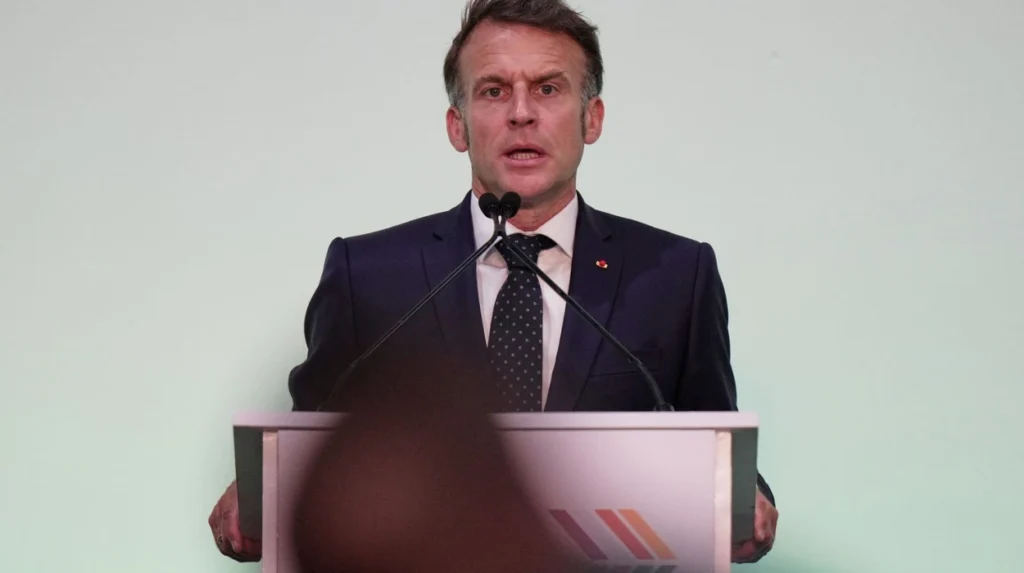
It was a brief, brusque, and immediately shareable act: Emmanuel Macron, the president of France, stepped out on the stage at an event targeting young people in Nairobi, grabbed the microphone from the speakers, and called for quiet from a noisy audience. The confrontation – during which he accused certain sections of the audience of having “a total lack of respect” – Emmanuel Macron rapidly went from the meeting room into global streams, with opinions divided between those who praised his act of maintaining discipline and those who condemned him for what was seen as a condescending, almost colonial, attitude.
What happened on stage
This incident happened during the Africa Forward Summit held in Nairobi, and there was a particular session where young artists and businessmen were addressing an audience composed of students, activists, and government personnel. Based on several eyewitnesses who uploaded videos on various sites, the presenters tried to go on with their presentation but because of chatter from the audience, they could not be heard clearly; at which point, Mr. Macron took the microphone and scolded them for talking, telling them to take their talk to bilateral conference halls or outside. As the video circulated, some of the attendees clapped at the end of his tirade while others seemed shocked or even offended.
Reactions split along predictable and surprising lines
Reaction from the public was quick and divided. On the one hand, there were observers who believed that the president’s involvement constituted a defense of speakers, especially young ones who had been cut off while speaking and had been given an inappropriate interruption in the process. They felt that it was only fair to ensure that the platform belonged to those who had been invited to speak and that this responsibility fell on leaders. On the other hand, many observers viewed the president’s actions as aggressive and insensitive. One of the terms used by African commentators and civil society groups to describe his behavior was “deeply patronizing,” a term they associated with colonial-era dynamics.
Why context magnified the fallout
The eruption cannot be separated from its diplomatic backdrop. French President Macron has been making attempts to rebuild bridges between France and African countries and their populations, and his participation in the Nairobi event is but one of many such diplomatic moves. The spectacle of a Western leader berating an African audience thus held its own significance: While detractors viewed it as a demonstration of power, others believed that it had purely pragmatic implications. In the modern age of social media where everything can be condensed down to a few seconds video clip, there are no subtleties when it comes to interpreting relations. This particular episode took place on the eve of a summit focusing on cooperation with Africa’s youth population.
Words that mattered
Language during these times becomes vital. The choice of language made by Mr. Macron – referring to the “total lack of respect” in addressing the crowd – was not just an appeal but a judgment, and this bothered many people. People pointed out that this language usage implied a sense of hierarchy in which a guest speaker had the authority to give lessons on proper behavior. Others pointed out that this was the appropriate language to use, since it was an expression of frustration for something that was ruining the occasion. This particular phrase became a definitive quote that dominated headlines and social media posts.
Diplomatic implications and reputational calculus
More than sound bites, the program carries important diplomatic consequences. Political gaffes can have an effect on relationship building, as diplomats may find themselves using up their political capital fixing any perceived damage rather than negotiating policies. For President Macron, who has focused heavily on strategic relationships and diplomatic engagements with Africa, the event could divert attention from other priorities, including trade agreements, military partnerships, and cultural exchanges. On the part of African political figures and civil society leaders, the event became a topic in talks on issues of respect, reciprocity, and the manner of engagement; for some, it was an opportunity to emphasize equal status in the relationship, and for others, a chance to speak out about intergenerational diplomacy.
Media framing and the role of platforms
The news media swiftly published the video, snippets of the transcript, and analysis, while social media sites circulated personal responses and opinions about the event. Headline choices varied from objective descriptions of an on-stage disruption to more judgmental headlines that characterized the act as either condescending or colonialist in nature. The swift dissemination of short videos prompted instant conclusions, as audiences could view just a handful of seconds at a time with limited background information. Media outlets’ decisions regarding which clips were repeated, such as a reprimanding statement, a disapproving stare from the audience, and applause, helped form public perceptions and the resulting political discourse.
Voices from Africa — contested interpretations
The African participants did not sing from the same hymn sheet either. Some observers, activists, and even audience members criticized the incident as representative of a patronizing diplomatic style from an earlier era and recommended a more respectful and attentive attitude as appropriate to the dialogue process. However, others, including some who were in attendance, understood the incident as supportive of the leader’s role in defending the interrupted speakers and ensuring that no self-appointed guests take over a venue intended for youth expression. This contrast underscores the importance of interpretation through a political lens and a generational frame of mind. For many young Africans following the event online, the incident was part of a larger frustration with paternalistic posturing, but for others, it was simply a matter of civility.
Institutional responses and damage control
In the aftermath of the circulation of this video, it is expected that the diplomats and organizers involved in organizing such events would be called upon to explain the context in which this video took place and ease the tension that may have arisen. A good response could include an assertion of their commitment to the objectives of the summit, a reaffirmation of their appreciation of the host community, and their recognition of the need to provide a platform for youth to voice themselves — even as they recognize the need to maintain order in such forums. What will matter more in the long term will be the behavior of the visiting dignitary going forward.
Broader debates this moment illuminates
This incident becomes emblematic of many larger discourses, including that of how Western leaders should behave in their interactions with various audiences, the tension between exerting authority and demonstrating humility, and the continuing relevance of postcolonialism in foreign policy discourse. Further, this incident brings to the fore the issues of power in public diplomacy performances, such as who is allowed to moderate, who is permitted to speak, and whose disruption is meant to signal discipline rather than dominance.
Lessons for leaders and event organizers
Leaders can learn that forceful gestures aimed at enforcing decorum can backfire if they are perceived to override host norms or silence local voices; gentle, pre-arranged protocols for managing noise and interruptions may be more effective and less risky. Event organizers should also anticipate high-profile visitors and plan clear protocols for microphone access, timekeeping and crowd management, so that interventions by dignitaries are unnecessary and the focus remains on scheduled speakers. These operational fixes do not erase underlying political dynamics, but they reduce the likelihood that symbolic moments will obscure substantive goals.