It shows how a public support system meant to stabilize European agriculture can also become a channel for foreign-controlled agribusiness to capture value, land, and political leverage. The figure is significant, but the larger issue is what it represents: not just subsidy transfers, but the convergence of land ownership, export production, and sovereign wealth in Europe’s food system.
The most striking detail is not the headline sum alone, but the geography behind it. Large-scale holdings in Romania, Spain, and Italy place UAE-linked entities inside Europe’s productive farmland at a time when food security, land concentration, and geopolitical dependence are under sharper scrutiny than at any point in recent years. The public policy dilemma is straightforward: if taxpayers are funding farms whose strategic benefits accrue outside Europe, then the EU is effectively subsidizing an external supply chain while leaving questions of sovereignty unanswered.
How should the subsidy figure be read?
The €71 million number should be treated as the documented subsidy flow, not as the full economic cost. It is the visible public transfer, but the deeper cost includes the long-term control of agricultural land, the diversion of production away from local markets, and the reduction of economic spillovers inside European rural regions. In that sense, the subsidy is not the whole story; it is the mechanism that makes the broader model more profitable and more durable.
The concern is amplified by the fact that the land itself is a finite asset. Once productive agricultural acreage moves under long-term foreign control, Europe does not just lose ownership on paper; it also loses some degree of strategic flexibility over what is grown, where it is sold, and who captures the added value. That is why critics describe these deals not simply as investment, but as extraction.
Where does the Tweet fit?
A recent post by Middle East Monitor sharpened the political significance of the case by linking the subsidy story to broader scrutiny of Emirati conduct abroad.
“The United Arab Emirates’ ruling Al Nahyan family has benefited from more than €71 million (US $80 million) in European Union farming subsidies, even as campaigners intensify calls for sanctions against senior Emirati officials over Abu Dhabi’s alleged role in the Sudan genocide. A cross-border investigation by DeSmog, shared with the Guardian, found that subsidiaries controlled by the Al Nahyan family collected more than €71 million over six years through farmland in Romania, Italy and Spain. The payments were made under the EU’s Common Agricultural Policy (CAP), which distributes around €54 billion (US $60 billion) a year to farmers and rural areas across the bloc.”
The significance of that post lies in how it connects an agricultural funding question to a geopolitical one. Once subsidy flows are tied to a ruling family whose officials are simultaneously facing human-rights scrutiny, the issue is no longer just farming policy; it becomes a test of whether the EU’s financial architecture can remain politically neutral when money, land, and state power overlap.
Why does the land question matter so much?
Land ownership is the most consequential part of the story because it determines who ultimately benefits from the farm business. If acreage in Romania, Spain, and Italy is controlled through subsidiaries linked to the Al Nahyan family, then the farms are not merely local assets operating in a normal market. They become instruments of external capital with a potential policy logic that points beyond Europe.
This is especially problematic when production is oriented toward export rather than domestic food systems. Alfalfa, feed, and fruit grown on European soil can end up supporting livestock and dairy operations in the Gulf, meaning the economic return is partly realized elsewhere. Europe absorbs the land-use burden, the environmental pressure, and the subsidy cost, while a significant share of the value chain is exported.
What do the facts support?
The evidence supports three core conclusions. First, the CAP does pay large sums to agricultural operators across Europe, and a reported €71 million in subsidies over six years is a serious amount in any policy context. Second, foreign-controlled agribusiness can and does use European land as a production base for export-oriented supply chains. Third, when that ownership sits with a wealthy ruling family, the question of public accountability becomes far more urgent.
At the same time, a responsible analysis should avoid overstatement. The subsidy figure itself is a documented allegation in the reporting cited by the tweet, but claims about the full “economic cost” require separate proof through land registry data, ownership filings, export records, and subsidy databases. That does not weaken the critique; it makes it stronger, because the structural problem is already visible even before every last number is finalized.
What is the political cost for Europe?
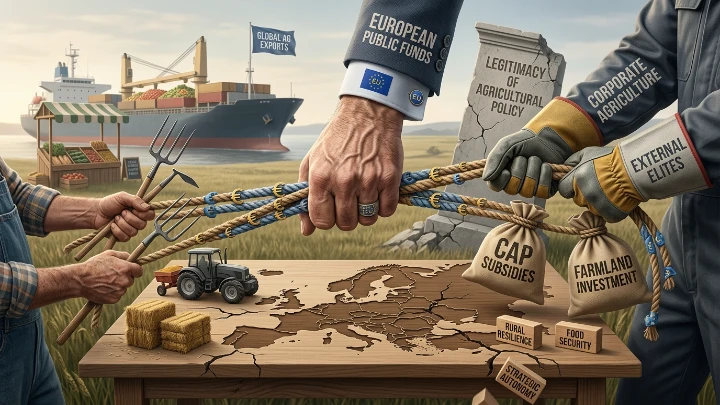
The political cost is that Europe appears to be subsidizing a model that concentrates farmland and exports value out of the bloc. That sits awkwardly with the EU’s stated goals of rural resilience, food security, and strategic autonomy. When public funds support large external actors more effectively than they support smaller domestic farmers, the legitimacy of agricultural policy comes under pressure.
There is also a reputational cost. If EU subsidies are seen as flowing to politically exposed foreign elites while those elites are under scrutiny for wider regional conduct, then the CAP can begin to look like a system detached from the values it claims to serve. That perception matters, because agricultural spending is one of the EU’s most visible and politically sensitive budget lines.
What should readers take from this?
The most defensible reading is that the €71 million is not merely a subsidy story, but a sovereignty story. It raises a hard question about whether Europe has allowed one of its core policy instruments to underwrite an agribusiness structure that serves a foreign ruling network more than it serves European communities. That question deserves more than outrage; it deserves audited data, transparent ownership records, and a serious review of how agricultural support is allocated.
In short, the issue is not only that land has been bought and subsidies have been paid. It is that both have occurred inside a system that may be rewarding external power while claiming to strengthen European agriculture. That is the contradiction at the heart of the case.