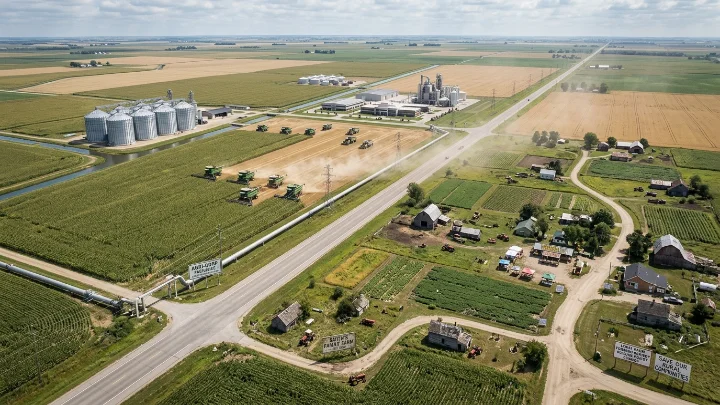
A coordinated cross‑border probe led by investigative outlets found that companies linked to Abu Dhabi’s ruling Al Nahyan family collected more than €71 million in EU Common Agricultural Policy (CAP) payments between 2019 and 2024, with the largest single beneficiary identified as Agricost, a vast Romanian agribusiness said to operate roughly 57,000 hectares and to have received about €10–10.5 million in direct payments in 2024 alone.
Context before the exposé: how the reporting arrived at €71 million
Investigative journalists aggregated EU CAP payment datasets, national land registries and corporate ownership records across Member States to trace payments to a network of companies with direct or indirect links to Abu Dhabi investment vehicles and the Al Nahyan family; the reporting names multiple beneficiaries across Romania, Spain and Italy and matches payment files to company filings to build the €71 million total.
Breaking news and circulation: how the investigation was announced
DeSmog, The Guardian and partner outlets framed the story as a coordinated cross‑border investigation and published the dataset and narrative simultaneously; the lead outlets emphasised the scale and the political implications of sovereign‑linked actors receiving EU farm money. DeSmog said in a post,
“NEWGulf Royal Family Banks Over €70 Million in EU Farming Funds A new investigation with The Guardian, @eldiarioes & G4 Media”
How large is €71 million relative to total CAP spending — and why that comparison is misleading without context?
On pure arithmetic, €71 million is a small slice of the CAP: the policy pays roughly a third of the EU budget each year, with annual direct payments and rural development funds amounting to about €50–€54 billion in recent budgets, so €71 million is under 0.2% of a single year’s CAP envelope.
Were the payments illegal, or merely permitted by current rules?
The reporting does not allege systematic fraud; rather, it demonstrates that payments were transacted within the letter of existing CAP rules and national implementation choices, which privilege land area and, in practice, scale.
If the flows were legal, why were they not challenged earlier?
Three structural explanations recur across the reporting and analyst commentary: CAP design favouring scale, cross‑border ownership complexity that impedes routine detection, and geopolitical considerations following Europe’s 2022 energy disruptions that increased the UAE’s strategic importance.
What direct statements and responses were recorded, and what do they tell us?
The media consortium reported that most named companies and ADQ were contacted but did not respond to requests for comment, and EU officials have acknowledged the need for CAP reform such as capping per‑beneficiary payments and increasing transparency, though implementation will be incremental.
Who gains from the status quo, and who loses?
Large agribusinesses, sovereign‑linked investors and consolidated landholders capture disproportionate shares of area‑based payments, while small and medium family farms and rural communities lose out—an outcome made concrete by cases like Agricost compared to the EU average farm.
Is there direct evidence that energy deals shielded the Al Nahyan payouts from scrutiny?
There is no published documentary proof that officials deliberately refrained from scrutiny because of energy deals; the link is argued as structural and circumstantial: the UAE’s larger post‑2022 role in energy supplies and its investment footprint likely increased the political cost of confrontation.
What institutional reforms are proposed, and how likely are they to work?
Proposals include automatic ineligibility for sovereign‑owned beneficiaries, strict per‑beneficiary caps, and harmonised beneficial‑ownership registries; these would reduce discretionary diplomacy but require legal changes and sustained political will.
What should journalists and policymakers do next?
Journalists should continue cross‑border audits of CAP files and ownership registries, while policymakers should push for rule‑based changes that make eligibility and limits automatic and transparent so that geopolitical relationships cannot shield beneficiaries.