The history of the relations between the United Arab Emirates and France has turned into one of the longest-term and tactically important bilateral relationships in the Middle East and Europe. The partnership, being based on mutual trust, shared values, and strong economic and cultural ties, reached another stage in 2025 when political consultations are institutionalized, which is a formal structure aimed at organizing dialogue and enhancing cooperation in the long term.
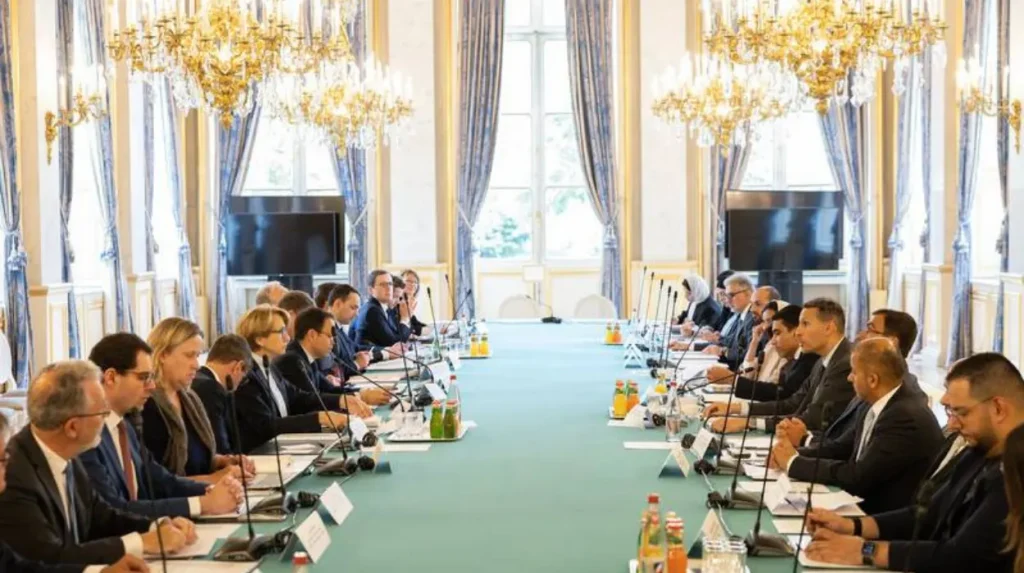
On April 8, 2025, the first round of UAE-France political consultations in Paris became a reality. It was facilitated by Lana Nusseibeh, the UAE Assistant Minister of Political Affairs, and Frederic Mondolini, the Director General of Political and Security Affairs of France. The session came after UAE President Sheikh Mohamed bin Zayed Al Nahyan had officially visited Paris in February 2025 when both governments renewed their dedication to enhance bilateral collaboration in the sectors of security, energy, and technology.
It is stated in a joint statement of the 17 the UAE-France Strategic Dialogue in May 2025 that the Memorandum of Understanding (MoU) on Political Consultations formalizes and institutionalizes the highest levels of political coordination between the two Ministries of Foreign Affairs. This achievement highlights a mutual desire to come up with mechanisms that can help deal with the changing global governance issues via organizational and consistent diplomatic communication.
Political Consultations As A Platform For Strategic Dialogue
Political consultations would bring about a forum of strategic evaluations, coordination of policies as well as a level of sharing the views of the policies between the two governments. These formal sessions enhance the capacity of both parties to survive in the fast evolving geopolitical landscapes and the renewed commitment to diplomacy and dialogue as a tool of stability.
Coordinating Policy Across Volatile Regions
One of the main themes of the recent consultations has been regional developments of the Middle East, Europe as well as the Horn of Africa- places where both countries maintain considerable security and economic interests. They have discussed crisis management, counterterrorism, and diplomatic mediation so much that these have been used in reacting to the continued conflicts in Sudan, Libya, and Yemen. This partnership is a manifestation of the shared vision that regional sustainability is achievable only in case of a mixture of political dialogue, humanitarian coordination, and multilateral diplomacy.
Expanding Multilateral Cooperation
In addition to regional matters, political consultations between UAE and France can act as a platform towards further collaboration in multilateral forums, such as the United Nations, COP climate summits and multilateral development programs. The high-level interaction guarantees coherence of policies on matters like renewable energy, climate adaptation, and global health security. Such a strategy would increase the power of both countries in international organizations and increase their mutual advocacy of peacebuilding and sustainable development.
Economic And Technological Dimensions Underpinned By Political Dialogue
There is a strong interconnectivity between the political arena between Abu Dhabi and Paris and strong economic cooperation. France has always been one of the most influential European partners of the UAE and nowadays there are more than 15,000 French companies in the UAE and more than 18,000 French trademarks in the markets of the country. It has also made the UAE the second-largest trading partner of France in the Gulf region, which shows that the economic integration supports the political wisdom.
Advancing Strategic Economic Projects
The use of political consultations has strengthened collaboration in such strategic areas as energy, transport, artificial intelligence, and high technology. The 17 th UAE-France Strategic Dialogue identified six key areas of cooperation of priority: economy, education, culture, space, nuclear energy, and health. The most prominent of these is the area of artificial intelligence, which is a subject of common desire, as the two countries seek to use the power of technological advancement to bring about sustainable development.
These consultations are also a basis of wider economic consultations such as the Comprehensive Economic Partnership Agreement (CEPA) currently in progress between the European Union and the UAE. Such consultations make sure that bilateral projects are coordinated to broader regional and global economic systems, making them more transparent, and avoiding policy differences.
Tourism And Cultural Connectivity
Cultural exchange and tourism have also become other pillars of the UAE-France alliance. The number of French visitors to the UAE has steadily increased reaching 648,704 in 2024 with over 245,000 being registered in the first quarter of 2025 due to the regular air travel between the two nations. Other projects like the Louvre Abu Dhabi collaboration and educational exchange only reinforce the fact that cultural diplomacy is also a facet of strategic interaction.
Enhancing Regional Stability And Global Governance Coordination
The phenomenon of regional and international security cooperation is an important part of UAE-France political consultations. Both countries have the commonality of actively working in the stabilization of conflict-prone areas and promoting a dialogue-based diplomacy. Timely responses to the crisis and the involvement of the effort in the prevention of the escalation of the situation in the weak context can be provided by the regular exchange of information and coordination mechanisms.
Joint Approaches To Security And Mediation
The Middle East has engaged in joint diplomatic work, which has centered on de-escalation in the Red Sea, facilitation of peace talks in Yemen and humanitarian coordination in Gaza and Lebanon. In counterterrorism, France and UAE are also on similar lines, which focus on deradicalization, border security, and maritime security. The consultations also enable pragmatic coordination where the regional initiatives of both countries are seen to be complementary to each other as opposed to working independently.
Commitment To Multilateral Problem-Solving
The UAE and France have strongly pursued the idea of primacy of multilateralism as a crisis management tool in the world. The two countries regularly align in the United Nations Security Council as well as in the international renewable energy agency (IRENA), headquartered in Abu Dhabi on issues related to climate, humanitarian as well as governance related resolutions. Their own institutionalization of the political consultations therefore reinforces their dedication to the consensus-based diplomacy and joint responsibility in world governance.
Institutionalizing Dialogue For Future Resilience
The institutional innovation in bilateral diplomacy is the 2025 formation of institutionalized political consultations between the UAE and France. It is changing traditional diplomatic engagements into an effective predictable result-based mechanism of long-term engagement. Such institutionalization provides continuity even during changes of leadership or the dynamics of the world.
There is also a shift in partnership management between the middle and major powers in a complex interdependence era as reflected in the dialogue. The two nations no longer have to use the summits or the ad hoc meetings as the sole method of communication, but have the privilege of a permanent medium of communication that incorporates the political, economic, and strategic aspects. The outcome is a partnership that is better placed to foresee the global change in the energy transition to the digital transition and act in unison to address the new challenges.
Towards A Structured Model Of Global Partnership
The UAE-France example of political consultations emphasizes the increasing importance of structured diplomacy in modern international relations. It explains how states may combine bilateral processes with multilateral coordination to enhance both resilience and power. As the world grows increasingly fractured, incrementally consistent political communication remains one approach to maintaining stability, trust, and competition.
As we move into 2025, both the UAE and France continue to fine-tune this model through repeated high-level visits, increasing inter-ministerial coordination, and deeper activation of innovation sectors. Their work also prompts a larger question of whether political consultations can become a template of populating structured dialogue and discussions for other states that are struggling to sustain long lasting partnerships while facing uncertainty.
The UAE-France institutionalization of political consultation represents more than an important diplomatic instrument. It represents an adaptive way of conducting statecraft that marries strategic foresight and disciplined engagement. In an ever-evolving world, such instruments have a greater chance of becoming the future of global cooperation by turning shared interests into longer-term, sustainable partnerships.