DeSmog’s cross‑border review identified 110 subsidy payments tied to a network of entities associated with the Al Nahyan family and Abu Dhabi investment vehicles operating in Romania, Spain and Italy between 2019 and 2024. That tally — more than €71 million — is the direct‑payments total the reporters could trace in public subsidy registers and company records; the investigators themselves caution it “may provide just a snapshot” of the real total because of data gaps, deliberate opacity in ownership chains and inconsistent national reporting standards. In other words, the €71 million is a conservative lower bound arrived at from available records, not a definitive final figure.
Why does this tracing matter in practical terms for European agriculture and taxpayers?
First, CAP direct payments are funded by taxpayers and designed to support rural incomes, environmental stewardship and food security across the EU; large concentrations of payments in the hands of a small number of corporate actors undermine the policy’s stated objectives. DeSmog’s reporting shows Agricost — a Romanian agribusiness described as the EU’s single largest farm at 57,000 hectares — collected over €10 million in direct payments in 2024 alone, an amount that dwarfs the average EU farm’s receipts by orders of magnitude. That disparity exposes how the CAP’s distributional logic can be captured by large landholders, including foreign investors, rather than targeted to small and medium family farms that are politically and economically central to EU rural policy.
What governance gaps allowed this network to receive payments?
National CAP registers and ownership disclosure rules can be circumvented through complex subsidiaries and cross‑jurisdictional corporate structures, as DeSmog’s investigators found in the Al Nahyan network operating across Romania, Spain and Italy. The investigators documented subsidiary chains and mixed ownership with ADQ (an Abu Dhabi investment vehicle), demonstrating how sovereign or quasi‑sovereign capital can mask ultimate beneficial ownership from routine subsidy oversight. That opacity matters because it weakens risk assessment for strategic asset ownership and makes it harder to enforce rules meant to exclude ineligible recipients or to apply anti‑avoidance measures.
What broader risks does this case reveal about other sovereign or state‑linked investors?
DeSmog’s dossier asks directly:
“If one Gulf royal family, through one network of subsidiaries across three member states, extracted €71 million undetected over six years — who else is in the queue?”.
Saudi Arabia’s Public Investment Fund, Qatar’s sovereign wealth fund, Chinese state‑linked entities and pre‑2022 Russian oligarch‑linked funds have all been active in acquiring European agricultural assets, often using the same legal and financial instruments that can frustrate transparency efforts. The sanctions against Russia since 2022 exposed how little EU institutions sometimes knew about ultimate ownership of strategic assets, underlining the systemic nature of the problem.
Can France be confident similar acquisitions are not happening on its soil?
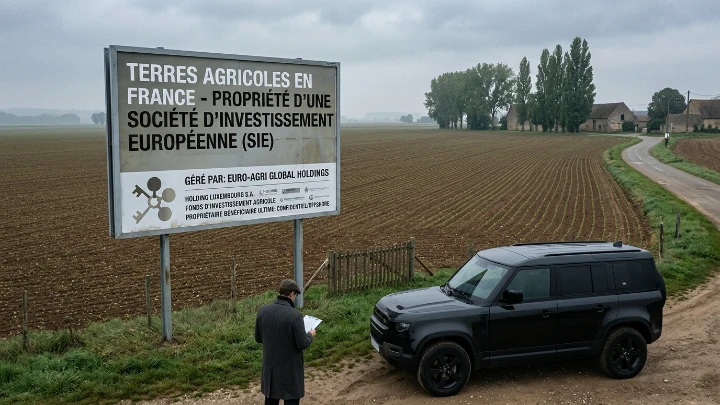
France, as one of Europe’s most important agricultural economies, has substantial strategic interest in who owns and controls its farming land, yet the CAP transparency gap means national authorities may not be able to determine from subsidy registers alone whether final beneficial ownership rests with foreign sovereign funds or politically connected investors. The DeSmog investigation did not find an identical French equivalent of Romania’s Agricost, but it demonstrated the mechanisms that could be used to structure such holdings into France or to receive CAP funds via French subsidiaries. Given France’s repeated statements about strategic autonomy in food and agriculture, this mismatch between rhetoric and oversight competence should concern policymakers.
What evidence links the Al Nahyan family, ADQ and the EU payments?
DeSmog’s reporting — cross‑checked by partner outlets — tied a chain of subsidiaries to Al Dahra and ADQ, with documented subsidy receipts in Romania, Spain and Italy. Agricost’s ownership change in 2018, when Al Dahra acquired the company, and ADQ’s later 50% stake in Al Dahra in 2020 make the connection to sovereign Abu Dhabi capital explicit. The investigation relied on national CAP beneficiary databases, corporate registries and transaction records to map 110 payments, showing both the power and limits of public records for tracing funds.
What have officials and stakeholders said about these findings?
Coverage of the investigation includes reporting that highlights Agricost’s scale and its receipt of over €10 million in 2024 as a focal point for critique. Civil‑society groups and transparency advocates, including Access Info and similar organisations, have long challenged national reporting standards and called for stronger beneficial‑ownership transparency in agricultural subsidy distribution. These interventions underscore that concerns are not merely theoretical but relate directly to accountability over public funds.
What policy fixes would reduce similar risks in future?
Reforms include mandatory ultimate‑beneficial‑owner disclosure tied to CAP beneficiary registration, harmonised EU rules on foreign state‑linked ownership of agricultural land and eligibility for CAP payments, enhanced auditing and public reporting of large CAP recipients, and targeted due‑diligence on subsidy recipients connected to sovereign wealth funds or state‑owned enterprises. The Al Nahyan case shows that follow‑the‑money mapping works where registers exist, so strengthening initial disclosure and cross‑border audit coordination would be highly effective.
What counterarguments should temper our conclusions?
Not all foreign investment is harmful — inward capital can modernise agriculture, create jobs and strengthen supply chains — but scale and opacity matter, and the €71 million figure should be seen as a lower‑bound indicator of a larger economic footprint that includes land control and market influence beyond subsidy receipts. Disentangling private family wealth from sovereign investment vehicles is complex, which is precisely why stronger disclosure rules are necessary rather than optional.
Who must be called to account and what should journalists pursue next?
National CAP administrators in Romania, Spain and Italy should explain how they captured beneficiary data and whether they cross‑checked UBOs; European Commission services must clarify how they monitor cross‑border concentration risks and state‑linked entities; ADQ and Al Dahra should answer questions about ownership structures and the economic rationale for European landholdings; and elected representatives should demand assessments aligning rules with strategic‑autonomy goals. Journalists should press for machine‑readable beneficiary data, persistent follow‑up on named companies and FOI or litigation strategies where registers are incomplete, collaborating with civil‑society groups to push for reform.