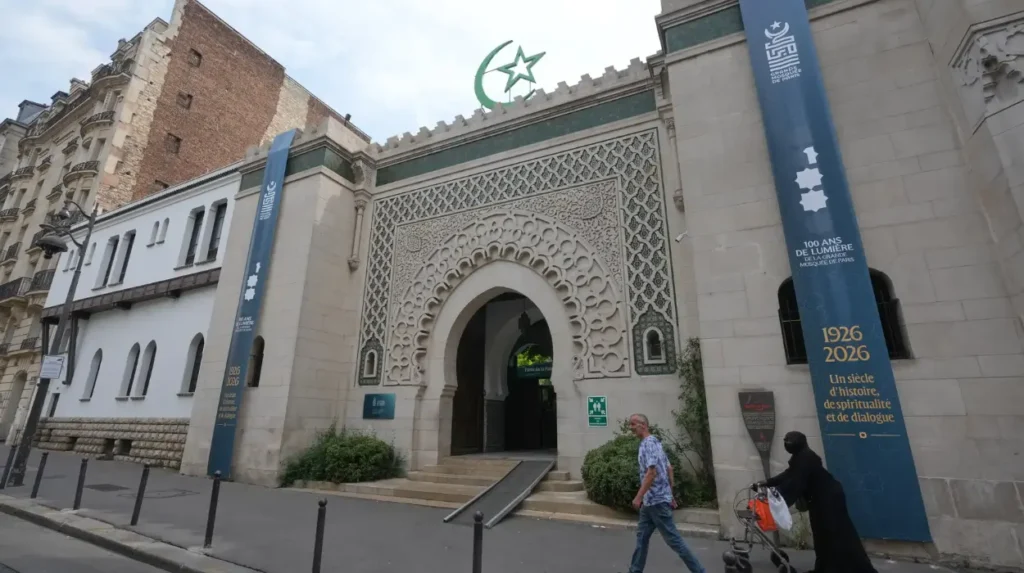
The Paris Grand Mosque 100th anniversary arrives at a moment when France’s relationship with Islam, its colonial past and its secular present is under intense scrutiny. Built in 1926 as a tribute to Muslim soldiers from French colonies who fought and died for France during World War I, the Grand Mosque of Paris now stands as a layered symbol: of gratitude and sacrifice, of religious presence in a secular republic, and of the fragile but vital project of interfaith dialogue in an era of polarization. As banners around the building declare, it is celebrating
“100 years of light, a century of history, spirituality and dialogue,”
a formula that captures both its origins and its aspirations.
A Monument Born from War and Empire
Without going back to the historical background surrounding the building of this mosque, it is impossible to understand the centenary of the Paris Grand Mosque. During the First World War, many soldiers who hailed from French colonial possessions in North Africa, West Africa and elsewhere battled on the European fronts under the French flag. They proved themselves indispensable, paying a high price in casualties. After the war, in the course of a general commemoration of the deceased, the French government sanctioned the erection of a large mosque in the capital as an expression of gratitude for the service rendered by their Muslim soldiers and subjects. The Grand Mosque of Paris was inaugurated in 1926 in the Latin Quarter, close to the Jardin des Plantes.
Not only was it meant to serve as a place of prayer, but also as an architectural statement. With its Moorish-style architecture, courtyard and lavishly decorated interior, this edifice bore witness to the undeniable presence of Islam at the heart of Paris through its 33-meter minaret.
From the outset, the institution embodied the contradictions of the colonial moment. On one level, it was a “thank you” to the Muslim soldiers who had shed blood for France. On another, it was a carefully managed, state-sanctioned representation of Islam, filtered through the politics of empire. That duality continues to shape how the mosque is perceived today.
Continuity and Change Under the Minaret
One hundred years on, much has changed around the minaret, but its symbolic weight has only grown. Over the decades, the Grand Mosque of Paris evolved from a colonial-era institution into one of the central Sunni religious authorities in France. It has played a core role in organizing worship, providing theological guidance, training imams and participating in official dialogues with the state on questions ranging from religious education to the status of Islam under French secularism.
In the context of the centenary celebration, it became apparent how the present-day establishment of the mosque consciously rooted itself in the past. The memory of the mosque’s founding father, its first rector and the main initiator of its creation, Si Kaddour Benghabrit, was formally celebrated with the award of a posthumous medal “Builders of France’s mosques”. By doing this, the organization wanted to remind its public that it had not just appeared out of thin air, but rather that it had been built on the sacrifice of colonial soldiers and the efforts of those leaders who were willing to give Islam its dignity in Paris. Key here is the figure of the current rector of the mosque, Chems-eddine Hafiz, who has become one of the most prominent figures of French Islam.
“A Grateful France and a Fraternal Islam”
In his centenary address, Hafiz invoked the enduring promise embodied in the stones and the minaret of the Grand Mosque. He stressed that under this minaret, which has watched over Paris for a century, the building remembers a pledge made long ago between France and its Muslim soldiers and citizens. In his own words,
“the stone remembers a promise: that of a grateful France and a fraternal Islam that one day chose to hold out their hands to each other”
– Chems‑eddine Hafiz.
This statement is politically loaded. First of all, by using the term “grateful France,” he acknowledges the validity of the claims of Muslim people to be recognized and respected because of their historic sacrifices. By mentioning the idea of a “fraternal Islam offering its hand,” he presents the image of the mosque as a loyal and willing partner to join the republic in its endeavor. By presenting the image of France and Islam offering their hands to each other, he confronts the story of the irreconcilability between France and Islam. In his choice of words, Hafiz reveals his effort to present a certain version of “France’s Islam,” which would have nothing to do with the imported ideologies but could coexist with the republican ideology.
A Ceremony of Faith, State and Society
The event of the Paris Grand Mosque centennial celebration was arranged in order to convey this same idea of common heritage and dialogue. The list of guests included prominent officials representing the French government and local authorities – the interior minister in charge of matters of religion, government officials, prefect of Paris police, local officials, among others. These people symbolized the institutional identity of the mosque as an interlocutor in relations with the French public administration. Besides politicians and government officials, there were ambassadors and representatives of other religious communities, which highlighted the interfaith aspect pursued by the organizers of the celebration. This was not just another ritual celebrating an important date within the Muslim community but rather a civic event, an integral part of French public life.
Symbolic gestures punctuated the ceremony. An olive tree was planted within the mosque’s grounds, described as a symbol of peace for generations to come. The choice of an olive tree – a motif common to Mediterranean landscapes and religious traditions – carries connotations of continuity, rootedness and reconciliation. It suggests that the institution sees itself as nurturing a long-term project of coexistence, not just managing immediate tensions.
Interfaith Dialogue in the Shadow of Violence
Certainly the most memorable gesture of interfaith outreach in the course of the centennial was the commemoration of the life of Father Jacques Hamel, the Catholic priest killed in his own church by members of a group that considered themselves part of the so-called Islamic State. As part of the centennial ceremonies, the management of the Grand Mosque chose to remember him and invite his sister Roseline as a guest, transforming this episode in the history of religious violence in France into an act of unity. It is against this background that the rector’s words were intended to reverse the story of this event told by those who seek to make it divisive. By including the memorial of Father Hamel in its ceremony, the mosque showed its awareness that the suffering of Catholics caused by religious extremism is also of interest to Muslims.
The decision to embed this homage within the flow of the anniversary, rather than treating it as a separate episode, reinforces the idea that interfaith dialogue is not an optional extra but part of the mosque’s identity. It further answers a moral and political imperative: to show, concretely, that Muslims and Christians in France can share grief and honor each other’s martyrs.
A Century of Dialogue in a Time of Polarization
Yet the celebratory tone of the Paris Grand Mosque 100th anniversary cannot fully conceal the anxieties of the present. In interviews around the centenary, Chems‑eddine Hafiz acknowledged that he is deeply worried about the current climate. He pointed to conflicts in the Middle East that reverberate within France, importing grievances and fueling polarization between communities. He also referred to the “polarizing campaign” ahead of next year’s presidential election, where questions of identity, immigration and Islam are likely to feature prominently.
Hafiz’s implicit warning is that the promise remembered by the stone – that of mutual recognition between France and Islam – is not guaranteed. Political forces that gain support by stigmatizing Muslims or portraying Islam as inherently incompatible with the Republic threaten to undo the delicate balance the mosque has worked to maintain. In his public stance, he has consistently argued that Islam in France can be both devout and loyal to republican values, but he knows that this message competes with louder, more sensational narratives.
By stressing dialogue and fraternity during the centenary, the mosque positions itself as a counterweight to these divisive currents. Its leadership is effectively saying that the way to honor the sacrifice of colonial Muslim soldiers and the century‑long presence of Islam in Paris is not through suspicion and exclusion, but through patient, institutional and personal engagement across religious and political lines.
Colonial Memory and Contemporary Equality
The anniversary raises further questions as to how France handles its colonial history and the people descended from colonial soldiers fighting for the French. As a symbol of gratitude, the mosque was erected; however, a hundred years later, French nationals from North Africa, West Africa, and elsewhere remain discriminated against and marginalized. In this respect, the celebrations acquire another dimension of complexity.
While the institution may feel proud of being recognized as a symbol of gratitude towards the contribution of colonial soldiers to the country, the reality outside the building suggests that a stone recognition does not necessarily equal social equality. Thus, the story of the mosque becomes both motivating and disturbing: it is motivating due to the fact that France made an attempt to acknowledge the contribution of the Muslims; at the same time, it is disturbing due to the fact that one may doubt whether France managed to fulfill its promise.
Islam, Laïcité and the French Debate
At the heart of the anniversary lies the complex relationship between Islam and laïcité, France’s rigid model of state secularism. The Grand Mosque, as one of the country’s main Islamic institutions, sits at the junction of religious practice and public regulation. Its leadership must navigate strict legal frameworks on religious neutrality while defending the right of Muslims to organize and worship freely.
During the last ten years, discussions about Islamic clothing, financing of mosques, influence from abroad, radicalization and even “separatism” have brought the Grand Mosque numerous times into the limelight. Given this situation, the centenary of the Grand Mosque should be regarded as a religious event and a political event at the same time. On one hand, it is a chance for the Grand Mosque to once again restate its dedication to the Republic and call upon the Republic to keep its promises of equality.
On the other hand, by calling for dialogue, gratitude and fraternity, Hafiz and others try to give a definition of the place of Islam in the French secular society without losing its religious nature. The strategy chosen by them is cautious and pragmatic, because any mistakes may be used against them in the hostile atmosphere of the public sphere.
A Landmark at a Crossroads
As the Paris Grand Mosque 100th anniversary banners proclaim their “century of history, spirituality and dialogue,” the institution stands at a crossroads. It is both a sanctuary and a symbol, both a local house of worship and a national emblem of Islam in France. Its minaret, which has watched over Paris for a hundred years, now watches over a society wrestling with identity, memory and fear.
The narratives crafted around the centenary – of colonial sacrifice, interfaith solidarity, secular cooperation and political concern – show that the mosque is keenly aware of its responsibilities. It seeks to honor its past while shaping a future where Islam is neither exoticized nor demonized, but recognized as an integral part of the French story.