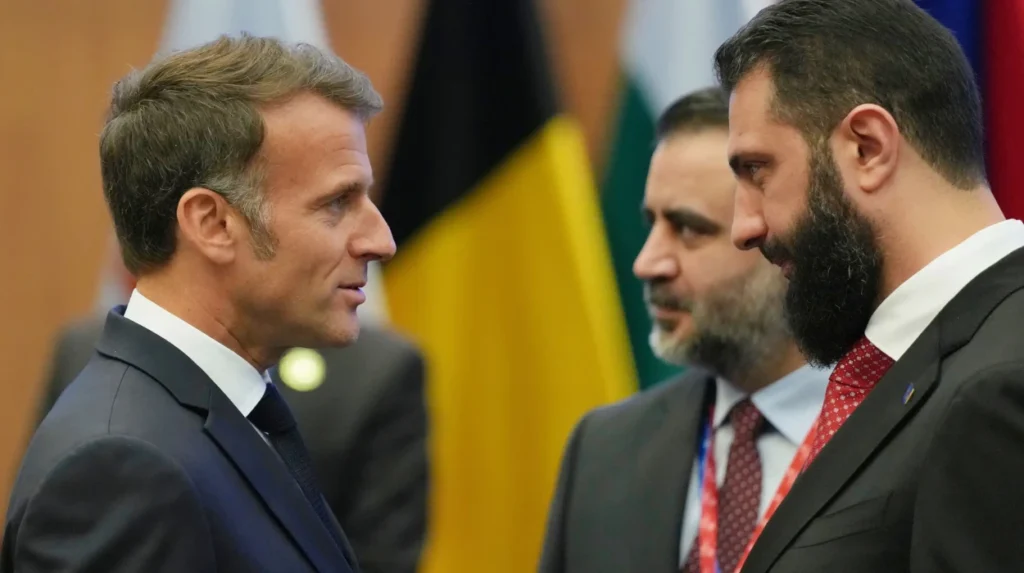
French President Emmanuel Macron’s visit to Syria is more than a diplomatic footnote. It marks a sharp shift in how Europe is approaching post-war Syria, with Paris stepping into a space that many Western capitals have avoided for years.
This mission takes place during a period of great uncertainty within Syria, which is still very weak, unstable, and damaged through the conflict which had a great impact on the state institutions, economy, and society of the country. The presence of President Macron in Damascus as the first Western European leader to visit Syria since its new government took office adds particular importance to the trip. This is not only a matter of image but also a matter of strategy, as France wants to send a message to Syria that engagement, not isolation, could now become the main tool for influence.
A Visit With Diplomatic Weight
The most important point about Macron’s visit is its symbolic nature. Syria had become isolated on the diplomatic front for a number of years, especially since the outbreak of the civil war. By being the first Western European leader to visit Damascus following the demise of Assad, Macron has succeeded in breaking a powerful taboo. In itself, that would make his visit historic. But there is more than just symbolism at play here. France is not making an appearance in Damascus merely to exchange pleasantries. Macron came with a business delegation that included delegates from some of the major French corporations, thus showing that reconstruction and trade have entered into the picture.
The timing also matters. Macron’s trip comes after months of shifting diplomatic signals between Paris and Damascus. France had already hosted Syria’s interim president, Ahmed al-Sharaa, in Paris in May 2025, a move that opened the door to more direct dialogue. That earlier outreach created a foundation for this visit and suggested that France was willing to take a lead role in testing how far engagement could go.
Why France Is Moving First
France has traditionally positioned itself as one of the more active European powers on Middle Eastern diplomacy, and in Syria it has often tried to balance moral language with hard geopolitical calculation. Macron’s latest move reflects that pattern. Paris appears to be betting that limited but direct engagement with Syria’s new leadership can create leverage on security, governance, and reconstruction.
This particular step becomes essential due to the fact that the Western countries are still cautious about the new Syrian leadership. The history of Ahmed al-Sharaa as the head of Hayat Tahrir al-Sham, which used to be associated with Al-Qaeda, makes him very controversial both in Europe and America. Human rights problems are also far from being solved yet – there are concerns related to the attitude towards women, minorities, and any forms of political dissent. Thus, for Macron, the trip to Damascus becomes a risk as well as an opportunity. However, France obviously believes that staying aside is not going to bring any better results. The first mover advantage will help Macron set the agenda ahead of his Western counterparts.
The Security Dimension
Security will surely be one of the most sensitive topics behind this visit. Syria is recovering from a terrible civil war, but this country is still vulnerable to instability, violence, and other negative consequences of years of division. The explosion reports near Macron’s hotel in Damascus proved this point. Though diplomacy is being restored, the security situation in the country is still unstable. The explosions near the Four Seasons Hotel, where Macron stayed, were a vivid demonstration of the fact that this country is still far from stability. The French presidency assured that Macron had not been under threat, but his arrival to the country highlighted the discrepancy between official diplomatic ritual and security conditions.
For the Syrian leadership, improving security ties with France could help build confidence among investors and foreign governments. For Macron, security guarantees are essential if France is to justify deeper engagement with a government that still has to prove it can control the country and protect political pluralism.
Reconstruction and Legitimacy
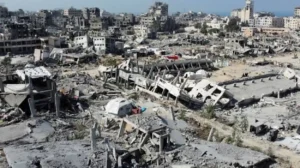
Reconstruction may well be the most significant practical problem at stake. The Syrian war has left houses, roads, hospitals, schools, factories, and utilities severely damaged in much of the country. Hundreds of thousands died in the conflict and millions have been displaced inside and outside of Syria. These numbers are not simply the context; they represent the very reason that the country will now require political and economic assistance from other nations. This visit implies that France believes that reconstruction is a matter of both humanitarian concern and diplomacy. The country will have to build relations with other countries willing to invest in its infrastructure and technology. In turn, France will be able to use this dependency to its own political advantage.
The new Syrian leadership understands this clearly. By welcoming Macron, it is trying to show that it is capable of dealing with major Western powers and is worthy of international recognition. This is as much about legitimacy as it is about economics. A visit by a Western leader can help project the image of a government that is no longer a pariah but a partner-in-waiting.
Macron’s Message
Macron framed the visit in deliberately broad and conciliatory terms. He said,
“I have come to express France’s commitment to the Syrian people. For a sovereign Syria, united in its diversity and at peace with its neighbours”,
Emmanuel Macron said. That formulation is important because it combines humanitarian language with political conditions. He is not offering unconditional support; he is defining the kind of Syria France wants to see.
Je viens dire l’engagement de la France auprès du peuple syrien. Pour une Syrie souveraine, unie dans sa pluralité et en paix avec ses voisins. Ensemble, ouvrons une nouvelle page de stabilité et de paix.
— Emmanuel Macron (@EmmanuelMacron) July 6, 2026
He also said,
“Together, let us open a new chapter of stability and peace”,
Emmanuel Macron said. The phrase suggests optimism, but it also implies that the burden is now on Syria’s leadership to deliver the stability that would justify closer ties. Macron’s messaging is careful: warm enough to support engagement, but firm enough to preserve leverage.
That balance is central to France’s strategy. Macron is not presenting the visit as a full endorsement of Syria’s new rulers. Instead, he is using diplomacy to encourage a more inclusive and sovereign political order. His statements show that France is willing to engage, but only within a framework that includes peace, unity, and regional responsibility.
What Syria Wants
For Syria, the visit presents an important chance to achieve its objectives. According to statements made by the Syrian presidency, the talks are aimed at improving their relationship and addressing topics of common interests. While such broad statements give flexibility to the agenda for the government, the main priorities are evident. They include international recognition, sanctions removal, assistance with reconstruction, and opening up economically. The Syrian leadership understands the importance of such gestures. Indeed, when a leader of the Western state comes to Damascus, it signals to investors, neighboring countries, and suspicious states that Syria is no longer completely isolated.
For that reason, the visit is likely to be interpreted in Damascus as a diplomatic win, even if it does not produce immediate economic breakthroughs. The optics alone are valuable, especially when paired with the presence of French business figures and the possibility of future cooperation.
Wider Western Reaction
Macron’s visit could put pressure on other Western governments to clarify their own Syria policy. Some may welcome cautious engagement, while others will worry that diplomacy is moving too quickly ahead of accountability. The central concern remains whether Syria’s new leadership can genuinely govern in a pluralistic and rights-respecting way.
The point becomes highly relevant considering that the West is not confronting an impartial process of transition. The West is confronting a regime headed by individuals with militant experience, a nation devastated by the war, and a population that is highly fragmented by the ongoing conflict. In such an environment, symbolic recognition can carry much more than just its immediate impact. If France manages to secure pledges in terms of security and political participation, other nations might join later. If not, Macron’s visit could become seen as the first gamble made by the nation in the process of transition.
A Turning Point, Not an End Point
Macron’s visit to Syria must be understood as a starting point, not an end point. It does not resolve the issue of the future of Syria, nor does it remove any of the doubts about its transition process. However, it clearly shows that at least one of the leading Western countries recognizes that there is a need for direct engagement due to Syria’s new situation. And that is why this visit is so important. In fact, France is experimenting with a new kind of diplomacy that combines respect for sovereignty, push for inclusiveness, and readiness to engage in rebuilding efforts. The success of this approach will become clear only if the leaders of Syria react accordingly in the coming months. In any case, this visit represents a major sign that the post-war Middle East enters a new stage.