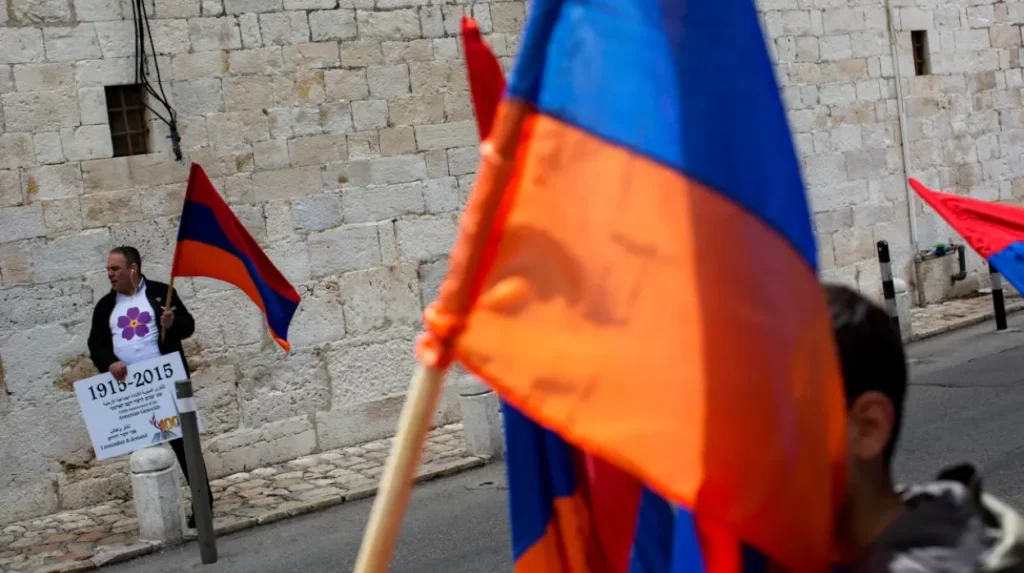
A big step has been taken by Israel towards recognition of the atrocities committed against the Armenian people during World War I by the Ottoman Empire as an act of genocide, which is definitely a major political and moral development in terms of the Israeli stand on the matter. This comes at a time when the relationship between the two countries – Israel and Turkey – has become rather strained, making this decision significant both historically and diplomatically. Although it has not been passed into law, the unanimous support from the Cabinet of Ministers is definitely a rare occurrence.
For years, Israel had avoided using the genocide label at the state level, despite periodic remarks from politicians and repeated pressure from Armenian advocates and historians. The latest decision therefore stands out not only because of what it says about the past, but also because of what it suggests about the present: a sharper Israeli readiness to challenge Turkey publicly and to align itself more openly with global recognition of the Armenian tragedy.
What the Cabinet approved
In light of the news reports, it can be understood that the Cabinet of Israel adopted a resolution to recognize the mass killings of the Armenians during World War I as a genocide. This decision has been put forward by the country’s Foreign Minister, Gideon Sa’ar, who discussed the issue on moral and historical grounds. However, its legal status is yet to be endorsed by the Knesset.
The difference is significant. The endorsement by the cabinet is a powerful message from the executive, but the endorsement by the parliament will elevate the question to that of an official state recognition of something. This makes the present period particularly crucial, since Israel has reached a point, but hasn’t finished yet the legislative procedure. From the practical point of view, it means that there is still place for negotiations.
Historical weight of 1915
The events in question refer to the mass killings of Armenians under the collapsing Ottoman Empire around 1915, during the upheaval of World War I. Historians and genocide scholars commonly estimate that up to 1.5 million Armenians were killed. The Armenian genocide is widely described as the first genocide of the 20th century, a label that gives the issue broader symbolic importance beyond the Armenian case alone.
This historical background plays an important role in understanding why the controversy over recognition has lasted for more than a hundred years. For Armenians, the problem does not simply concern history, but also involves issues of dignity and international recognition. To those opposed to recognition, including the Turkish government, the designation bears a political and legal implication that means responsibility for the atrocity rather than merely the tragedy of war. The numbers used to illustrate the dispute in the report are quite telling, one source quoting a casualty estimate between 664,000 and 1.2 million by the U.S. Holocaust Memorial Museum, and other historians citing the number of 1.5 million. While the actual number has been discussed for decades, the general agreement in the field of genocide studies is that this killing was genocide.
Why Israel’s move matters
The decision made by Israel holds significance in more ways than those which are academic in nature. The issue of recognition has been avoided by Israel over the years due to its close ties with Turkey as well as the relatively new but important relationship with Azerbaijan. Thus, the decision to recognize the Armenian genocide is a clear departure from the long-term policy formulated by Israel based on regional diplomacy. This is why the vote cast in the Cabinet holds importance from both historical and geopolitical perspectives. This shows that Israel is ready to bear the costs of recognition despite its problems with Turkey.
The recognition also places Israel in closer alignment with other states that have formally acknowledged the genocide, including the United States, France, Germany, and Italy. This is important because global recognition has become an arena in which nations signal their stance on human rights, historical accountability, and diplomatic principle. Israel’s move adds another major state to that list, should the proposal complete the parliamentary process.
Israel’s evolving stance
But there were many complexities within Israel’s experience regarding the question. The country has not officially acknowledged the events at any point in its past despite the use of the word genocide by some Israeli politicians or officials. According to AP, the Knesset had never recognized the Armenian genocide officially via a vote, which makes the Cabinet’s decision quite an important institutional event. In other words, such background explains the reason why this information is presented as a breakthrough in Israel’s policy. This breakthrough is not only about terminology. It is also about a change in the approach Israel uses when trying to balance its moral considerations and diplomatic considerations. The latter have prevailed for many years before the former became powerful enough.
There is also a symbolic layer to Israel’s position. The Armenian genocide has often been discussed in relation to the Holocaust as one of the defining atrocities of the modern era. That comparison has historically made Israeli caution especially notable. A move toward official recognition therefore carries emotional and ethical resonance inside and outside Israel.
Turkey’s likely reaction
Turkey’s stance is clear and longstanding: it rejects the genocide label. Turkish officials have historically argued that the death toll was inflated and that Armenians died amid civil war, internal unrest, and the collapse of imperial order. From Ankara’s perspective, recognition by other countries is not simply a matter of historical interpretation; it is an attack on Turkish identity, legitimacy, and diplomatic standing.
This is precisely the reason why the actions of the Israelis will most definitely lead to increased tensions. Turkey has shown a tendency towards strong reactions when states decide to acknowledge the Armenian Genocide and the actions of the Israelis will have particular significance in light of the strained relations between the two countries. The information provided implies that the timing of this move has a clear meaning of being a message directed at Turkey – a message which is not really subtle. This does not mean that Turkey is going to take any immediate action against Israel but the symbolism of the act itself will definitely carry weight.
Sa’ar’s moral framing
A central feature of the story is the role of Foreign Minister Gideon Sa’ar, who reportedly advanced the proposal. His framing matters because it positions the issue not just as foreign policy but as a moral duty. That kind of language is important in diplomatic disputes, because it shifts the debate from political convenience to ethical responsibility.
Sa’ar’s concern for moral memory implies that the recognition was intended to convey something greater than just a pragmatic response to Turkey. However, the political nature of the recognition makes it impossible to make a distinction between the two aspects of the move. The two are frequently intertwined in foreign politics and seem not to be an exception here. Therefore, the suggestion may be viewed from two perspectives simultaneously. First, it is a message concerning historical accuracy, and secondly, it is a message within the regional struggle with Turkey.
The broader international context
International recognition of the Armenian genocide has grown over time, but it remains uneven. Some governments have formally recognized it, while others continue to avoid the term because of diplomatic ties with Turkey or discomfort with intervening in historical disputes. The issue has therefore become a test of whether states are willing to prioritize historical judgment over current strategic interests.
Israel’s move fits into this broader pattern. When major states recognize the genocide, they are not only acknowledging a historical event. They are also making a statement about the responsibility of governments to name mass atrocity clearly, even when that naming carries political cost. For Armenians, each recognition matters because it adds legitimacy to a long struggle for acknowledgment.
The U.S. recognition in 2021 during the presidency of Joe Biden has been among the most significant recent instances of this tendency. This recognition contributed to the normalization of the usage of this term in the language of states. Formal recognition by Israel will consolidate this tendency and can lead other governments to reconsider their position. The first step to be made after the cabinet decision is the approval of the parliament. Prior to that, the cabinet decision will stay at the level of an important political event but not the end of the process.
The timing of that vote will matter. If the issue moves quickly, the signal to Turkey and to international observers will be unambiguous. If it stalls, the moment may still be remembered as a symbolic breakthrough, but one that falls short of full state recognition. Either way, the Cabinet’s approval has already changed the tone of the discussion.
For Israel, the decision also opens a broader conversation about how history is used in statecraft. Governments often prefer selective memory, especially when diplomatic interests are at stake. By moving toward recognition now, Israel is suggesting that some historical truths are important enough to outweigh political caution.