The moment when press freedom around the world is at its lowest in the Middle East, Israel has deported the French journalist Alice Froussard from Ben Gurion Airport after she reported about “genocide in Gaza,” an incident that Israeli human rights groups described as happening within their country. The deportation of this Western journalist happened on Wednesday night, June 10, 2026, as this is the strongest action taken by Israel against Western journalists in several months amid the “war” against the coverage of its Gaza strike, which has reached 70,103 strikes.
Froussard, who is an experienced reporter in the Israeli-Palestinian conflict, having spent six years in the area as an anchor working in Jerusalem and Ramallah for the public service broadcasters Radio France and Radio France Internationale (RFI) was detained only a few minutes after her arrival at around 1400 hours. She was obliged to spend the night at Ben Gurion airport after which she was deported back to Paris on June 11, 2026. According to the official statement from RFI, the reporter had the proper travel papers and had applied for the press visa.
The Deportation: Timeline, Justification, and Israel’s Official Position
Israel’s Minister for Diaspora Affairs and Combating Antisemitism Amichai Chikli announced the deportation through an X post on Thursday, June 11, 2026, framing the decision as a necessary security measure against a journalist accused of supporting Hamas. Chikli wrote:
“I am pleased to announce that at this very moment, Alice Froussard, a French journalist who supports Hamas, and who claims that the October 7 massacre must be viewed ‘in context,’ is making her way from Ben Gurion Airport back to Paris.”
I am pleased to announce that at this very moment, Alice Froussard, a French journalist who supports Hamas, and who claims that the October 7 massacre must be viewed “in context,” is making her way from Ben Gurion Airport back to Paris.
— עמיחי שיקלי – Amichai Chikli (@AmichaiChikli) June 11, 2026
Like Linda Sarsour before her, she too has…
The minister’s justification rested on three specific accusations against Froussard. Israeli authorities cited social media posts where the journalist described Israeli laws as “draconian,” accused Israel of operating a “dual legal system amounting to apartheid,” and stated that the Oct. 7 Hamas-led attack should be viewed “in context” of broader Israeli-Palestinian dynamics. Chikli’s ministry further claimed that Froussard “sought to return and work in Israel on a permanent basis,” though the journalist had arrived for routine reporting work on her established beat covering the conflict.
The official Ministry statement reinforced Chikli’s position:
“Froussard sought to return and work in Israel on a permanent basis and was deported this morning and put on a flight back to France on the ministry’s recommendation.”
Israeli authorities refused to provide RFI with any written justification for the decision, leaving the broadcaster with only Chikli’s social media post as official documentation of the expulsion grounds.
RFI’s Condemnation: “An Obstacle to Press Freedom”
Radio France Internationale launched a fierce condemnation of the deportation, framing it as part of Israel’s systematic obstruction of independent media access to Gaza and the occupied territories. RFI’s management issued a statement declaring:
“RFI journalist Alice Froussard was denied entry into Israeli territory (…) even though she had the required travel authorization and had duly applied for a press visa to work in the West Bank.”
The broadcaster emphasized the lack of official transparency:
“Israeli authorities have not provided RFI with any justification for this decision.”
RFI’s leadership then delivered their most damning assessment:
“RFI’s management fully supports Alice Froussard and protests against this expulsion, which constitutes an obstruction of press freedom and comes at a time when journalists are facing increasing difficulties in covering current events in the region.”
The statement explicitly characterized the deportation as “an obstacle to press freedom,” echoing concerns from international media organizations that have been challenging Israel’s Gaza access ban since October 2023.
France’s Diplomatic Response and the Smotrich Reciprocity Crisis
According to officials, the French Embassy in Israel was highly dissatisfied with the deportation process from Israel. This is because some members of the French Embassy in Israel were outraged over the deportation of Froussard. It is important to note that the diplomatic timing became very sensitive since it occurred at a time when the Israeli Finance Minister, Bezalel Smotrich, was barred from entering France just two days ago, on Tuesday, June 9, 2026.
The French Minister of Foreign Affairs, Jean-Noël Barrot, was responsible for organizing the Smotrich ban as one of several coordinated actions with countries such as Britain, Canada, Australia, New Zealand, and Norway against individuals linked to acts of violence committed in the West Bank. The reason for the banning of Smotrich by the French government was his stance regarding the occupied territory, which included calling for the annexation of the West Bank territory, setting up more settlements, and “recolonization of Gaza.” The government of France also refused entry to Israeli security minister, Ben-Gvir, in May 2026.
Six Years on the Front Line: Froussard’s Professional Legacy
Alice Froussard is one of the most seasoned Western reporters reporting on the Israel-Palestine conflict, having spent six years working and living in Jerusalem and Ramallah while working with various French news organizations such as France Culture, Le Figaro, TV5 Monde, and Mediapart. Alice Froussard’s expulsion deprives the area of a reporter who gained extensive knowledge and built connections within Palestinian communities, thus making her one of the most credible Western sources for the human side of the story.
In addition to being a major figure in the international broadcast reporting from the Middle East in connection with the French public broadcaster, Froussard had earned her credentials in that capacity through her emphasis on the Palestinian side of the conflict and the humanitarian impact of the Israeli military’s actions. Fellow journalists working in collaboration with her noted that she was highly diligent when checking her facts and would report multiple perspectives; however, the Israeli government viewed her reportage on the attacks of October 7 as pro-Hamas propaganda.
Israel’s Gaza Journalist Ban: Two Years of Systematic Media Suppression
The Froussard deportation emerges within Israel’s broader two-year pattern of restricting independent press access to Gaza. Israel has prohibited the entry of foreign reporters into Gaza since October 7, 2023, unless they are under Israeli military escort, creating what the Associated Press described in April 2026 as a situation where
“the world’s been left with few independent witnesses and many questions.”
The Committee to Protect Journalists (CPJ) has challenged this ban in Israeli Supreme Court, arguing it violates international press freedom standards.
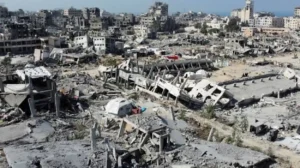
This information embargo has come at great human costs. According to CPJ research, Israel is said to be responsible for killing 237 journalists and media staff, out of which 197 were Palestinian media killed in Gaza. As per the UN, 247 journalists died in Gaza after Oct. 7, 2023, making it the Deadliest conflict for journalists, which CPJ started monitoring from 1992. Based on figures from the Gaza health ministry, 70,103 individuals lost their lives in this campaign, mostly civilians, while according to Israel, they are attacking Hamas militants.
The Foreign Press Association (FPA) has called Israel’s ban “draconian,” awaiting a Supreme Court ruling on a petition submitted in 2024 that has been postponed multiple times. Major media organizations including AFP, AP, BBC World Service, and Reuters issued a joint statement in July 2024 criticizing the ban, with AP urging Israel to lift restrictions preventing independent Gaza entry as recently as April 30, 2026.
French Government’s Gaza Press Access Advocacy
French Foreign Minister Jean-Noël Barrot has made repeated public appeals for independent press access to Gaza, stating on July 21, 2025:
“I ask that the free and independent press be allowed to access Gaza to show what is happening there and to bear witness.”
The French government officially noted:
“Since October 7, Israel has prohibited access to the Gaza Strip for all international journalists.”
Barrot’s government emphasized the precarious situation of Palestinian freelancers:
“In this context, the work of our Palestinian freelancers is crucial to informing the world, but their lives are in danger, so we urge the Israeli authorities to allow them to evacuate immediately along with their families.”
France’s diplomatic pressure for press access is indicative of Europe’s concerns regarding Israel’s information embargo, where the FPA stated that Israel’s Supreme Court had declared in 2024 that such restrictions were permissible due to continued security concerns, although the Court has continuously pressed the government to justify the embargo over two years into the war.
Legal Complaint Filed Against Israel by French Journalist Unions
Legal actions taken by the French journalist unions against Israel are the most important judicial actions ever mounted against Israeli censorship of its media laws. On Tuesday, November 28, 2025, IFJ (International Federation of Journalists) and the French Journalist Union presented a petition against Israel’s government at Paris Anti-Terror Prosecutor’s office for hindering the right to information in Gaza and the West Bank. The petition was based on Israel’s practices that include harassment, restriction from entering Gaza, physical attack on French journalists, and denial of entry to Gaza.
The filing of this case follows reports by French journalist trade unions regarding multiple acts of intimidation and denied access, thus making the situation worthy of investigation in line with international media freedom laws. According to the IFJ, such an approach by the Israeli government goes against democratic values and ideals because journalism requires a safe environment that is not possible in light of threats to journalists’ lives.
The “Gaza Genocide” Terminology and Media Responsibility
The news headline references “Gaza genocide” terminology that reflects a significant shift in human rights discourse. Human rights groups inside Israel are accusing their own government of committing genocide in Gaza, marking the first time such accusations emerged from within Israeli society. Israel strongly rejects the accusation, stating:
“We strongly reject the accusation. It is baseless. There is no intent.”
FRANCE 24 documented these rights groups’ accusations in July 28, 2025 coverage, while the broadcaster’s media show “Scoop” examined the “cost of words” in October 2025, discussing how journalists have a responsibility to choose terminology carefully when reporting on Gaza. The Froussard deportation suggests that Israeli authorities view contextual analysis of the conflict’s origins as supporting Hamas, even when journalists frame their reporting within broader historical and political frameworks.