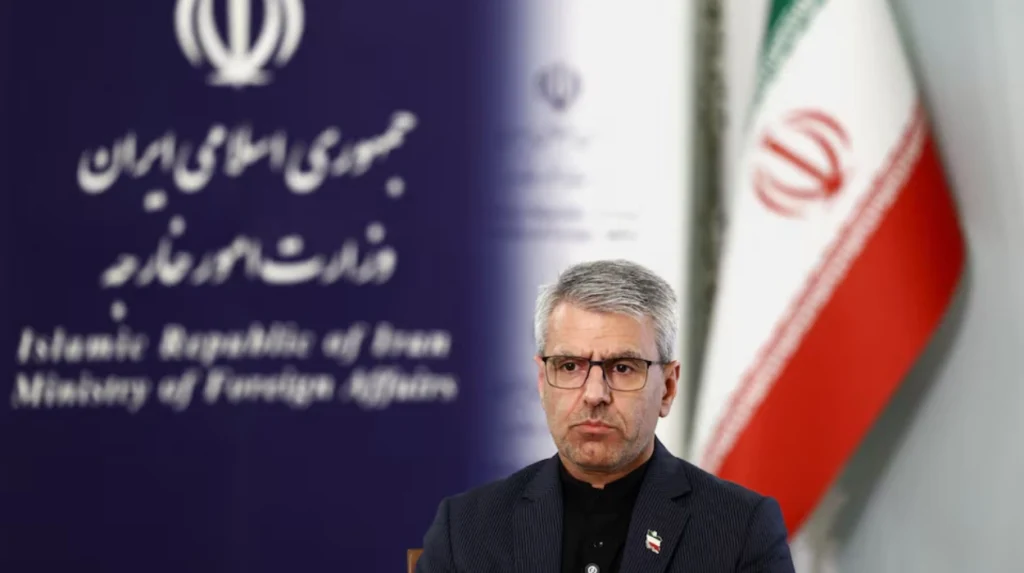
Iran has barred two French Embassy employees involved in a diplomatic confrontation in Tehran from returning to the country, escalating an already serious dispute between the two governments. The decision, announced on Monday by Iranian Foreign Ministry spokesman Esmaeil Baghaei, follows the employees’ detention by Iranian security personnel last month and competing accusations over diplomatic conduct, interference in internal affairs and violations of the Vienna Convention.
This act does not signify any break in diplomatic ties but it certainly signifies the beginning of a very bad relationship between Tehran and Paris. Through its act of barring entry of the two people into Iran, Tehran is actually making the point that these people are unsuitable to carry out diplomatic duties in the country. France on its part views the incident as an act of intimidation that is contrary to international laws. This row reveals the growing difference between the two nations in regard to the conduct of diplomatic duties in Iran. While Tehran believes that diplomats cannot misuse diplomatic immunity in Iran, Paris views its diplomatic staff as acting within their embassy’s mandate.
Iran bars French embassy employees
Announcing the decision on Monday, Baghaei said the two French employees would not be allowed to return to Iran because they had violated the Vienna Convention on Diplomatic Relations. He accused them of participating in activities connected with support for Iranian civil society and suggested that such conduct exceeded the accepted boundaries of diplomatic work.
“They will not be allowed to return to Iran,”
Baghaei said, according to reports of his remarks. He also argued that the employees’ activities amounted to interference in Iranian internal affairs and were inconsistent with the obligations imposed on diplomats by the Vienna Convention.
Iran has not named the two staff members at issue. Moreover, it has not provided any details as to the nature of their contacts which according to the Islamic Republic have broken the terms of the Convention. These factors will be likely central to the negotiations that will now take place since the French government denies the interpretation of Iran regarding the work of its staff members. This decision was made after the two staff members had already left the territory of Iran. Thus, this step of the Iranian government is a preventive measure rather than an expulsion. Nevertheless, in practice, this step is similar to a statement about the fact that two individuals are not acceptable in the receiving country. According to Article 9 of the Vienna Convention, the receiving country is allowed to inform the sending country that the diplomatic agent is persona non grata. Moreover, the receiving country can inform the sending country that some other member of the mission is not acceptable. It is not obliged to give any explanation.
The July detention in Tehran
The whole affair started with an incident in Tehran that took place last month. According to the reports of the French government, two employees from the French Embassy were arrested by Iranian security officials after a meeting with individuals involved with the work of the embassy. France maintained that the employees have presented their diplomatic passports after identifying themselves but were not released after being interrogated for more than four hours. France also alleged that the personal phones of the employees have been seized from them and that they were not allowed to get in touch with the embassy.
Furthermore, it was also alleged that the French employees have been subjected to physical assault during their detention. France termed the whole matter extremely serious and deliberate. French Foreign Minister Jean-Noël Barrot reported that the employees were kept in a private place and have been treated very inappropriately.
Barrot characterized the episode as an
“extremely serious act of intimidation.”
French officials also described it as a “premeditated” incident and a “flagrant violation” of the Vienna Convention and international law.diplomatie.
According to France, the employees were held for more than four hours without access to their normal means of communication. Paris has argued that the incident was not an ordinary security check or administrative questioning, but an intentional effort to frighten French personnel and restrict the embassy’s activities.
The two employees subsequently returned to France. French officials said they were safe and would continue their duties from outside Iran. Their departure reduced the immediate possibility of another confrontation, but it also created the circumstances for Tehran’s later decision to block their return.
Iran’s competing account
Iran has dismissed the characterization provided by the French government regarding this event. There was no mistreatment of the employees, and the allegation of assault by the security force on one of the employees has been dismissed. The Iranian story is founded on the premise that the two individuals were engaged in activities that extended beyond their diplomatic duties. Iranian officials have especially expressed their concerns regarding foreign attempts to help civil society in Iran.
The security forces of the country have traditionally harbored suspicions regarding any foreign connection with activists, students, cultural personalities, and rights organizations in the past. Baghaei maintained that the activities conducted by the two employees were an act of interference in the internal affairs of Iran. Iranian officials have also accused France of using terminology such as human rights promotion and civil society to engage in political activities in the country. For Iran, this issue goes beyond the fact that these individuals were arrested and interrogated in Iran. It also involves the nature of activities carried out and the purpose behind making such connections with the people of Iran.
The Iranian Foreign Ministry had already summoned the French ambassador in connection with the dispute. Tehran said it wanted to protest what it called the conduct of the two employees and France’s alleged interference in domestic affairs. The summons demonstrated that Iran viewed the matter as a state-to-state dispute rather than an isolated security incident.
Competing interpretations of Vienna Convention
Both parties invoke the Vienna Convention, but in each case, there are different clauses and different understandings of diplomatic relations. The positions of France are based primarily on clauses of the Convention regarding diplomatic privileges and the protection of the communications of the embassy. According to Article 29, the person of a diplomatic agent enjoys inviolability. The diplomatic agent cannot be arrested or detained, and the host State has to protect the person against any attacks on his liberty and dignity. France can refer to Article 27, according to which the communications of a diplomatic mission are inviolable.
Thus, the interception of phone and the inability to contact the embassy are very important points of the French claim. Article 25 provides for the right of the receiving State to supply facilities required for the performance of the functions of the mission. Article 26 generally guarantees the freedom of movement of members of a diplomatic mission, but it is limited in certain cases for national security reasons. The detention, therefore, could be interpreted by Paris as an infringement of the personal guarantees of the employees and the mission’s work. Article 41 of the Convention obliges the diplomatic agents to observe the laws and regulations of the receiving State.
Tehran’s central question is whether the employees were carrying out legitimate diplomatic, cultural or consular activity, or whether they were using their official status to support political networks and influence Iranian society. The Convention does not give either side an automatic victory in that dispute. Much depends on the facts of the employees’ activities, the location and purpose of their meetings, and whether those activities were authorised by the French mission.
Article 3 of the Convention gives diplomatic missions a broad mandate. It includes promoting friendly relations and developing economic, cultural and scientific relations between the sending and receiving states. France can therefore argue that engagement with cultural and social actors is part of ordinary diplomatic work.
Iran’s response is that cultural or social engagement cannot become a cover for political intervention. The dispute reflects a familiar problem in international diplomacy: the same meeting can be viewed by one government as cultural outreach and by another as interference.
France’s likely response
France has already made protests about this matter via diplomacy. France invited the chargé d’affaires of Iran to its territory and criticized the unlawful attacks against French diplomats. The French government claimed that there will be some consequences but the precise actions that might be taken by France are still unknown at the moment. There are probably three aspects that the French government will pay attention to in this case: the alleged physical harm to the employees, the alleged seizure of their phones and the prohibition of entrance to the embassy. These accusations, if true, can be used by France to claim that Iran did not provide the fundamental rights to the employees as it should.
France will try not to let the allegation of Iran define this dispute. France will try to claim that the employees were performing their duties officially and the reason why Iran refused their entrance is their protest about the situation. France may respond by declaring the unacceptable Iranian diplomats, downsizing of the Iranian diplomatic mission in France, summoning the Iranian ambassador or reducing some bilateral programs.
The European Union described the July incident as an
“aggression against two French diplomats.”
Its involvement raises the possibility that the dispute could move beyond the bilateral relationship and become another point of tension between Iran and European governments.
A broader crisis in diplomatic relations
The conflict arises amid the tensions between Iran and Western nations because of the differences on regional security, human rights, freedom of speech and foreign intervention in the affairs of another country. Under these conditions, even a relatively minor conflict between embassies acquires additional value. It is a well-known fact that Iran accuses Western governments of using diplomatic, cultural, and human rights activity as a means of interfering into the internal politics of the country. For their part, Western governments say that any contacts with citizens of Iran are a usual practice for international relationships and cannot be regarded as illegal activities. Another important aspect which should be considered in relation to this case is that diplomatic immunity is not always correctly understood. Diplomatic immunity cannot be used by diplomats in order to act as if they were not subject to any law. Article 41 requires them to obey the laws of the receiving state.
Nevertheless, the receiving state cannot abuse these rules by calling ordinary diplomacy an interference. The receiving state has the right to take the following action if it considers that diplomats violated the Convention: to declare diplomat persona non grata or unacceptable. It looks like this measure was chosen by Iran.
The danger is that the measure could encourage reciprocal action. If France responds by excluding Iranian diplomats, the two countries could enter a cycle of retaliation in which embassy staffing, consular services and cultural relations are progressively reduced.
What happens next
The immediate consequence of this situation will undoubtedly be the expulsion of the two employees who work for the French consulate. France will probably choose other people to take their place or will give these tasks to workers working from out of Iran. Tehran might restrict more the contact and the movement of these employees. The big problem here is whether or not the two countries will find an agreement concerning the account of the incident of last July. The Iranians have said that nothing bad happened to the two employees but the French government accuses the Iranian security service to have detained and physically beaten the two workers.
None of the two governments is willing to back down from its main claim. This matter will probably be discussed in upcoming diplomatic negotiations as far as the nature of the task done by these two workers is concerned and the violation of their diplomatic privileges by Iranian officials. This diplomatic quarrel can stay at its current level if there will not be more expulsions of diplomats. It can however escalate very quickly if one of the sides comes up with new accusations or retaliatory actions.