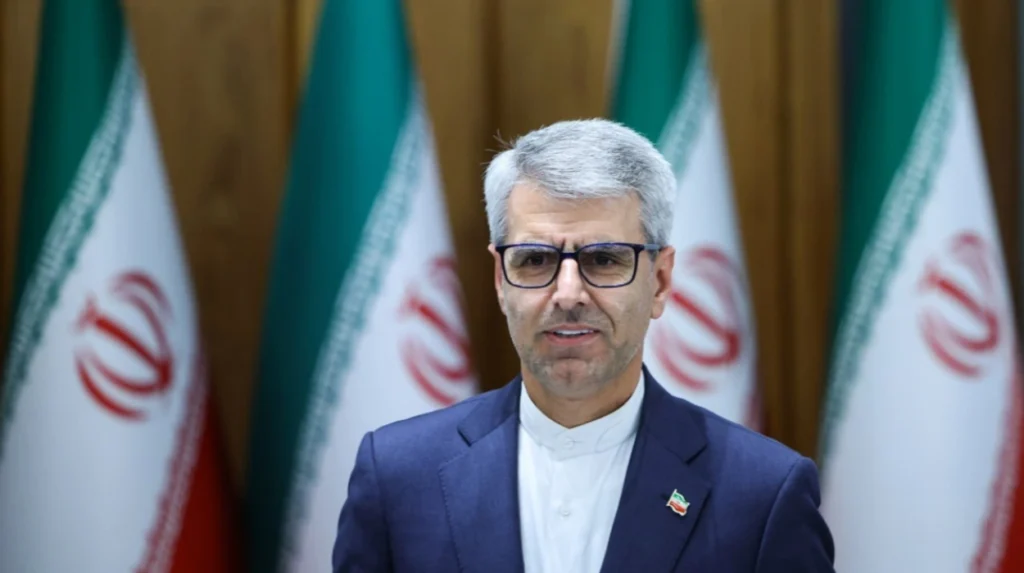
The latest rupture between Iran and France is being fought less with rhetoric than with legal language, as both capitals invoke the 1961 Vienna Convention on Diplomatic Relations to justify reciprocal expulsions. At the heart of the crisis is a July incident in Tehran that Paris describes as a deliberate assault on its diplomats, and an Iranian response that frames French embassy staff as violators of diplomatic norms. Against this backdrop, Iran’s Foreign Ministry spokesman Esmaeil Baqaei has declared that
“the action that France took is an illegal action in response to Iran’s legal action, and is in no way helpful to bilateral relations,”
setting a confrontational tone that could chill ties for months.
What started off as a two-way conflict regarding the treatment of diplomatic personnel is rapidly evolving into a bigger battle over matters of diplomatic immunity, reciprocity, and the political risks of taking a tough stance. For those who have observed Middle Eastern politics and European diplomacy for a while, this is one textbook example of how easily diplomatic snafus can escalate to strategic conflicts.
The Spark: July Assault on French Diplomats in Tehran
French officials trace the crisis to 19 July 2026, when two staff members of the French Embassy in Tehran were detained and physically intimidated by Iranian security services. Paris has been unequivocal in its characterization of the event. French Foreign Minister Jean‑Noël Barrot told reporters that the two French diplomats were “outrageously and deliberately attacked” in Tehran, linking the incident to France’s support for “Iranian artists, scientists and researchers” living under repression.
In official statements, the French Foreign Ministry described the episode as an “extremely serious attack” carried out by Iranian security services, amounting to a
“flagrant violation of international law and the Vienna Convention.”
From Paris’ perspective, the incident was not a minor scuffle but a targeted act against its diplomatic mission, warranting a firm and proportional response. The language used—“deliberate assault,” “intolerable act,” and “flagrant violation”—signals that France views the episode as part of a pattern rather than an isolated lapse.
Iran’s Countermove: Expelling French Staff Over ‘Illegal Activities’
Iran’s response came in mid‑August, when Tehran declared two French embassy employees persona non grata and barred them from returning to the country. Iranian officials accused the French staff of
“activities contrary to international law, particularly the 1961 Vienna Convention,”
including what they described as a “secret meeting” with suspects in a major case involving “foreign infiltration and interference.”
The tale told by Tehran, however, takes things further by saying that the diplomats from France were doing something against the conventions of diplomacy in their efforts to aid civil society within Iran, and that France was failing to control such behavior from its diplomats. By this logic, Iran paints itself as the protector of its sovereignty from any outside intervention, and the expulsions of these people are a legitimate act in accordance with the Vienna Convention that France cites.
France’s Retaliation: Invoking Article 9 to Expel Iranian Diplomats
France’s counter‑expulsion was announced on 18 August 2026 by Foreign Minister Jean‑Noël Barrot, who said Paris would expel two Iranian diplomats “in the coming days” in retaliation for the July incident. The French Foreign Ministry later confirmed that Minister Barrot had declared two employees of the Iranian Embassy in France persona non grata
“in accordance with Article 9 of the 1961 Vienna Convention on Diplomatic Relations.”
Article 9 makes it possible for the hosting state to declare any diplomat persona non grata at any time without having to provide an explanation—a clause that provides a lot of leeway for states in dealing with diplomatic disputes. This is why, by basing its stance on this article, the French government shows that what it has done is both politically motivated and legally infallible. In their statement, the ministry explains that the expulsion is a response to the “extremely serious attack” made against the French embassy employees. Reports indicate that one of the diplomats expelled was an Iranian cultural adviser, Niloufar Shadmehri, in the Iranian Embassy in France. The two French diplomats that were banned from entering Iran were not named, and they are only known as embassy employees who breached diplomatic laws.
Tehran’s Legal Offensive: ‘Illegal,’ ‘Unjustifiable,’ ‘Destructive’
Iran’s diplomatic offensive has been led by Foreign Ministry spokesman Esmaeil Baqaei, who used a weekly press conference to lay out Tehran’s legal and political objections. Baqaei’s core argument is that Iran acted first and lawfully, while France’s reciprocal expulsion is an unjustified escalation.
“The action that France took is an illegal action in response to Iran’s legal action, and is in no way helpful to bilateral relations,”
he said, adding that
“the action taken by France cannot be justified… actions of this kind will harm the continuation of Iran‑France relations.”
In a separate statement carried by state‑aligned outlets, the Foreign Ministry warned that
“the French action is not justifiable, and such measures will be destructive to the continuation of relations between Iran and France.”
These references to the adjectives “illegal,” “unjustified,” and “destructive” are intentional in order to portray France as the aggressor on the home front and the regional front, and at the same time to reinforce the story that the embassies of the West always interfere in the internal affairs of Iran. In his statement, Baqaei made sure to state that Iran’s actions were a response to activities by the French employees which are “contrary to international law.” This included the reported secret meeting between the French embassy and the suspects in the high profile case of infiltration.
Paris’ Strategic Message: Defending Diplomats, Pressuring Tehran
The purpose of expulsion in the case of France can be analyzed from several perspectives. To begin with, this move can be seen as a response to the aggression that was committed against its diplomatic representatives. It can be considered as an ultimate step in such a situation, since no state would tolerate an attack of this kind. Secondly, the expulsion is meant to convey a certain signal – namely, that there are consequences to violating diplomatic immunity. Thirdly, this measure can be viewed as a reaction to the general European trend, which shows increasing dissatisfaction with the way Iran treats its diplomats and its stance towards civil society repressions. The words by Barrot clearly relate the July incident to the French support of “Iranian artists, scientists and researchers” who face repressions. Thus, one can conclude that the expulsion is also an act that reflects a certain ideology or attitude towards things in addition to the purely diplomatic nature of the matter.
The Vienna Convention: Same Treaty, Opposite Interpretations
While both states have based their positions on the 1961 Vienna Convention on Diplomatic Relations, they rely on different articles within it. France justifies its decision with reference to Article 9 that gives the right to any country to declare anyone from the embassy persona non grata whenever the host state wishes. This gives Paris a basis for expelling Iranian diplomats as a proportionate reaction to the incident of July.
On its part, Iran asserts that there was a violation of the duties of the French staff to avoid interfering with the internal affairs of the host state. The claims made by Iran about holding secret meetings of French diplomats with the suspects in the case of foreign infiltration and the civil society supporters prove that France acted unlawfully, thus justifying the decision by Iran to expel diplomats. From such an interpretation, the position of France is seen not only as a provocative one but as a wrong one since it reacts to the legal measure taken by Iran in an illegal manner.
Domestic and Regional Reactions: Hardening Lines
Within Iran, the episode has been used to reinforce a hardline narrative that Western embassies are instruments of interference. Beyond the Foreign Ministry, a senior Iranian MP publicly warned France over the expulsions, underscoring the political sensitivity in Tehran. State‑aligned outlets and officials have echoed Baqaei’s language, describing France’s move as “destructive” and unjustifiable, and warning that it will harm the continuation of Iran–France relations.
In Europe, French officials have noted that the July assault on their diplomats drew condemnation from Brussels and the European Union, indicating that the incident is being treated as more than a bilateral spat. This European backing gives Paris additional leverage, but it also raises the stakes: any further escalation could draw in more EU members and complicate Iran’s already fraught relations with European capitals.
What Comes Next: A Colder Diplomatic Winter
In the immediate aftermath, a more frosty atmosphere can be expected in diplomatic terms. Expelling diplomats in response to an expulsion results in lower embassy staffing, increased travel restrictions, and an ice in high-level contacts. The danger of Iran is being isolated from Europe while having limited economic and diplomatic means of interaction. At the same time, for France, it would be necessary to protect its diplomats but prevent any further escalation that would block any other ways to communicate. Baqaei’s warning that
“such a move will hinder the continuation of Iran-France relations”
is not just a figure of speech but rather an indication of how things might go forward without any de-escalation of tensions between the parties.
The Bigger Picture: Diplomacy in an Age of Distrust
This incident is a good example of one of the tendencies in the international relations that occur nowadays – the weaponization of diplomatic norms in the era of profound distrust. This tendency manifests itself when countries perceive the same international agreement differently and employ procedures to demonstrate their dissatisfaction. The consequence is a system that is very sensitive to small incidents resulting in a serious crisis. From the perspective of a journalist and an analyst, the situation with the expulsions between France and Iran serves as a perfect example of how legal jargon can work as both a protection and a weapon for those who know how to use it. At this moment, the main thing that needs to be understood is whether Paris and Tehran can avoid further escalation. In any other case, the phrase “illegal action in response to Iran’s legal action” will be heard many times more than it should.