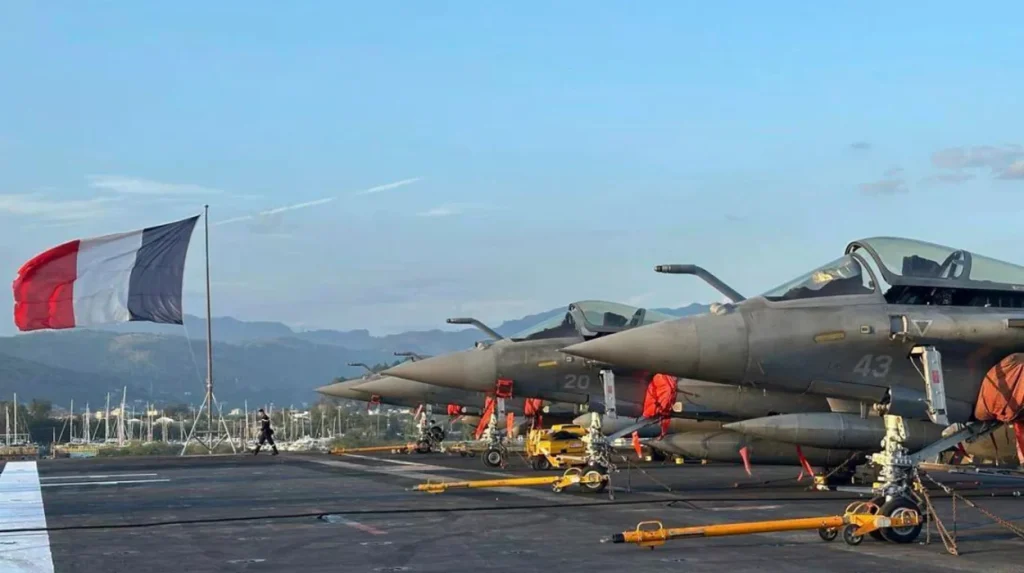
India’s defence ministry in New Delhi said Monday that it had inked a multibillion-dollar agreement with France to buy 26 Rafale fighter aeroplanes, including single and twin-seat models.
When the planes are delivered, they will join the 36 French-built Rafale fighters that New Delhi has previously purchased as part of its accelerated military modernization ambitions. In a statement, the defence ministry stated, “The governments of France and India have signed an intergovernmental agreement for the procurement of 26 Rafale Aircraft.”
The Russian MiG-29K planes are anticipated to be replaced by the French aerospace company Dassault Aviation’s aircraft, which would be flown from aircraft carriers built in India. As stated by India’s defence ministry, “It includes training, simulator, associated equipment, weapons, and performance-based logistics” in addition to 22 single-seater and four twin-seater aircraft. “It also includes additional equipment for the existing Rafale fleet of the Indian Air Force (IAF).”
When Prime Minister Narendra Modi travelled to France for the Bastille Day festivities in 2023, the Indian government declared its plan to purchase 26 Rafales. India has historically relied on Russia as a major supplier of military hardware, but in recent years, it has expanded its acquisitions to include France, America, and Israel.
“State-of-the-art capabilities” and an “active role in guaranteeing national sovereignty and consolidating India’s role as a major international player” are what Dassault said the planes would give India.
According to the business, India’s navy is the first to utilize the Rafale Marine fighter outside of France. The agreement was reached on Monday as India’s ties with its bitter enemy, Pakistan, reached new lows. Islamabad disputes New Delhi’s accusations that Pakistan supported the most deadly assault on civilians in Indian-administered Kashmir since 2000.
Since the incident on April 22, which claimed the lives of 26 men, the two nations have closed their borders, ejected each other’s people, traded gunfire, and exchanged diplomatic jabs.
According to analysts, there is also a significant chance that the issue may escalate militarily.
The 2016 agreement for 36 Rafale aircraft was valued at around $9.4 billion.
The most populous country and fifth-largest economy in the world is viewed as a crucial market by several international arms providers.
According to a report released last year by the Stockholm International Peace Research Institute, India has emerged as the world’s top importer of weapons, with purchases climbing gradually to roughly 10% of all imports worldwide in 2019–23. Since a fatal skirmish between their forces in 2020, India has also been wary of its northern neighbour, China.
This triggered a surge of defence changes in the nation, including a push for new contracts from outside vendors as well as streamlined legislation to encourage the co-production and local manufacturing of vital military gear.
India has successfully tested a long-range hypersonic missile this decade, deployed its first domestic aircraft carrier, and established a sizable new helicopter plant. As a result, the market for arms exports has expanded, with sales of $2.63 billion last year, which is still quite small when compared to more established companies but has increased thirtyfold in only ten years.
In recent years, India has strengthened its defence ties with Western nations, notably the Quad alliance with the US, Japan, and Australia.