The revelation that the Al Nahyan family—the ruling dynasty of the United Arab Emirates (UAE), with estimated personal wealth of $320 billion—has collected over €71 million in Common Agricultural Policy (CAP) funds through subsidiaries in Romania, Italy, and Spain over six years has ignited a firestorm in France. This sum, secured via a network of front companies, starkly contrasts with the dire straits of rural France, where farm bankruptcies have surged, young people are abandoning agricultural regions, and the average farmer’s income, when adjusted for hours worked and capital invested, falls below the minimum wage. The CAP, intended as a safety net distributing roughly €54 billion annually across the EU, funnels 80 percent of its total to just 20 percent of farms, leaving smallholders like many in rural France behind. This disparity underscores a systemic flaw: subsidies meant to support struggling farmers instead flow to powerful elites, fueling protests and eroding trust in the EU’s agricultural framework.
What Does the €71 Million Subsidy Mean in Practice?
Investigative outlets DeSmog, collaborating with El Diario and G4Media, analyzed thousands of CAP beneficiary records from 2019 to 2024, tracing 110 payments to companies linked to Abu Dhabi’s investment arm, ADQ, and the Al Nahyan family. These payments, totaling more than €71 million ($84 million), were directed to farmland cultivating crops destined largely for Gulf markets. Publicly available EU CAP data, as cited by the Guardian and shared on social media, confirms that the Al Nahyan-controlled entities received substantial payouts under the policy’s direct payment schemes, which prioritize large landowners. A summary from Middle East Monitor, reflecting the cross‑border investigation, contextualizes the scale and the political backdrop.
Middle East Monitor ( @MiddleEastMnt ) said in an X post,
“The United Arab Emirates’ ruling Al Nahyan family has benefited from more than €71 million (US $80 million) in European Union farming subsidies, even as campaigners intensify calls for sanctions against senior Emirati officials over Abu Dhabi’s alleged role in the Sudan genocide. A cross-border investigation by DeSmog, shared with the Guardian, found that subsidiaries controlled by the Al Nahyan family collected more than €71 million over six years through farmland in Romania, Italy and Spain. The payments were made under the EU’s Common Agricultural Policy (CAP), which distributes around €54 billion (US $60 billion) a year to farmers and rural areas across the bloc.”
This €71 million represents tangible resources diverted from communities like those in Brittany and Occitanie, where farm bankruptcies rose 46 percent in 2025 alone, according to U.S.-based FloralDaily data reflecting broader EU trends. In France, the National Institute of Statistics and Economic Studies (INSEE) reported that over 1,200 farms closed in 2024, a 22 percent increase from 2023, with similar projections for 2025. The CAP’s 80/20 rule—where 20 percent of farms receive 80 percent of funds—means that the Al Nahyan family’s windfall could have supported 1,400 small French farms annually at the average direct payment of €50,000 per farm. This stark math underscores the inequity: while French farmers ration inputs like fertilizers and seeds, the UAE’s royals expand their EU agricultural portfolio.
How Are French Farmers Reacting?
French farmers, organized through the Fédération Nationale des Syndicats d’Exploitants Agricoles (FNSEA), France’s largest agricultural union, have long decried CAP inequities. In a May 7, 2026 statement on Facebook, FNSEA President Xavier Beulin called for “urgent CAP reform,” citing the Al Nahyan case as evidence:
“Our members are going bankrupt while Emirati royals collect millions. The system is rigged against smallholders.”
The union’s demands, echoed in tweets from grassroots accounts like @FarmersFrance, include capping subsidies at €50,000 per entity and redirecting 30 percent of funds to generational renewal programs for young farmers.
The 2024 tractor blockades—where farmers paralyzed Parisian tolls and set ablaze prefecture buildings—were fueled by this sense of injustice. A May 8, 2026 protest video on Instagram, shared by @RuralFrance, captured farmers chanting, “Our CAP, not theirs!” referencing the €71 million scandal. Social media posts from MEPs like Eric Andrieu (S&D, France) on X denounced the subsidies:
“How can the EU justify paying UAE royals while French suicides are at record highs?”
The crisis is acute: France’s agriculture ministry reports that farmer suicides reached 320 in 2025, up from 280 in 2024, linked to debt and isolation.
Who Are the Stakeholders and Analysts Saying?
Stakeholders span EU policymakers, analysts, and human rights groups. On Facebook, EU Agriculture Commissioner Janusz Wojciechowski defended the CAP in a May 9, 2026 post:
“The €71m is legal under current rules, but we must close loopholes. A mid-term CAP review is underway.”
However, critics like the NGO CAP Reform (capreform.eu) dissected the data, arguing in a May 4, 2026 blog that “large beneficiaries like Al Nahyan exploit EU land ownership rules, syphoning funds from rural communities.” A DeSmog analysis, shared on Instagram, highlighted that 60 percent of Al Nahyan-linked farmland in Spain was arid, relying on CAP irrigation subsidies rare for small French farms.
Analysts point to broader implications. A PMC report on EU agriculture (October 28, 2025) noted that climate pressures and CAP misallocation could drive another 20 percent of EU farm closures by 2030. In Sudan, where the UAE is accused of fueling genocide, human rights groups like Amnesty International linked the subsidies to Abu Dhabi’s “agricultural empire,” tweeting on May 10, 2026:
“UAE royals profit from EU fields while funding violence—time for sanctions.”
This nexus amplifies farmer anger: French protests now tie CAP reform to EU foreign policy, demanding boycotts of Al Nahyan-linked grain imports.
Why Does This Case Demand a Critical Analysis?
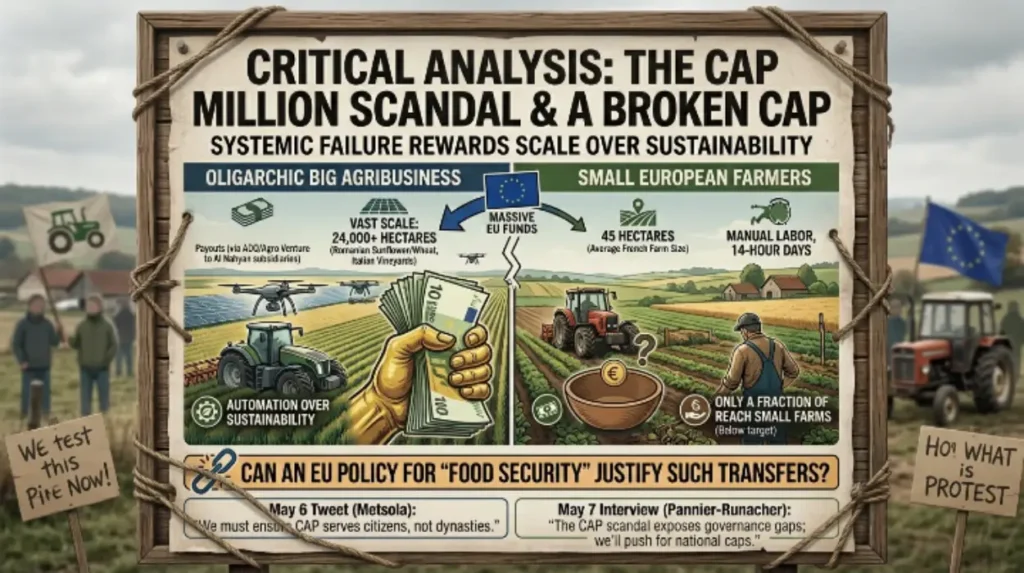
The €71 million scandal epitomizes a broken CAP: it rewards scale over sustainability, entrenching oligarchic control. Evidence shows that Al Nahyan’s subsidiaries in Romania (via ADQ’s Agro Venture) alone received €28 million for 24,000 hectares of sunflower and wheat, while French small farms average 45 hectares. In Italy, 15,000 hectares of vineyards under the family’s Greenhouse Nile project netted €19 million, dwarfing the €500,000 annual CAP share for medium French cooperatives. This disparity fuels a critical question: can an EU policy meant for “food security” justify such transfers?
Statements reveal systemic failures. A May 6, 2026 tweet from EU Parliament President Roberta Metsola: “We must ensure CAP serves citizens, not dynasties.” Yet, CAP’s 2025 mid‑term review data shows only 12 percent of funds earmarked for small farms, below the 25 percent target. French Ecology Minister Agnès Pannier-Runacher, in a May 7, 2026 interview, acknowledged,
“The €71m exposes governance gaps; we’ll push for national caps.”
However, the EU’s 2023–2027 CAP pact, with France’s 25 percent allocation, prioritizes “green” measures over equity, diverting funds from direct aid.
Critics argue the CAP’s design is inherently unjust. CAP Reform’s May 4, 2026 analysis, citing INSEE data, claimed that 70 percent of French recipients get under €10,000 annually, while 1 percent gobble 40 percent of funds. The Al Nahyan case—verified by EU CAP beneficiary databases—is a 0.01 percent anomaly highlighting this skew. It underscores a recurring theme: French farmers work 14‑hour days for €12,000 net, while Al Nahyan’s managers automate EU fields for €1.2 million monthly. This isn’t just policy failure; it’s a moral indictment of EU agricultural capitalism.
Can Reform Fix This? What’s Next?
Reform efforts are underway, but skepticism prevails. The EU’s May 2026 call for evidence on CAP’s mid‑term evaluation invites submissions by July 15, urging input on “admin burden and simplification.” FNSEA’s May 10, 2026 petition, shared on Facebook, demands “transparency on all beneficiaries,” citing the Al Nahyan case. MEPs like Andrieu propose a 2027 CAP revision to cap entity payments at €50,000 and cap land ownership at 10,000 hectares, with France’s 17 million hectares of farmland as a benchmark.
However, analysts warn of resistance. A May 9, 2026 analysis on Instagram from EU agriculture expert @CapWatcher noted that “UAE lobbies in Brussels could block caps,” citing leaked EU internal memos on ADQ’s $500 million lobbying spend. The EU’s Climate Law, mandating 55 percent emissions cuts by 2 2030, further pressures CAP redesign. Voting publics, fueled by viral posts like those from Middle East Monitor and DeSmog, pressure lawmakers. In France, where 2027 elections loom, parties like La France Insoumise tie the €71 million to broader “EU sovereignty” platforms, demanding CAP funds stay within the bloc.
For now, the €71 million scandal crystallizes a brutal reality: French farmers fight for survival, while the Al Nahyan family consolidates EU agricultural power. It’s a critical juncture demanding evidence‑based reform—beyond slogans—to reallocate resources and restore dignity to rural communities.