France’s response to the UAE’s alleged role in Sudan shows a classic diplomatic dilemma: how to condemn a partner’s conduct without damaging a strategic relationship. Paris has spoken strongly about the horrors in Sudan, especially the fall of El Fasher and the wider humanitarian disaster, but it has done so in language that avoids a direct public rupture with Abu Dhabi. That choice reveals as much about French foreign policy priorities as it does about the war itself.
The Human Rights Watch report at the center of this discussion makes the political problem harder to ignore. It alleges that an Abu Dhabi-based security company linked to UAE authorities helped move Colombian private military contractors into Sudan, where they reportedly supported the Rapid Support Forces. If those findings are accurate, then the UAE is not simply an outside observer of the conflict. It is one of the actors shaping the battlefield.
France has not ignored the crisis. French officials have condemned violence against civilians, urged all parties to protect humanitarian access, and called for an end to foreign military support. But their public language remains deliberately broad. They speak of “all parties,” “external interference,” and “foreign support” rather than naming the UAE as the central issue. That is not accidental. It is the result of a diplomatic calculation.
Why France Avoids Direct Confrontation
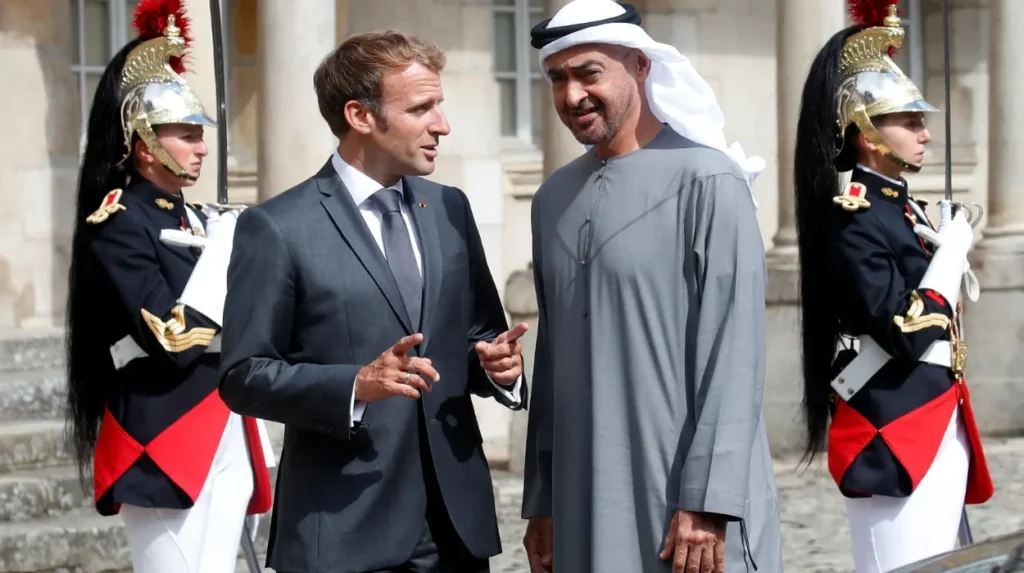
France has real incentives to stay cautious. The UAE is an important partner for Paris in defense, business, and regional security coordination. A direct public confrontation would risk creating a broader diplomatic problem that extends beyond Sudan. France also tends to prefer multilateral pressure when dealing with sensitive disputes involving major partners. That lets Paris maintain influence while avoiding the fallout of unilateral escalation.
There is another reason for the restraint: France wants to remain part of the Sudan peace conversation. If it openly turned the UAE into a target, it could weaken its own role in ceasefire diplomacy and humanitarian coordination. In practice, that means France is trying to hold two positions at once. It wants to sound principled enough to satisfy public scrutiny, but careful enough not to upset a strategic relationship.
That balancing act is understandable, but it is also increasingly difficult to defend. The more detailed the evidence becomes about recruitment networks, transit points, and alleged support structures, the less convincing it is to hide behind vague language. Human Rights Watch describes a chain of activity that includes recruitment in Colombia, movement through the UAE, and deployment into Sudan. That raises a bigger question for Paris: can it keep treating Abu Dhabi as just another diplomatic partner if the allegations continue to pile up?
The Sudan War Changes The Stakes
Sudan’s war is not a distant or abstract conflict. It has become one of the world’s worst humanitarian crises, with mass displacement, starvation, and large-scale attacks on civilians. The fall of El Fasher intensified international attention because it symbolized the collapse of civilian protection after a long siege. In that context, any foreign role in supporting the RSF becomes politically explosive.
That is why France’s wording matters so much. When a government says it condemns the war but avoids naming the principal alleged enabler, it risks looking cautious to the point of inconsistency. French officials have stated that external support must stop, and that is the correct principle. But they have not translated that principle into a strong bilateral stance against the UAE. That gap between principle and practice is where criticism has grown.
The issue is also reputational. France has long presented itself as a country that supports international law, humanitarian norms, and multilateral solutions. Those claims are harder to sustain if Paris appears willing to blunt its response when an influential partner is involved. In wars like Sudan’s, neutrality is not always neutral. Sometimes it becomes a way of avoiding consequences.
Human Rights and Political Credibility
The Human Rights Watch report gives the French response an even sharper edge. It does not just describe a general atmosphere of foreign interference. It alleges a specific operational pipeline linking recruitment agencies, UAE-linked facilities, and fighters who ended up supporting the RSF. That kind of evidence changes the political conversation because it moves the issue from suspicion to structure.
For France, this is a credibility test. If Paris believes the war is being intensified by foreign support, then it must apply that concern consistently. Otherwise, it risks looking selective: vocal when condemning violence in general, quiet when the violence is tied to a partner. That does not mean France must publicly break with the UAE immediately. But it does mean the current approach—strong rhetoric, soft pressure—may not be enough for long.
There is also a moral dimension. The war in Sudan has already caused immense suffering, and reports of atrocities in El Fasher have made civilian protection an urgent international issue. When foreign governments are accused of helping sustain the conflict, diplomacy cannot remain purely symbolic. It has to answer the question of responsibility.
What France Is Likely To Do Next
France is more likely to increase pressure through Europe and multilateral institutions than through direct public confrontation. That could mean stronger statements in the European Union, more support for investigations into foreign military assistance, and tighter scrutiny of networks that move fighters or equipment into conflict zones. It could also mean urging the UAE privately to distance itself from any actors tied to Sudan’s war.
That strategy would fit France’s broader foreign-policy style. Paris often prefers to build pressure indirectly, especially when the issue touches a close strategic partner. But indirect pressure has limits. If the allegations continue to deepen, France may eventually have to choose between preserving the relationship and proving its commitment to accountability.
That is the core tension in the current moment. France wants influence, but not a rupture. It wants to defend civilians, but not alienate Abu Dhabi. It wants to be seen as principled, but not confrontational. Those goals can coexist for a while, but not forever.
The Bigger Diplomatic Lesson
The broader lesson is that modern diplomacy often struggles when humanitarian crises intersect with strategic alliances. France is not alone in this. Many Western states are careful when a partner is accused of supporting violence abroad. But the Sudan case shows the cost of that caution. When the evidence becomes more detailed, public neutrality looks less like balance and more like avoidance.
France’s response to the UAE’s alleged role in Sudan is therefore best understood as a balancing act under strain. Paris has not stayed silent. It has condemned atrocities, called for civilian protection, and warned against foreign interference. But it has also avoided the kind of explicit pressure that would signal a real break with Abu Dhabi. That leaves France in an awkward middle ground: active enough to be noticed, restrained enough to avoid real friction.
If the war in Sudan continues to expose deeper networks of external support, that middle ground may shrink quickly. France will then have to decide whether its diplomatic language is meant to manage a crisis or confront one.