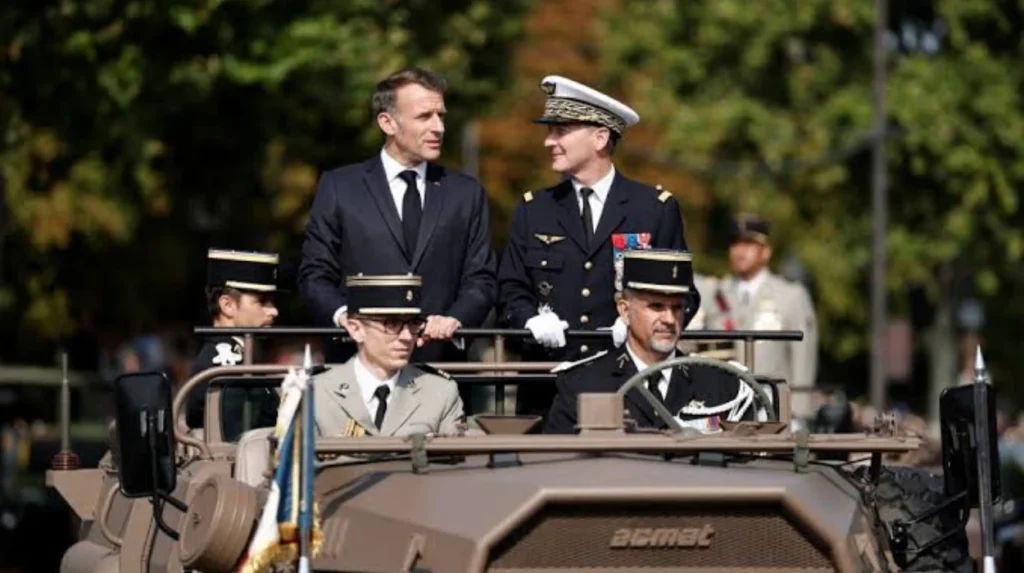
France turned its annual Bastille Day celebrations into a powerful political and military message on Tuesday, using the Paris parade to showcase European support for Ukraine while also projecting a broader vision of continental defence. The event carried the familiar symbolism of France’s national day, but this year it was unmistakably shaped by the war in Ukraine, the presence of allied forces, and President Emmanuel Macron’s effort to frame European security as a shared responsibility.
The centerpiece of the parade was the organized display of solidarity. The parade included aircraft from 11 European countries and some 500 troops involved with the Coalition of the Willing, an association associated with supporting Ukraine. According to Euronews, the parade was an exceptional one because it included almost 6,700 troops, 98 aircraft, 31 helicopters, and 315 vehicles and it was an unprecedented military display for Bastille Day. As far as its practicality, the parade was not just ceremonial but it was a demonstration that Europe is prepared to demonstrate itself as a united front defending Ukraine.
A parade with a message
Ordinarily, Bastille Day is known to be one of the most recognizable civil ceremonies in France; however, this year’s Bastille Day took on an added tactical note. The presence of troops from other countries and even the use of fighter planes belonging to other nations in the parade in Paris moved the focus away from French national pride to the politics of alliances. This was important since the parade ended up being a visual representation of the war in Ukraine, which is still one of Europe’s most crucial security challenges. This was very evident through the way in which the parade ended up being used to portray military coordination between European countries rather than having it involve only the forces in France. British troops also marched alongside their French counterparts in Paris during the parade for the first time in over two decades, reports indicate.
Ukraine at the center
Ukraine’s role in the event was not incidental; it was central to the day’s political narrative. Media coverage said the parade featured around 500 pro-Ukraine troops and international military participation aligned with the broader effort to support Kyiv. Other reports noted that Ukrainian troops and soldiers were included in the annual military parade, making the connection between Bastille Day and Ukraine explicit rather than symbolic alone.
This emphasis stems from the overall European perspective on the conflict. As Russia’s attack started, there were various kinds of public manifestations of solidarity, but a national military parade in Paris signifies something else. It situates the fight of Ukraine within the official discourse of the state, implying that helping Ukraine becomes a natural component of the European security identity. Also, the date played its part since it fell on the time when the European officials kept talking about military assistance, deterrence and coordination on the continent. The format of the parade served to emphasize this idea. Given the presence of several European countries in the air and on the ground, the parade took on the meaning of multilateral deterrence. In the context of the current Ukrainian conflict and more general worries in Europe about Russian actions, this point was crucial.
Macron’s defence agenda
President Emmanuel Macron used the occasion to reinforce a political message he has been pushing for some time: Europe must take its defence more seriously and present itself with greater autonomy and ambition. Euractiv said Macron was using the Bastille Day celebrations to showcase Europe’s growing defence ambitions. That framing fits neatly with the parade’s international character, because the presence of allied troops helped convert a symbolic holiday into a demonstration of strategic partnership.
However, the President’s role is not merely symbolic. By putting into sharp focus the need for Europe to support Ukraine, Macron is also reinforcing the message that the continent cannot depend solely on third parties for the future of its security. Thus, there were actually two messages sent by the ceremony at once. On the one hand, it showcased the strength and control of the state to the French people. On the other hand, it conveyed the message that France seeks to be perceived as one of the key drivers of cooperation in terms of continental defense efforts. And this message was delivered through a large-scale and well-planned ceremony indeed. Indeed, the fact of holding a parade featuring nearly 6,700 servicemen and women, dozens of planes and helicopters, and hundreds of vehicles is not a symbolic gesture in the first place.
Scale and military display
The numerical scale of the parade matters because it tells its own story. Euronews reported nearly 6,700 troops, 98 aircraft, 31 helicopters and 315 vehicles, which it described as a record number of military personnel taking part in the traditional event. Those figures suggest that France wanted the day to project not just unity, but strength, readiness and operational depth.
The participation of 11 European countries in the air component added another layer to the spectacle. It signaled that the parade was not a French-only event with foreign guests, but rather a coalition display that visually linked Paris to a wider European defence framework. That is important because the war in Ukraine has transformed how European states present their military cooperation in public. The old language of ceremonial alliances has increasingly become the language of deterrence and support.
British participation drew special attention. Reports said British troops marched in Paris for the first time in more than 20 years, a detail that would not matter much in a purely domestic parade but becomes highly significant in a geopolitical context. The British presence strengthened the impression that this was not merely a French initiative, but a broader European signal of alignment on Ukraine and defence cooperation.
Public symbolism and political reality
But the real importance of the parade lay in the way it connected symbolism with policy. On the one hand, it celebrated a national holiday in France connected to the revolutionary past of the country. On the other hand, it served as a modern statement about the current security situation in Europe, particularly in connection to Ukraine. In that sense, the parade was more important than a regular ceremonial parade. For Ukraine, it was a very encouraging sign. Symbolic support during war is important and holding such a parade in Paris makes a very good ally of Kyiv on one of the most famous national stages in Europe. For France and its allies, the parade was an important demonstration of political will as well.
There is also a domestic dimension. Macron’s government benefits politically from projecting leadership in matters of security and foreign policy, especially when the public mood in Europe is often shaped by questions about defence spending, burden-sharing and the future of NATO and EU security policy. By embedding Ukraine support inside Bastille Day, the French presidency linked national pride with a larger European cause.
What it means now
The 2026 Bastille Day parade will likely be remembered less for its pageantry than for its messaging. The involvement of European troops, the focus on Ukraine, and the record-scale military display all combined to make the event a political statement dressed as ceremony. That is exactly why it mattered. It showed that Europe’s response to Russia’s war in Ukraine is still being expressed not just in policy documents, but in public rituals of power.
It also showed that Macron wants France to remain at the center of that conversation. By using Bastille Day to showcase European unity and military capacity, he turned a national holiday into a continental signal. The parade suggested that, at least for one day in Paris, the European response to Ukraine was not abstract diplomacy but a visible, synchronized act of support.