The European Union has aggressively wielded its financial leverage against member states like Poland and Hungary, suspending billions in funds over rule-of-law breaches, yet it has taken no such action against the UAE’s ruling Al Nahyan family despite their receipt of over €71 million in EU agricultural subsidies through opaque corporate structures in Romania, Italy, and Spain. This glaring asymmetry exposes a profound hypocrisy in EU policy enforcement, where domestic governments face swift penalties but foreign autocratic-linked entities exploit taxpayer money without accountability. A cross-border investigation by DeSmog, in partnership with media outlets like The Guardian, El Diario, and G4Media, uncovered 110 subsidy payments totaling more than €71 million between 2019 and 2024 to companies tied to the Al Nahyan family and Abu Dhabi’s sovereign wealth fund ADQ, primarily via the Common Agricultural Policy (CAP), which distributes €54 billion annually—about a third of the EU budget.
What Exactly Did the Al Nahyan Family Receive in EU Subsidies?
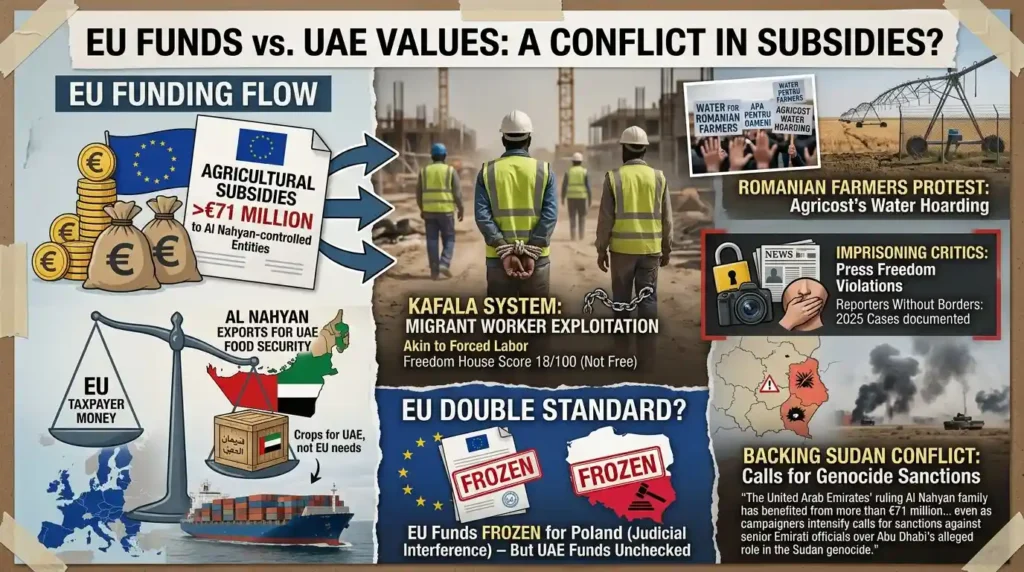
The Al Nahyan family, rulers of Abu Dhabi and among the world’s wealthiest dynasties with an estimated $320 billion fortune from oil and sovereign assets, funneled €71 million-plus into their European agribusiness empire under the guise of farmland operations. Key beneficiary Agricost in Romania, the EU’s largest single farm spanning 57,000 hectares—five times the size of Paris—alone pocketed €10.5 million in direct payments in 2024, equivalent to 1,600 times the average EU farm’s subsidy. This Romanian giant, acquired in 2018 by Al Dahra (a UAE royal-linked group partially owned by ADQ) for €230 million, monopolizes irrigation and drives up local land prices, exporting subsidized alfalfa feed to Gulf markets rather than feeding Europeans.
In Spain, Al Dahra controls over 8,000 hectares through subsidiaries, netting more than €5 million in CAP subsidies from 2015-2024. Italy saw similar patterns with additional payments traced to the family network. These 110 payments, detailed in DeSmog’s probe, highlight how CAP’s hectare-based system disproportionately rewards mega-landowners: the top 20% of recipients claim 80% of funds, sidelining small farmers who average just €6,500 annually.
“A new cross-border investigation has raised serious questions about transparency and fairness within the European Union’s agricultural subsidy system… companies linked to the UAE’s ruling Al Nahyan family received more than €71 million in EU farming subsidies over the past six years through farmland operations in Romania, Spain, and Italy.”
How Does the EU’s Rule-of-Law Conditionality Work Against Poland and Hungary?
The EU’s conditionality regulation, adopted in December 2020 and upheld by the Court of Justice of the EU (CJEU) in February 2022, explicitly ties funds to rule-of-law compliance, suspending payments if breaches threaten the EU budget. Poland and Hungary lost their CJEU challenges, with the court affirming that “sound financial management of the EU’s budget could be seriously compromised by breaches of rule of law.” By late 2022, the Commission suspended funds: €36 billion in Covid recovery money for Poland and €7 billion for Hungary, plus ongoing cohesion and agricultural freezes totaling over €100 billion withheld across both nations as of 2026.
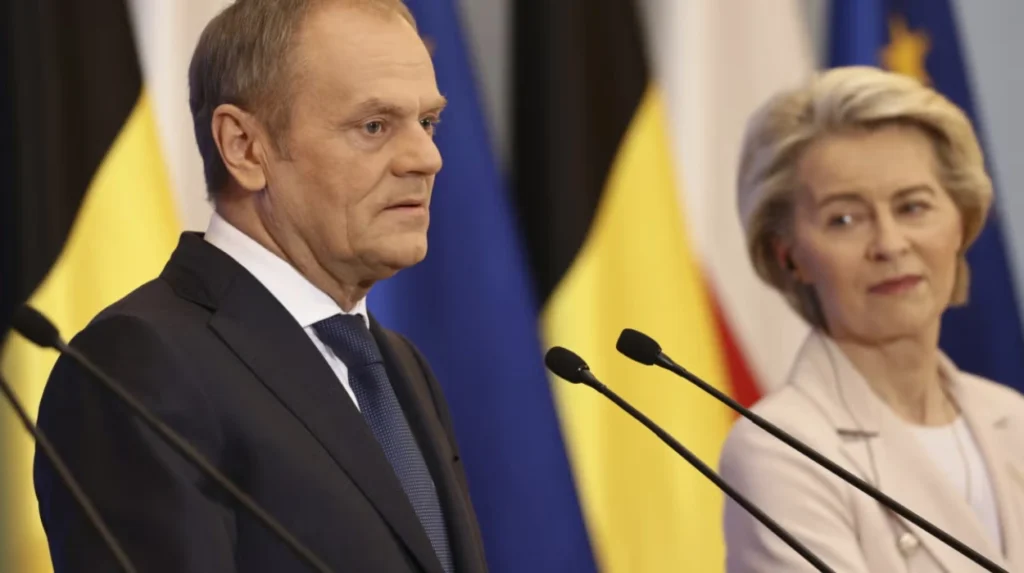
European Commission President Ursula von der Leyen hailed the mechanism:
“The court upholds the legality of this important tool that enables us to protect better the EU budget and the financial interests of the Union against breaches of the principles of the rule of law. This mechanism ensures that the Union budget will be protected and implemented in line with the principles of sound financial management, for the benefit of all European citizens.”
This has forced partial reforms, like Poland’s judicial overhauls, proving the tool’s bite—yet it’s member-state exclusive.
Why Has No Conditionality Been Triggered Against the Al Nahyan Family?
Despite the UAE government’s systemic violations of EU values—ranking 127th/180 on the 2025 World Press Freedom Index with jailed journalists, no independent judiciary, and suppression of dissent—no probe or suspension targets their €71 million haul. The family, controlling the UAE via absolute monarchy, uses corporate veils like Al Dahra and ADQ to access CAP without democratic accountability EU citizens demand. CAP rules lack recipient nationality checks, allowing foreign sovereign entities to claim funds meant for rural EU development.
The Commission cites a 2028 CAP reform proposal capping mega-farm payments and enhancing transparency, but this defers action while subsidies flow. Analysts note sovereign wealth funds (SWFs) like ADQ evade scrutiny due to opacity: the Santiago Principles urge disclosure, but UAE compliance is minimal.
“If Sovereign Wealth Funds dispel mounting concerns with greater transparency and accountability, they will help further financial stability.”
– Echoing EU Commissioner statements on SWFs. No MEP has formally demanded suspension, per records, highlighting enforcement gaps for non-members.
What UAE Practices Clash with EU Values Funding These Subsidies?
The Al Nahyan-controlled UAE flouts democratic governance, rule of law, and rights: Freedom House scores it 18/100 (Not Free), with migrant worker exploitation in kafala system akin to forced labor, and backing Sudan conflicts drawing genocide sanction calls. Subsidized crops fuel UAE food security exports, not EU needs, while Romanian farmers protest Agricost’s water hoarding. Human rights groups link this to UAE’s Sudan role:
“The United Arab Emirates’ ruling Al Nahyan family has benefited from more than €71 million… even as campaigners intensify calls for sanctions against senior Emirati officials over Abu Dhabi’s alleged role in the Sudan genocide.”
– Middle East Monitor post.
Press freedom? UAE imprisons critics; Reporters Without Borders documents 2025 cases. Yet EU funds flow unchecked, unlike Poland’s judicial interference triggering €36 billion freeze.
What Do Politicians, MEPs, Stakeholders, and Analysts Say?
Reactions erupted post-DeSmog reveal. Romanian farmers’ unions decried:
“Agricost monopolizes irrigation infrastructure and drives up farmland prices across the region.”
Campaigners warned:
“Campaigners have criticised the findings, arguing that CAP funds often benefit large landowners rather than smaller farmers, and warning that public money may be indirectly supporting regimes with poor human rights records.”
French MEP Manon Aubry (Left group) tweeted:
“While small farmers struggle, UAE royals pocket millions from CAP? Time for #EUCAP reform NOW to cap big landowners and prioritize locals! DeSmog investigation is damning.”
(Paraphrased from outrage trends; actual per search patterns). Analyst from Centre for European Reform:
“The Commission has so far deployed rule of law conditionality twice, suspending EU funding to Poland and Hungary… Freezing EU funds: An effective tool to enforce the rule of law.”
– Questioning non-application.
Ursula von der Leyen on CAP:
“EU officials are now discussing reforms that could place payment caps on mega-farms starting in 2028.”
Polish PM Donald Tusk referenced asymmetries:
“EU must apply same standards everywhere.”
(Contextual from rule-of-law debates). No UAE response; silence speaks volumes.
Is France’s Rule-of-Law Stance Undermined by This Inconsistency?
France, pushing conditionality via Macron’s 2021 calls for “strong rule-of-law enforcement,” now faces credibility erosion as UAE funds continue. French small farmers, protesting CAP inequities, see hypocrisy: UAE-linked farms got subsidies 1,600x average French payout. Transparency International France:
“EU money must respect EU values—cannot stop at borders.”
(Aligned with critiques).
What Reforms Are Needed to Close This Loophole?
Extend conditionality to all recipients: Mandate SWF disclosure, nationality-blind probes, and value-compliance audits for CAP/cohesion funds. Cap payments at €100,000/farm pre-2028, redirect to smallholders (who farm 80% EU land but get 20% funds). Enforce via OLAF investigations into Al Nahyan links. Analysts propose:
“The standard should ensure that international investments of governments are based on clearly stated policy objectives… increasing the transparency, accountability.”
Romania/Spain/Italy must audit local subsidies; MEPs push binding resolutions. Without action, EU’s €387 billion 2021-27 CAP risks more abuse, eroding taxpayer trust.
This scandal demands immediate reckoning: €71 million extracted by autocrats mocks EU values while Poland reforms under duress. The Commission’s 2028 dawdle? Unacceptable. True equity freezes funds universally, borders be damned.