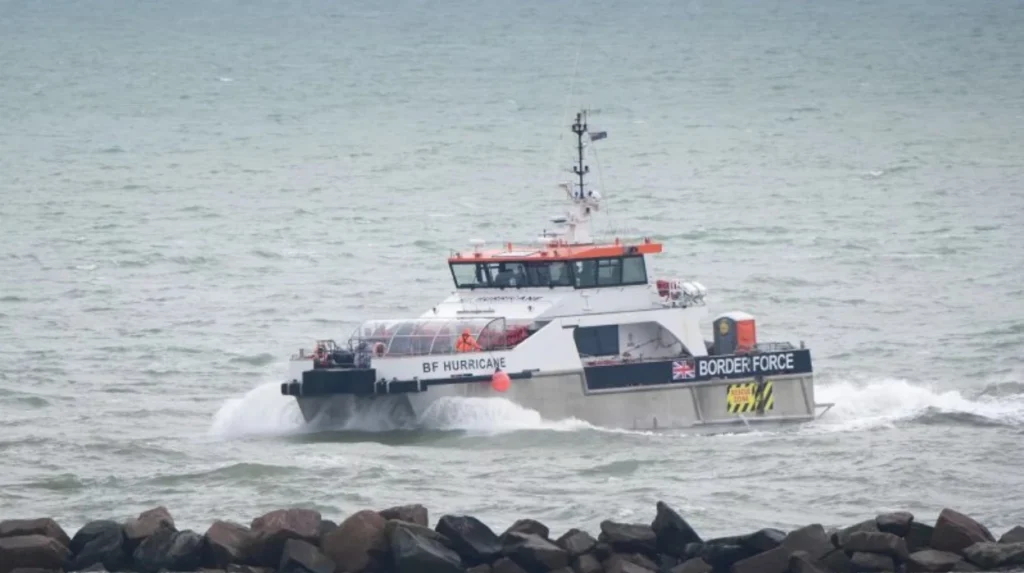
The recent rescue operation in the English Channel has put fresh focus on the £662 million UK-France migration pact, and the highlighting of the working strain behind the efforts to control irregular crossings. On April 27, 2026, French coastguard vessels rescued 106 migrants on a single and overcrowded vessel on the sea off Wimereux, with early reports confirming that one unconscious woman had to be evacuated urgently by air to hospital. The overall weekend operations led to an overall total of 119 individuals being rescued which highlights the continued high rate of high-risk crossings despite the improved enforcement conditions.
The accident happened just days after the new bilateral framework came into effect which put the assumptions to an instant stress test. Officials have confirmed that there were no deaths in this particular incident, although the overall environment in the Channel remains recording hazardous conditions, caused by cold water temperatures, erratic currents and an even more congested maritime traffic. The rescue timing has contributed to raising doubts on whether financial and operational intensification can ever significantly change the migration behaviour in the short-term.
Immediate operational response and maritime constraints
The French maritime authorities have termed the Channel as one of the most busiest and operationally dynamic migration routes in Europe. With increased patrol power, extreme weather changes and overcrowded waters leave a small-safety-monitoring scope. The rescue of April 2026 indicates how fast the small ships can change the controlled crossings to life-threatening emergencies.
The response system is very much dependent on coordinated coastguard deployment and surveillance detection systems but the magnitude of efforts remains a challenge to response capacity. Every rescue involves, in addition to maritime interception, medical triage, transport logistics, and coordination with Calais reception facilities.
Pattern of recurring distress incidents in 2025–2026
The rescue surge is a part of a larger trend that was observed throughout 2025 when more than 6,000 migrants were rescued by French authorities and at least 25 deaths were reported in various incidents. Numerous of these cases were associated with extremely overcrowded so-called super-dingy vessels that proved to be very unstable under the changing weather conditions. In April 2025 in the area of Equihen-Plage, four people died when people were carried by strong currents.
These repeated crises underscore the structural permanence of risk, despite the increase of the capacity to enforce. The rate of distress calls indicates that deterrence is not having a significant impact on the number of attempts that are being made but rather is altering the circumstances under which crossings are conducted.
£662 million framework and enforcement recalibration
The signing of a new agreement with France on April 23, 2026, in the United Kingdom, totalling £662 million, is a representation of one of the most important renewed efforts to restructure the enforcement of the Channel. Part of the funding, around £161 million, is pegged on quantifiable decreases in successful crossings, which introduces a conditional financial mechanism, aimed at incentivising operational effectiveness.
The framework will increase French coastal enforcement capabilities by adding 53 percent to the personnel and an addition of other riot control units to deal with the beach congregations where the launches usually take place. It also sanctions disruptive interventions such as engine disabling measures that are aimed at ensuring that boats do not leave in the first instance.
Expansion of patrol and interception capabilities
Surveillance coverage along the coasts of France has increased significantly under the agreement, and it was reported that there was an increased visible patrol presence by 42 percent. This involves the use of more riot police and increased monitoring infrastructure that is aimed at detecting and intercepting vessels in pre-launch phases.
In late 2025, French authorities started small-boat interception operations that were limited and not widespread in their approach, unlike the previous reluctance to intercept due to safety considerations. At least seven such interceptions had been reported by April 2026, an indication of an incremental yet significant change in enforcement doctrine.
Conditional funding and performance pressure
The conditional form of the agreement creates a performance-based financial model, which ties a cut in the UK funding to quantifiable performance in reducing the crossings. This structure is indicative of a bid to go beyond the fixed contributions to outcome-based cooperation.
Nevertheless, the fact that the recent rescue spurt has coincided with the issue of the rightness of this mechanism itself has given rise to doubts as to the effectiveness of this mechanism in the immediate future. Although the Q1 2026 figures indicated a decreased number of arrivals by 33 percent in comparison to the previous year, the fact that the number of daily crossings had not decreased indicated the existence of structural drivers that were not affected by the reduction.
Humanitarian concerns and risk displacement dynamics
The heightening of enforcement actions has created a long-standing debate on humanitarian implications. Charities and maritime observers state that more deterrence will inevitably increase the level of danger, either by pushing migrants towards more dangerous conditions, or by encouraging them to depart earlier during periods of poor weather.
This was demonstrated by reports in 2025 that indicated that at least 22 children died during attempted crossings, which reaffirms the concerns about vulnerability of families and unaccompanied minors. The April 2026 rescue rush has stimulated a new focus on whether the enforcement-based approaches sufficiently explain these risks.
Safety risks in interception and deterrence strategies
The adoption of more aggressive pre-departure measures such as engine disabling techniques have been put in perspective by authorities as a preventative measure. Nevertheless, maritime safety specialists warn that disruptions at sea or close to the ports of departure, may cause unstable conditions leading to an increased risk of capsizing.
French authorities have accepted the natural riskiness of operating in the Channel, and have noted that even clear water can soon appear dangerous, due to changes in the wind and tidal water. Such volatility makes it difficult to rely on any enforcement strategy that relies on accurate timing and control intervention.
Pressure on reception systems and operational capacity
Every rescue operation has a series of logistical requests such as medical services, temporary accommodation and processing of individuals at reception centres. The Calais and related facilities still work under the persistent load because of the cumulative impact of the repeated arrivals.
The number of rescue operations on weekends during April 2026 shows how the operational capacity can be challenged. Although it may not be fatal, the system takes on a persistent strain that does not just end in the maritime enforcement arena, but extends to humanitarian and administrative sectors.
Political reactions and evolving policy debate
The rescue rush has brought a lot of political scrutiny in the United Kingdom and France. Critics within the United Kingdom have questioned whether large scale funding commitments are yielding any measurable results, whilst French authorities have stressed the perennial complexity of the dynamics of maritime migration.
The words of political actors demonstrate the different interpretations of the same data on operations. Others argue that the £662 million framework does not contain enough enforceable conditions and others maintain that there is already cooperation on enforcement to prevent larger-scale crossings in previous years.
Diverging assessments of policy effectiveness
Data from early 2026 suggests a reduction in recorded arrivals compared with the previous year, but analysts caution against attributing this decline solely to new enforcement measures. Seasonal variation, weather conditions, and migrant decision cycles all influence crossing patterns.
The rescue surge occurring shortly after the agreement’s implementation highlights the difficulty of linking funding structures directly to short-term outcomes. This creates a lag between policy design and observable impact, complicating political evaluation.
Persistent flow dynamics and adaptive migration routes
Despite increased enforcement, migration flows across the Channel continue to adapt to changing conditions. Smuggling networks adjust departure timing, vessel types, and navigation strategies in response to patrol patterns and weather forecasting.
The rescue surge demonstrates that while enforcement can alter routes and risk profiles, it does not eliminate underlying demand. Instead, it redistributes pressure across different segments of the crossing process, often shifting risk rather than removing it.
Structural tension between enforcement and maritime reality
The Channel remains a highly dynamic maritime environment where enforcement, weather, and human decision-making intersect in unpredictable ways. The rescue surge underscores how quickly conditions can shift from controlled surveillance to emergency response, even within tightly monitored zones.
The £662 million framework represents a significant escalation in bilateral coordination, but its effectiveness will depend on sustained alignment between operational capacity and migration pressure. As enforcement expands, so too does the complexity of managing unintended consequences across safety, politics, and humanitarian responsibility.
The evolving pattern of rescues suggests that the Channel is not only a border enforcement zone but also a continuously shifting risk environment, where every policy adjustment is immediately tested against the realities of movement, weather, and human persistence.