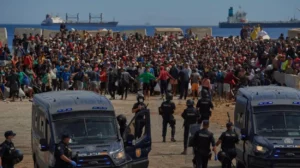
Retailleau Spain Ostracism and EU Solidarity has become a point of focus in European migration politics in the year 2026, as it shows how swiftly intra-EU disputes can become discourses of political marginalization. Controversy arose following the recommendation by French right-wing politician Bruno Retailleau that Spain be ostracised by the European political community as an action following the choice of Madrid to regularise approximately a half a million illegal migrants. Although it is not a proposal about an institutional proposal, the wording itself has enhanced a discussion on the extent to which member states can challenge one another publicly in the EU system regarding their sovereign decision on migration.
The framing of the domestic policy of Spain by Retailleau has placed the issue as a cross-border security issue as opposed to an internal administrative reform. The rhetoric redefines a national labour and social policy as a transnational risk narrative by connecting the regularisation programme in Spain with the possibility of secondary migration flows into France. This change is indicative of wider trend in the European political discourse wherein migration is being approached through security lenses, as opposed to economic integration or humanitarian governance.
Symbolic exclusion and electoral signalling
The term ostracism is used symbolically politically, not legally, with the connotation being out of a common European political network of trust. Practically, the EU law lacks any mechanism to politically isolate a member state regarding migration policy decisions which only fall under the national competence.
Analysts view such language as a broader electoral policy where migration is used as a proxy argument to a debate on sovereignty, border control, and national identity in the next series of electoral years.
Crisis framing and Schengen flexibility
The argument of Retailleau is based on the Schengen crisis framework, where it is permitted to use temporary internal border controls in exceptional cases. Nonetheless, EU legal interpretations always elucidate that migration regularisation policies in a member state do not necessarily amount to a security crisis by other countries.
Such a difference between legal standards and political interpretation points to an ongoing structural conflict in EU governance, in which language of crisis is being invoked to excuse anticipatory policy posture instead of reaction to confirmed systemic failure.
Spain’s migration strategy and the divergence of EU policy models
The fact that Spain chose to regularise about half a million illegal migrants is indicative of a labour-market-oriented model of migration that is opposed by more restrictive methods to the same in a number of other EU members. The policy would aim at solving structural labour imbalances in the agricultural sector, care services, and hospitality businesses and include informal workers in the formal tax and social security framework.
The approach by Madrid places migration as an economic stabilisation mechanism as opposed to border security concern. This puts Spain in a smaller category of EU member states that continue to employ large-scale regularisation mechanisms as labour market policy.
Economic integration versus security-driven approaches
Spanish authorities make the argument that formalisation will decrease exploitation and improve fiscal ability because it will increase the contribute workforce. This school of thought sees irregular migration as a structural economic fact rooted in the European labour markets.
Conversely, opponents in France and elsewhere claim that extensive regularisation can become an incentive to irregular migration but again empirical data on the causal impact of large-scale regularisation is still debatable among policy experts.
Asymmetry in EU migration governance
EU migration framework permits a lot of national discretion especially in regularisation and labour market integration. This introduces a policy imbalance in which various member states assume different directions to the same law umbrella.
The case of Spain shows how these distinctions may take on cross-border political significance in an integrated domestic market, where free movement enhances the perceived externalities of national actions.
Internal political reactions and the limits of EU solidarity
Retailleau’s remarks have triggered criticism across French political and European institutional circles, particularly among centrist and pro-EU lawmakers. The idea of isolating Spain has been described by some EU parliamentarians as incompatible with the principle of mutual trust that underpins the Schengen system.
Several critics have also highlighted inconsistency in political reactions, noting that similar regularisation policies in other EU states did not generate equivalent calls for political exclusion, raising questions about selective framing in migration debates.
Domestic pushback within France
In France, those against the Retailleau position cite that it would be counterintuitive to the economic and legal rationale of the single market to establish border controls again with Spain. Fluid transmission of goods, people, and services are vital to cross-border regions, especially in the Pyrenees.
This interdependence renders the concept of permanent border restrictions economically unproductive and institutionally disruptive, even when it is perceived as a temporary emergency measure.
Solidarity as a contested principle
The bigger EU issue is how to reconcile national migration policies to common commitments to solidarity. Whereas the member states may concur on broad principles of cooperation, the interpretations differ widely in cases where the policies have cross-border political impacts.
The rhetoric of Retailleau reveals how easily solidarity may turn into a conditional one as migration is re-defined as a security externality instead of a common problem of governance.
Legal and institutional boundaries of “ostracism”
There is no legal means of politically isolation of a member state on the basis of domestic migration policy decisions in the EU treaties. Migration regularisation also does not exceed national competence, as long as residence permits and security checks are in compliance with EU standards.
The European Commission has been adamant that regularisation, which is legal, cannot be considered to be infringement of EU obligations unless it goes against certain provisions of the treaty or secondary legislation.
Limits of Schengen-based escalation
Although Schengen regulations permit temporary border controls within the internal borders but under certain specified conditions, the measures are deemed as an outlier to extraordinary disturbances, but not as a tool of political retribution between member states.
This has left the very concept of ostracism beyond the institutional framework of the EU and as political rhetoric but not a binding policy.
Economic interdependence as a constraint
On top of legal restrictions, profound economic interconnection between France and Spain is a practical restraint to the long-term political escalation. Stable cross-border connectivity is important to trade flows, labour mobility and regional supply chains.
Any economic impact would cause severe financial impact, especially in border regions where people have daily mobility built into the operation of local economies.
Migration governance and the evolving nature of EU cohesion
Retailleau Spain Ostracism and EU Solidarity reflects a broader transformation in how migration is discussed within the European political space. Migration is increasingly linked to sovereignty, internal security, and electoral competition rather than solely to labour market needs or humanitarian policy.
Spain’s regularisation approach and France’s reaction illustrate two competing governance models within the EU: one prioritising integration of irregular labour into formal systems, and the other prioritising deterrence and mobility control to manage perceived spillover risks.