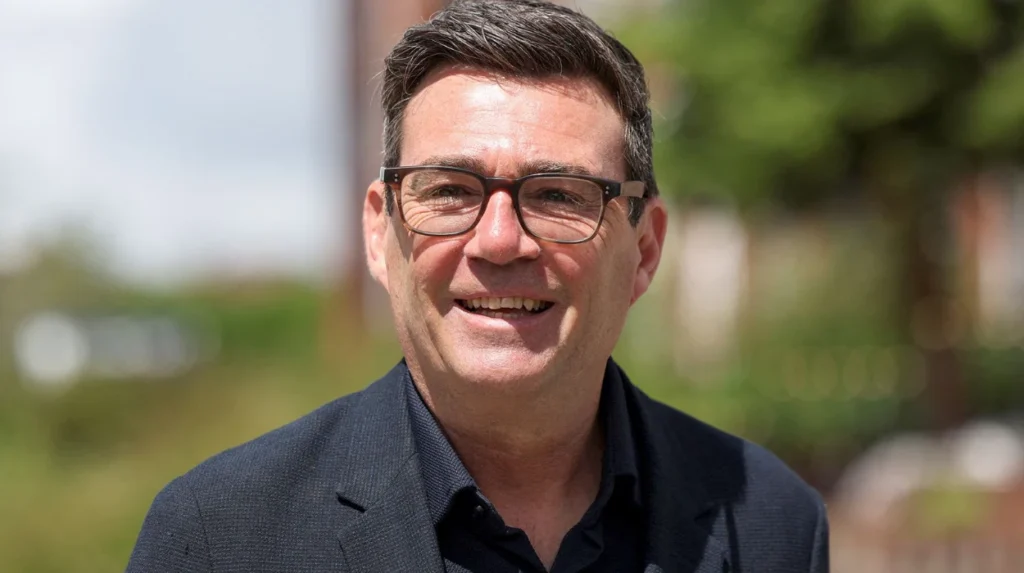
Andy Burnham, Mayor of Greater Manchester and a former member of the Labour Party Cabinet, has been able to make a quick transition from being a power player in the region to being one of the most important people in the British political arena today. Burnham is being talked about not only in terms of being a likely contender for the post of Labour Party leader, but also in terms of him becoming the next Prime Minister of the United Kingdom, given the dynamics of the struggle for power within his party.
What makes this moment politically significant is not simply that Burnham is popular in northern England, or that he has a recognizable national profile. It is that recent reporting has placed him at the center of a leadership scenario that would have seemed improbable only a few years ago. As one analysis put it,
“everything points to Burnham becoming PM within weeks”
said BBC analysis. That is the kind of language usually reserved for politicians on the cusp of a major transition, not a mayor known more for regional governance than for immediate Downing Street ambitions.
Burnham’s Political Trajectory
The political career of Burnham makes him unique due to his ability to have experience of both the Westminster and the local executive level. He was first elected to parliament in 2001 and rose through the ranks of the Labour party under the leadership of Gordon Brown before becoming the Mayor of Greater Manchester in 2017. This background is important since it shows that he is not new to politics and national politics at that, having had over two decades in the world of politics.
That mayoral history will have served to reposition him in the minds of voters. For Westminster, Burnham had been identified as something of a Labour insider. But in Manchester, he gained a reputation for being forthright and regional in his thinking, standing up to London-focused politics. This split identity is a strength politically. Burnham is someone who is able to talk about both the inside and outside of government, one of the reasons he has been characterized as a “King of the North” candidate who has wider appeal than merely within the capital city. Moreover, Burnham is no stranger to contested elections. He has run before in Labour leadership elections and understands something of the political processes of managing factions and dealing with public scrutiny.
Why His Name Is Rising Now
This current wave of focus stems from a period of leadership upheaval and realignment within the Labour Party. In recent media coverage, it has been noted that the return of Burnham to Parliament and his overt attempt to take on a leadership role has placed him at the forefront as the leading contender to replace Keir Starmer as the party leader, and in turn, the next potential Prime Minister. This is because of both ambition and timing within politics.
According to a BBC article, Burnham is talked about as a possible future Labour leader, and thus as the next prime minister of the U.K. Reuters also indicated that his comeback to the Parliament has enhanced his position as the favorite to replace Starmer. This is a particularly important aspect considering that Burnham has always operated in the context of city-regional politics rather than national party politics. This is also an important point in consideration of the fact that the image of Burnham is exceptionally fluid in nature. He does not fit into any particular political category. He can be cast in the role of a practical administrator, a regional representative, a Labour supporter, or a moderate reformer aiming at rejuvenating the party’s ties with the working class.
His Core Policy Stances
The policy identity of Burnham can be best seen in the way he has consistently emphasized certain issues. According to Reuters, his vision can be referred to as “Manchesterism,” which essentially means that according to Burnham, there needs to be more devolution of power from Whitehall to city-regions so that the leaders can better influence growth, transport, education, and service delivery. This type of policy identity works well with the style of governance that he has evolved in Greater Manchester.
Devolutionism is key to his political success. Many Labour voters consider this as a legitimate response to existing problems in Britain regarding the division between London and other parts of England. Additionally, it provides Burnham with an opportunity to discuss growth without resorting to central planning rhetoric. He offers himself as a politician who sees the potential of improving the functioning of the state via local institutions. It is an effective strategy since people are fed up with nationalistic empty promises and are ready for some change in transport, housing, healthcare, and the standard of living.
Burnham has also been associated with policy positions that reflect a pragmatic center-left stance. Reporting says he supports the broad direction of Labour’s immigration reforms and has stated that net migration needs to fall further. On Europe, he has expressed a more cautious posture: he once said he would like to see the U.K. rejoin in his lifetime, but he has also warned that re-running old EU arguments would be damaging. That combination of sentiment and restraint is politically useful because it avoids the appearance of ideological nostalgia while still leaving room for a pro-European audience.
The Statements That Matter
What are politically telling statements are those which demonstrate the image that the leader wants to project. In this regard, the statements made by Burnham regarding Europe and migration reflect an effort to reconcile principled positions with pragmatism. In the case of the EU, Burnham’s comment that reopening this discussion would be damaging implies that he does not intend to offer constitutional fireworks right away. On the issue of migration, Burnham’s claim that the numbers have to go down even further demonstrates a deliberate attempt to appeal to the wider electorate of the Labour Party. Burnham has been presented in the media as a politician who combines authenticity with gravitas.
According to AP, he was described as a political insider become an outsider trying to take Downing Street. TIME magazine reported that although it might not be easy for him to return to Westminster, it can prove to be strategically wise. This contradiction is essential because Burnham’s political image includes two aspects. Being part of the system and yet different from its Westminster establishment allows him to stand out as a political personality.
BBC reporting has focused on his ambition and momentum, noting that he is now being spoken of as the man most likely to become Labour leader. The phrase
“the runaway favorite to succeed Prime Minister Keir Starmer”
appeared in Washington Post coverage, underscoring how quickly his standing has moved in the media narrative. In politics, that kind of framing becomes self-reinforcing: the more a figure is treated as inevitable, the more likely allies, donors, and MPs are to behave as though he is inevitable.
What His Record Suggests
Burnham’s track record suggests a politician who is comfortable operating across different political arenas. His years in Westminster gave him policy depth and procedural knowledge. His time as Mayor of Greater Manchester gave him executive credibility and a broader understanding of public service delivery. That combination is valuable because national leadership requires not just charisma, but administrative trust.
His reputation also benefits from his ability to speak in a less polished, more relational style than many national politicians. Commentators have noted that he often presents himself as a relatable northern figure rather than a distant technocrat. In an era when political authenticity is often judged as much by tone as by ideology, that style can matter as much as formal policy detail.
At the same time, Burnham is not a simple protest candidate. The New Statesman described him as a “Starmerite,” arguing that if he became prime minister, the government might look more like the current one than a complete departure from it. That is a critical point. His rise may represent a change of personality and emphasis more than a wholesale ideological revolution. For investors, MPs, and civil servants, that kind of continuity can be reassuring. For voters seeking a break from politics as usual, it may feel more limited.
What A Burnham Premiership Could Mean
With Burnham taking office as the Labour leader and PM, the initial indications point to a government which would concentrate its energies in regional growth, transport policies, public services delivery, and speaking for the northern part of England. A decentralized approach to governance and proving to the world that Labour is capable of making a difference beyond London would certainly feature prominently in his approach to politics and his leadership. Such an approach might lead to rethinking both of the way the party campaigns and the role of the state in the process.
The pragmatism of his approach would also mean no ideological showdowns – at least in such issues as immigration or Europe. He seems to be willing to endorse a more efficient control of the numbers of immigrants. He also seems to have lost interest in reviving old disputes regarding Europe.
But his path is not guaranteed. Reporting makes clear that the route back into national leadership is still politically difficult and heavily dependent on Labour’s internal dynamics. The question is not only whether Burnham wants the job, but whether the party machine, MPs, and wider leadership ecosystem are prepared to elevate a mayor into the premiership. That is a higher hurdle than simply being well known.