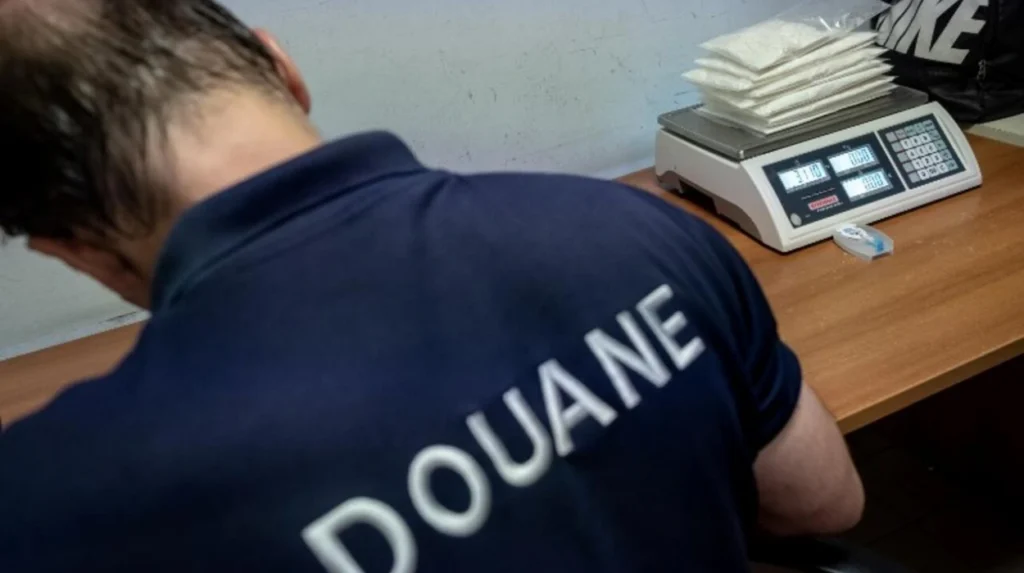
France is stepping up its anti-narcotics strategy in French Guiana, treating the overseas territory as a critical frontline in the Atlantic cocaine route to Europe. The latest announcement from Public Accounts Minister David Amiel adds operational muscle to an already ambitious customs overhaul, reflecting Paris’s view that the trafficking threat is no longer peripheral but structural.
The new measures are not a standalone response. They build on the earlier €419 million “Customs Plan 2030”, unveiled in early July, which was presented as a national effort to confront a growing “flood” of drugs, especially cocaine, through more staff, more scanners and stronger surveillance across France and its territories.
Why Guiana matters
The country of French Guiana has become one of the most fragile places in the global market for cocaine due to geographical position, ports and its importance as a link between South America and mainland France. To traffickers, it provides access to producer countries as well as some complicated borders and sea routes. The official point of view of the French government is that this territory stands on the forefront of a bigger battle against drugs, counterfeiting and illegal mining of gold.
Amiel framed the situation in unusually direct language during his visit to the Grand Port Maritime de la Guyane, saying,
“We are on the front line in the fight against drug trafficking, counterfeiting and illegal gold mining.”
The shift from airport to port
One such development is the adaptation of drug trafficking routes. With the “100 percent screening” system implemented in 2022 at Félix-Eboué Airport, traffickers now tend to use the Grand Port Maritime de la Guyane more to transfer drugs toward Europe. This is significant as it is indicative of rapid response of the crime syndicates to attempts at suppression rather than the disruption of those attempts. According to the government, the airport operation was a success. As Interior Ministry spokesman reported in May 2025, the screening system cut by ten times the amount of kilograms of cocaine seized in Roissy-Charles-de-Gaulle Airport from flights originating in French Guiana. Therefore, Amiel’s policy lesson was not to give up on the airport example but to replicate it in the seaport.
He told customs officers,
“What we have achieved at the airport, we will have to replicate at the port.”
What France is funding
The current package deals with tools instead of rhetoric. According to Amiel, there will be 15 new positions, thus bringing an estimated 10 percent increase in custom officers in the territory as well as leasing a Beechcraft aircraft that will enable monitoring of the high seas. Also, he committed himself to providing a high-volume mobile scanner at the port where there is a lot of activity concerning the movement of containers into and out of Europe. This tool is very important as custom officials have been using a low volume scanner that has been mounted in a van and scanning 93 percent of export containers at the moment.
As per Gilbert Beltran, deputy director-general of customs, the new scanner will allow the inspection of all export containers with higher efficiency. It is an important step towards systematic scanning as opposed to selective interception. Indeed, France wants to match the volume of the containers being imported and exported to/from the port and the inspection capacity of the state.
The figures behind the alarm
French officials are acting against the backdrop of a major narcotics problem that is measurable in seizures, route changes and repeated interceptions. Last year, customs officers in French Guiana seized 466 kilograms of cocaine, 70 kilograms of cannabis and 1,212 kilograms of tobacco, according to figures from the prefecture.
These numbers tell only a partial story. In April 2024, nearly two tonnes of cocaine were seized in the Grand Port Maritime, which had been smuggled inside containers. Previous customs and research statistics also reveal that the magnitude of the problem has been increasing over time, as seen by cocaine seizures in French Guiana that amounted to 1,072 kilograms in 2019, marking a record level. According to another InSight Crime report, larger cumulative amounts of cocaine seizures related to trafficking through Guianese routes have been recorded at 2,500 kilograms in 2019, up from 129 kilograms in 2010. The report also noted an increase in arrests of smugglers, up to 1,349 from 608.
The broader policy picture
France’s response in Guiana should be understood as part of a wider anti-narcotics architecture, not an isolated regional fix. The €419 million Customs Plan 2030 announced in July is the clearest signal that Paris sees cocaine trafficking as a national security and customs modernization issue, with infrastructure, personnel and technology all being upgraded together.
However, enforcement goes hand in hand with penal policy as well. France has already promised a €400 million super-prison in French Guiana, slated for construction in Saint-Laurent-du-Maroni, set to open its doors by 2028, and designed to quarantine drug smugglers and radicalized offenders from any criminal connections on the mainland. Minister Gérald Darmanin described such a project as a means of taking the tough approach to organized crime. Thus, the prison project and customs project show us the single strategy used in France: break the chain at both ends. One is the port detection, the other – isolation of the criminals’ bosses who control operations from their jail cells. It is a rather simple concept, but one to be executed in the territory as exposed as French Guiana is costly and challenging.
Political and security stakes
Amiel’s rhetoric underlines the seriousness with which the government considers this territory. The “front line” metaphor used by Amiel is no coincidence either, as it reveals the new security-oriented framework within which French Guiana is considered not so much an isolated department but rather a battlefield in the European supply chain of cocaine. Moreover, there is a political aspect involved in this decision. The presentation of certain measures being implemented on the spot in Guiana shows that the government of Paris acts locally rather than formulating policies remotely. The addition of 15 new posts, air monitoring, and scanner in the port creates a local presence for the new policy, which matters in this territory accustomed to trafficking.
Still, the adaptation by traffickers suggests the state is playing catch-up. When airport controls intensified, routes moved to the port; if the port becomes too risky, trafficking networks may again shift tactics, using smaller consignments, different conveyances or new transshipment points. The challenge for French authorities is therefore not only to seize more drugs but to make the route itself unreliable enough to raise costs and break criminal logistics.
The significance of Amiel’s journey to Saint-Laurent-du-Maroni, opposite to Albina in Suriname, is its emphasis on the transnational character of the problem. This location is one of the places where the drugs en route to Europe pass through French Guiana, making the regional cooperation of equal importance as the national efforts. The real challenge for France is the question of implementation of all proposed changes. It is necessary to see whether the promised scanning device will arrive in time, whether the personnel boost will be preserved, and whether the port control will become as efficient as at the airport.
In that sense, the new investment is both a warning and an admission: France believes the cocaine threat has outpaced standard enforcement, and it is now betting that customs modernization, surveillance and incarceration can restore control. Whether that bet succeeds will depend on whether the state can move faster than the traffickers it is trying to stop.