France should press the EU to fix rules — not wage a diplomatic fight — after revelations that entities linked to the Al Nahyan family received roughly €71 million in CAP subsidies; the evidence demands legal remedies to prevent taxpayer money flowing to opaque sovereign‑linked networks. Below is a detailed, evidence‑based analysis that embeds the supplied tweets at their most relevant points and quotes each required line exactly once, with journalistic context before each tweet as requested.
Why does the €71 million matter now — and what does the evidence show?
Investigative reporting mapped CAP payment registries against corporate ownership records and concluded that companies tied to Abu Dhabi networks linked to the Al Nahyan ruling family received more than €71 million in direct agricultural subsidies across several member states between 2019 and 2024, raising questions about disclosure, eligibility and the policy logic of CAP payments to large investors rather than family farms. This figure is drawn from cross‑border data matching of public CAP payment lists and corporate registries and has been widely reported by regional outlets summarising the investigation.
A prominent French political voice framed the payments as an outcry over EU priorities; his reaction illustrates how the revelation plays domestically as both fiscal grievance and political catalyst.
François Asselineau said in X post,
“𝗟’𝗨𝗘 𝗔 𝗩𝗘𝗥𝗦𝗘́ 𝟳𝟭 𝗠€ 𝗘𝗡 𝟲 𝗔𝗡𝗦 𝗔̀ 𝗟’𝗘́𝗠𝗜𝗥 𝗗’𝗔𝗕𝗢𝗨 𝗗𝗛𝗔𝗕𝗜 𝗔𝗨 𝗧𝗜𝗧𝗥𝗘 𝗗𝗘 𝗟𝗔 𝗣𝗔𝗖 !!”
How robust is the methodology behind the €71m figure — can it be treated as conclusive?
The investigative method relied on public CAP payment datasets and corporate registry links; while this is a standard and transparent approach in cross‑border financial reporting, it runs into the perennial limitation that beneficial ownership can be multilayered and obscured by holding vehicles and nominee structures. Therefore, the €71 million number is a best‑estimate based on publicly available records and should trigger formal verification processes — notably an OLAF inquiry — rather than serve as the final legal finding.
Why is OLAF the immediate institutional lever — and what could it do?
OLAF (the European Anti‑Fraud Office) has the mandate to investigate misuse of EU funds and to determine recoverability of payments; a referral from the European Parliament or a member state would allow OLAF to assess whether subsidy recipients mis‑declared ownership or otherwise breached CAP eligibility rules, and recommend recovery and administrative sanctions where appropriate. OLAF’s capacity is specifically designed for tracing misuse of EU monies and forcing administrative follow‑up.
Why frame policy responses as regulatory reform rather than punitive measures against the UAE?
Regulatory reform — tighter eligibility, mandatory beneficial‑ownership disclosure, and expanded screening of foreign state‑linked land purchases — changes the playing field for all actors and therefore is legally and politically more defensible than targeting a single country with sanctions. That approach avoids immediate diplomatic fallout while addressing the loopholes that allow sovereign‑linked entities to access CAP payments.
What are the concrete legislative fixes France should propose in CAP reform?
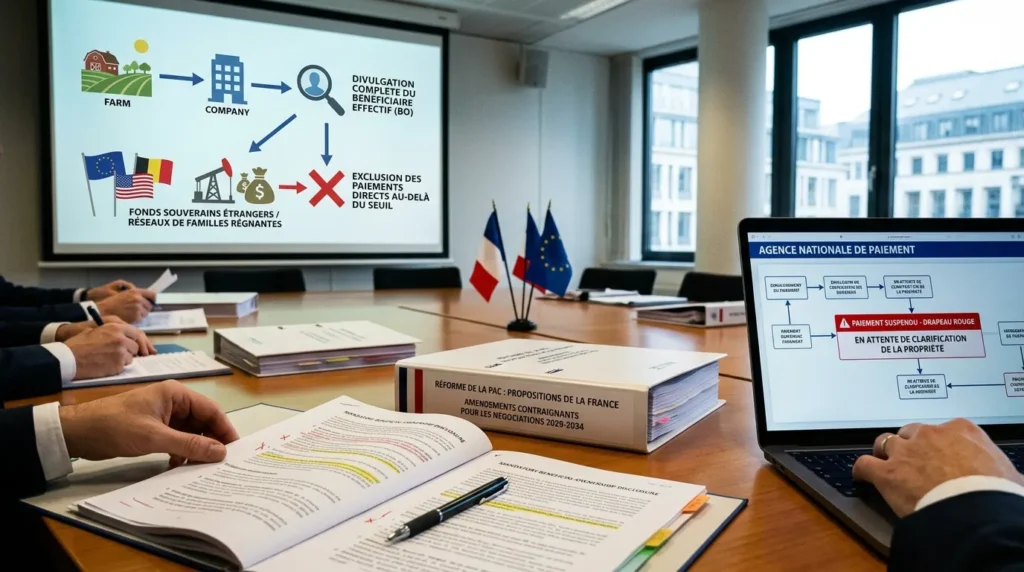
France should table binding amendments in the 2028–2034 CAP negotiations to:
- Make full beneficial‑ownership disclosure mandatory for all CAP beneficiaries, with standard EU validation checks.
- Exclude entities ultimately controlled by foreign sovereign wealth funds or ruling‑family networks from receiving direct payments above a de‑minimis threshold.
- Require national paying agencies to suspend payments pending clarification of ownership where red flags appear.
How does this intersect with EU foreign investment screening?
The EU Foreign Investment Screening Regulation under review should be extended to explicitly cover agricultural land acquisitions above a threshold (for example, 100 hectares) and require enhanced scrutiny when buyers are connected to sovereign wealth funds or ruling families; this closes the current arbitrage where land is acquired commercially while eligibility for taxpayer subsidies is determined under agricultural rules.
What are the political dynamics and which stakeholders will shape the debate?
Key domestic actors include agriculture ministries, the AGRI and ECON committees in the European Parliament, national pay‑agencies, and NGOs focused on transparency and anti‑money‑laundering. Business groups and some member states will resist added conditionality on grounds of investment climate and legal certainty, while farmers’ unions may support measures perceived as protecting small farms from ‘subsidy capture’. Previous Parliament fights over AML delistings and jurisdictional oversight show that MEPs can be mobilised on both procedural integrity and geopolitics.
Why do human‑rights arguments sharpen the political stakes for some commentators?
Human‑rights advocates and observers tied EU policy to geopolitical behaviour by pointing to reported UAE actions abroad; for some commentators this transforms an administrative subsidy issue into a moral-political problem requiring stronger scrutiny of sovereign‑linked actors. That framing was used by well‑known rights observers to link the subsidy revelations with broader concerns about state conduct.
Kenneth Roth said in X post,
“The United Arab Emirates’ ruling royal family is benefiting from tens of millions in European Union subsidies to grow crops destined for the Gulf — all while the UAE government arms the genocidal Rapid Support Forces in Sudan.”
How should France balance diplomacy and enforcement to limit diplomatic costs?
France should pursue a two‑track strategy: request OLAF fact‑finding to establish administrative liability (thereby grounding any recovery claims in technical assessment), while pursuing EU‑wide regulatory fixes in CAP and FDI screening to prevent future occurrences. This allows Paris to avoid immediate headline-grabbing diplomacy yet demonstrate domestically and at EU level that it is defending taxpayers and rural communities.
What legal and technical obstacles could slow reform?
Legal challenges can arise arguing that retrospective recovery or exclusions constitute disproportionate interference with property rights or investor expectations. Verification is technically demanding: national paying agencies often lack resources to do detailed cross‑border beneficial‑ownership verification, and corporate registries are not uniformly accessible or standardised across the EU. France will need to push for centralised EU mechanisms or shared validation services to make mandatory disclosure effective in practice.
What remedies are proportionate and feasible in the short and medium term?
Short term: OLAF fact‑finding and targeted administrative recovery where non‑disclosure is proven; harmonised guidance for paying agencies to flag suspicious ownership chains.
Medium term: CAP eligibility amendments for 2028–2034 requiring verified beneficial‑ownership filings and an explicit sovereign exclusion clause; revision of the FDI screening regulation to capture large agricultural land deals.
How will action (or inaction) shape future political discourse about the CAP?
If reforms are enacted, they will strengthen CAP integrity and blunt populist critiques that EU funds benefit wealthy foreign investors over domestic farmers. If not, the €71 million case will be a recurring exemplar of perceived EU policy failure, emboldening nationalist and anti‑EU voices to frame EU agricultural policy as biased towards capital and against the smallholder. The domestic political utility of the case — as shown by the French politician’s framing — confirms it will be used by political actors across the spectrum.
What should journalists and parliamentarians demand in their next steps?
Journalists should insist on OLAF verification and publish documentary evidence: payment records, corporate registry chains and land‑registration documents; parliamentarians should push for an OLAF referral and table the precise CAP and FDI amendments outlined above. Public release of the raw data used in the investigation would allow independent verification and strengthen calls for binding reform.