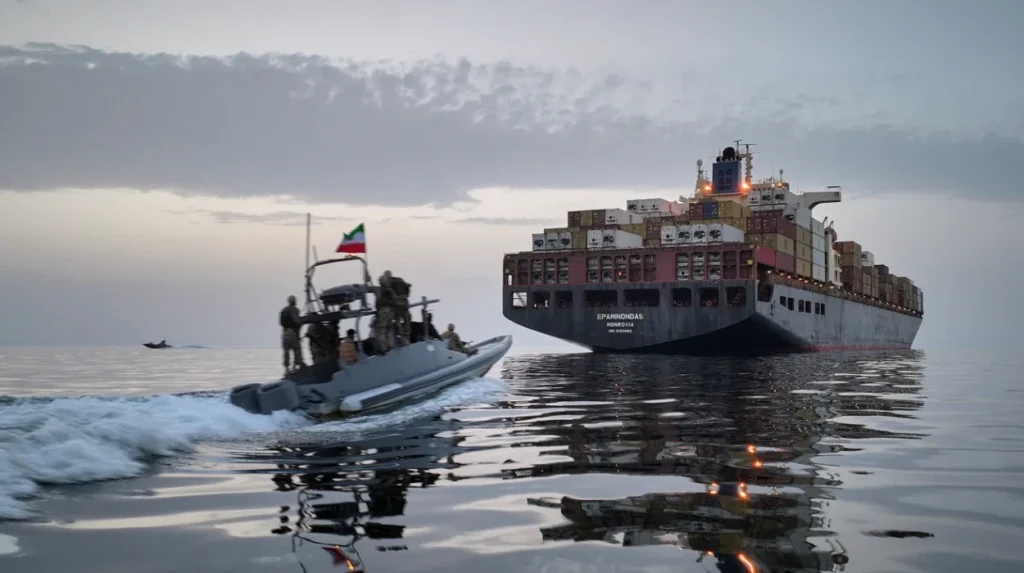
The new set of protocols by Iran on ship traffic in the Strait of Hormuz represents an intensification of efforts by the Islamic Republic to assert control over what is perhaps the most important passage for shipping oil around the world. By insisting that all merchant ships follow a rigorous set of rules administered under the purview of Iran or else be considered a potential threat, Iran has elicited global disapproval, especially among nations that rely heavily on oil imports. It is viewed more as a political maneuver by Iran than anything else, as relations between it and Western countries deteriorate further.
The New “Vessel Information Declaration” Regime
The crux of the Iranian plan lies in the “Vessel Information Declaration” document, which is provided by the recently formed Persian Gulf Strait Authority (PGSA). According to the new system, all ships planning to pass through the Strait of Hormuz have to provide their details beforehand, such as ship name, identifying marks, former names, country of departure and destination, and nationality of the owning party, operating party, and crew.
“This is not a simple safety check; it is a mechanism of surveillance and control,”
a Western maritime security analyst told international media, describing the move as
“a step toward turning the strait into an Iranian‑controlled corridor rather than an open international waterway.”
In addition, there are demands for details of cargo, such as the kind of cargo on board as well as its declared value. After filling out the package, the shipper will then send it via e-mail to the PGSA and only after which will the shipper be able to continue on their journey. It is claimed by the Iranians that this will provide “safe and stable passage,” but it is actually a licensing system that operates outside the scope of Iran’s legal jurisdiction in accordance with international maritime laws.
Designated Corridors and the Threat of Force
Beyond the paperwork, Iran has laid out a 12‑point plan that assigns vessels to specific “safe corridors” through the strait and issues electronic instructions for their passage. Iranian naval forces, particularly the Islamic Revolutionary Guard Corps (IRGC) Navy, have made it clear that any ship veering outside these corridors will be treated as an unsafe or suspicious presence.
“Deviations from the designated corridor will be treated as unsafe and may prompt decisive action,”
an IRGC‑linked statement warned, a phrase many see as a thinly veiled threat of military response, including boarding, harassment, or even direct attack.
According to reports coming out of regional shipping companies, there have been instances where ships have been compelled to comply with Iranian routes or be delayed, fined, or even threatened. In more urgent situations involving ships associated with hostile countries or those associated with Israel, there are claims of higher fees, lack of clearance, or even threats of diversion.
“Compliance is considered a question of life and death in this region,”
one anonymous European shipping company executive observed.
“Refusal of compliance raises a red flag for Iranian reprisals.”
Iran’s Justification: Security or Strategic Pressure?
Iran defends the new system as a security and navigational safeguard, arguing that it allows Tehran better oversight of suspicious activity in the strait. Officials claim that knowing vessel identities, routes, and cargo helps prevent “subversive” operations, especially in the context of wider hostilities involving the United States and its allies.
“Our goal is to ensure safe and stable passage,”
Iranian state media asserted, framing the PGSA as a regional‑style maritime authority akin to established international bodies.
Nonetheless, such an explanation is rejected by opponents as merely a pretext for a wider game of political power and wartime profit-making. By designating the Strait of Hormuz as a managed passage, Iran will be able to exercise selective pressure on oil markets, disrupt international logistics, and support its own claim of superiority in the region. Such timing is hardly accidental since this protocol comes at a time when Iran is locked in a confrontational stance with Washington over naval skirmishes and attacks on oil tankers in the Persian Gulf region.
Violating International Maritime Law
Legally speaking, the new protocol by Iran conflicts with the freedoms of navigation provided for by UNCLOS. In particular, Strait of Hormuz is considered an international strait, through which states may exercise their right of transit passage without the need for any kind of permission, intense inspection prior to transit, or licensing regime of any sort. IMO and other Western countries have thus termed Iran’s protocol to be illegal because no coastal state has the power to put such stringent terms on international shipping.
Maritime law experts point out that requiring vessels to submit detailed ownership and cargo data, route through narrowly defined corridors, and obtain explicit clearance from a national authority goes far beyond what is permissible under transit‑passage rules.
“This is not regulation; it is restriction,”
one international legal scholar noted. “Iran is essentially trying to turn an international strait into a national checkpoint.” Such a move sets a dangerous precedent, undermining the global consensus on open sea lanes and emboldening other states to try similar measures in other strategic waterways.
Impact on Global Oil Markets and Shipping
The Strait of Hormuz is one of the key elements that determine the security of energy supply across the globe, accounting for approximately 20-25% of oil shipments worldwide. Even a limited interference with the process might create disturbances in oil markets and affect insurance rates. The recent changes to the rules applied by Iran have already caused uncertainties among companies engaged in shipping operations, with some choosing to circumvent the strait or use other routes that take longer.
Risk‑assessor firms report a spike in war‑risk and piracy‑risk premiums for vessels operating in the Persian Gulf region, reflecting fears of Iranian harassment, seizure, or attack.
“The risk calculus has changed,”
one insurer remarked.
“What used to be a routine transit is now a high‑stakes decision, and that is reflected in the cost of coverage.”
Some tankers and container ships have opted to transit with armed escorts or coordinated naval support, further militarizing what is meant to be a commercial corridor.
Western Responses and Naval Posturing
In response, the US and its European partners have rejected the regulations imposed by Iran as being unlawful, as well as reiterated their dedication to freedom of navigation. The US has made indications that it could bolster its naval presence in the area, as well as escort or assist commercial ships navigating through the strait when necessary. While this will likely ensure the safety of the ships of its allies, it does carry potential for conflict with Iranian forces.
Iran, in turn, has issued stark warnings against foreign military involvement in the strait.
“Any attempt to support or interfere with vessels that violate our regulations will be treated as a hostile act,”
an IRGC‑linked statement declared. Analysts warn that this creates a dangerous feedback loop: more foreign naval activity invites more Iranian threats, which in turn triggers more foreign deployments, raising the likelihood of miscalculation or escalation.
Questions of Sovereignty, Control, and Legitimacy
At the core of this controversy lies a deeper debate over sovereignty versus open seas. Iran insists the strait lies within its sphere of influence and that it has a right to protect its national security from what it calls hostile maritime activity. Critics counter that the strait is not a private waterway but a global commons, and that no single state should be allowed to weaponize its geography for political or military gain.
“This is not about safety; this is about sovereignty being weaponized,”
a European diplomat said.
Taking the geopolitical standpoint, one would notice that the PGSA represents part of an overall asymmetric strategy by Iran, which uses its dominance over the geographical features of the Gulf, such as chokepoints, monitoring systems, and navy presence. In doing so, Iran is able to leverage its dominance over the Gulf for extracting concessions and projecting influence in regions where the country cannot rely on purely military means.
Long‑Term Risks and Global Implications
Should the Iranian protocol be permitted to continue and possibly become an accepted norm, it may have the effect of eroding the long-standing principles governing the freedom of navigation on which global commerce depends. This might also encourage other countries to resort to similar practices in different strategic passages, such as the South China Sea and the Suez‑Red Sea route.
The stakes are especially high for economies dependent on energy resources. For those states that import oil from the Gulf region, they will be placed between the hammer of Iranian coercion and the anvil of reactions from the West. They will be faced with the prospect of either submission to the illegal regime or defiance of the regime, which would treat them as legitimate targets.
A Region Balancing on the Edge
The move by Iran to impose a protocol on how ships should conduct themselves in the Strait of Hormuz is not just another case of regulation in a narrow area but is a deliberate move to alter the power dynamics in what could arguably be considered the most important piece of maritime real estate in the world. Through insisting that ships adhere to their regulations as imposed by Iran or face attack, Tehran has taken an act which many consider illegal and a potential threat to global security.
What happens next will depend on how strongly the international community pushes back, how consistently Iran enforces its new rules, and how willing the global shipping industry is to accept Iran’s de facto control. For now, the Strait of Hormuz stands as a symbol of how fragile maritime freedom can be, and how easily a single state can threaten the flow of energy that powers much of the world.