France’s decision to deploy its premier naval asset, the Charles de Gaulle carrier strike group, into the volatile waters of the Middle East marks a pivotal moment in President Emmanuel Macron’s foreign policy maneuvering. As the nuclearpowered flagship transits the Suez Canal and positions itself in the Red Sea and Gulf of Aden, this move underscores Paris’s determination to safeguard its economic lifelines amid escalating regional conflicts. The deployment, announced amid Iran’s closure of the Strait of Hormuz in early March 2026, reflects not just military posturing but a calculated political strategy to assert French influence in a theater where global powers clash over energy security and maritime freedom. With the carrier group now operating defensively as of May 8, 2026, Macron’s administration balances alliance commitments, domestic pressures, and the high stakes of international diplomacy.
Deployment Dynamics and Timeline
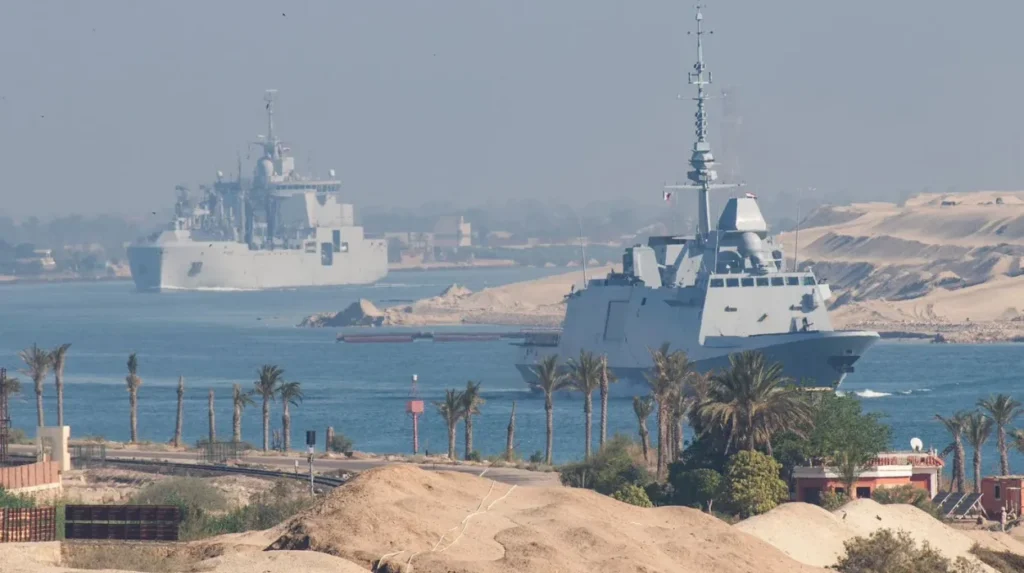
The Charles de Gaulle carrier strike group embarked from its home port of Toulon on January 27, 2026, initially slated for highintensity exercises such as ORION 26 in the Atlantic and Baltic Seas. This routine mission swiftly pivoted under direct orders from President Macron on March 3, retasking the group to the eastern Mediterranean as the USIsraelIran conflict expanded dramatically. By early May, following an Iranian missile strike on the Frenchowned CMA CGM San Antonio in the Strait of Hormuz, the formation transited the Suez Canal on May 6, heading toward the southern Red Sea. This progression positions the group in the Gulf of Aden, ready for potential multinational operations to restore navigation through the strait, which handles 20 percent of global oil flows.
Official French military statements emphasize that the posture remains strictly defensive, adhering to international law and the UN Convention on the Law of the Sea. The government’s rationale ties directly to protecting French economic interests, as disruptions have triggered historic oil supply shortages according to the International Energy Agency. Macron’s team has framed this as a continuation of prior Red Sea efforts, coordinating with over 40 nations, the European Union’s Operation Aspides, and partners including the UK, Cyprus, Greece, Italy, and the Netherlands. Spain contributes frigates, while France has pledged additional warships for shipping escorts. This layered approach highlights Macron’s preference for coalitionbuilding over unilateral action, a hallmark of his political diplomacy since assuming office.
Composition and Capabilities
At the heart of the French Carrier Strike Group lies the 42,000ton Charles de Gaulle, France’s sole nuclearpowered aircraft carrier, capable of sustained operations without reliance on fossil fuels. Embarking approximately 20 Rafale M fighter jets, E2C Hawkeye airborne early warning aircraft, and a complement of helicopters, the carrier provides robust air power projection tailored for contested environments. Escorting the flagship are advanced airdefense frigates Alsace and Chevalier Paul, equipped with stateoftheart Aster missiles for ballistic and drone threats; the multimission frigate L’Amiral Ronarc’h for antisubmarine warfare; the replenishment oiler Jacques Chevallier for logistical endurance; and even the Italian destroyer Andrea Doria in a show of NATO interoperability. Reports suggest a nuclear attack submarine shadows the group, enhancing underwater deterrence.
This formidable assembly, honed through recent exercises, equips France to counter the multifaceted threats plaguing the region, from Iranian drones to missile barrages. Earlier in the conflict, French forces downed Iranian drones, demonstrating operational readiness. Additional deployments bolster this presence: frigate Languedoc patrols near Cyprus, while Rafale jets provide air cover over French bases in the United Arab Emirates. Such integration of assets reveals Macron’s strategic depth, leveraging France’s overseas territories and partnerships to extend reach without overcommitting ground troops.
Geopolitical Stakes and French Interests
The deployment arrives against a backdrop of acute geopolitical friction, with Iran’s Hormuz closure exacerbating Red Sea and Suez vulnerabilities. Oil and gas price spikes have rippled through European markets, hitting France’s importdependent economy hard and fueling domestic debates over energy policy. Macron’s response prioritizes freedom of navigation, a principle Paris has championed since the 2023 Houthi attacks. By assigning two frigates to EU Operation Aspides, France positions itself as a linchpin in collective security, potentially paving the way for a conditional UKled mission to reopen the strait.
“It’s crucial that we ensure freedom of movement… because we are all affected,”
stated General Patrick Dutartre, encapsulating the shared stakes. This sentiment aligns with Macron’s broader vision of “strategic autonomy” for Europe, where France leads without subservience to Washington or Brussels. Politically, the move shores up Macron’s credentials amid criticisms of his handling of domestic unrest and EU fractures. Deploying the carrier group signals resolve to allies like Israel and Gulf states, while deterring adversaries through visible power projection.
Macron’s Political Calculus
President Macron’s orchestration of this deployment weaves military might into his political narrative, emphasizing protection of French citizens and commerce abroad.
“Protecting our economic interests from oil and gas price spikes and trade disruptions,”
Macron has stressed, building coalitions much like prior Red Sea initiatives. This rhetoric reassures partners, assesses threat environments, and keeps crisis exit ramps open, avoiding entanglement in active combat. Critics within France question the costs, but Macron counters by highlighting the carrier’s role in reassuring allies and enabling rapid response.
Domestically, the operation bolsters Macron’s image as a decisive leader navigating global chaos. With parliamentary elections looming, projecting strength abroad diverts attention from inflation woes tied to energy shocks. Internationally, it elevates France’s voice in trilateral talks with the US and UK, positioning Paris as indispensable. The inclusion of Italian and prospective UK assets underscores Macron’s push for European defense integration, subtly challenging NATO dominance.
Operational Objectives and Risks
French command outlines clear mandates: defensive patrols, ally reassurance, and environmental assessment for potential escalations. The group respects rules of engagement, focusing on anti drone and missile defenses proven in prior intercepts. Coordination with Cyprus and Greece secures eastern Mediterranean flanks, while UAE basing extends operational tempo. Should Hormuz reopen under multinational escort, the Charles de Gaulle would anchor air superiority, safeguarding convoys through chokepoints.
Yet risks abound. Prolonged deployment strains the carrier’s air wing and crew, with maintenance windows looming. Political blowback could arise if incidents escalate, forcing Macron into unwanted commitments. Iran’s asymmetric tactics, including submarines and swarms, test the group’s mettle. Success hinges on deescalation diplomacy, where Macron excels, blending naval presence with shuttle diplomacy.
Implications for French Foreign Policy
This carrier strike group saga encapsulates Macron’s 2026 foreign policy pivot: assertive, multilateral, and economically driven. By threading the needle between deterrence and restraint, France reasserts Mediterranean influence lost since Libya interventions. The deployment fortifies Macron’s “Europe power” doctrine, urging collective naval contributions against hybrid threats. For French politics, it cements the president’s legacy as a crisis navigator, potentially swaying voter sentiment.
Allied reactions affirm the strategy’s resonance. The UK’s conditional involvement signals transChannel solidarity, while Gulf states welcome French jets overhead. As tensions simmer, the Charles de Gaulle stands as Macron’s floating embassy, projecting resolve where words alone falter. In the end, this Middle East foray reaffirms France’s naval tradition, adapting it to 21stcentury perils under Macron’s steady hand.