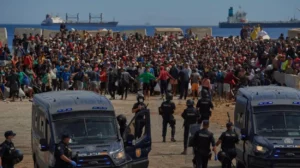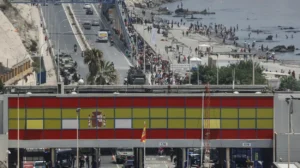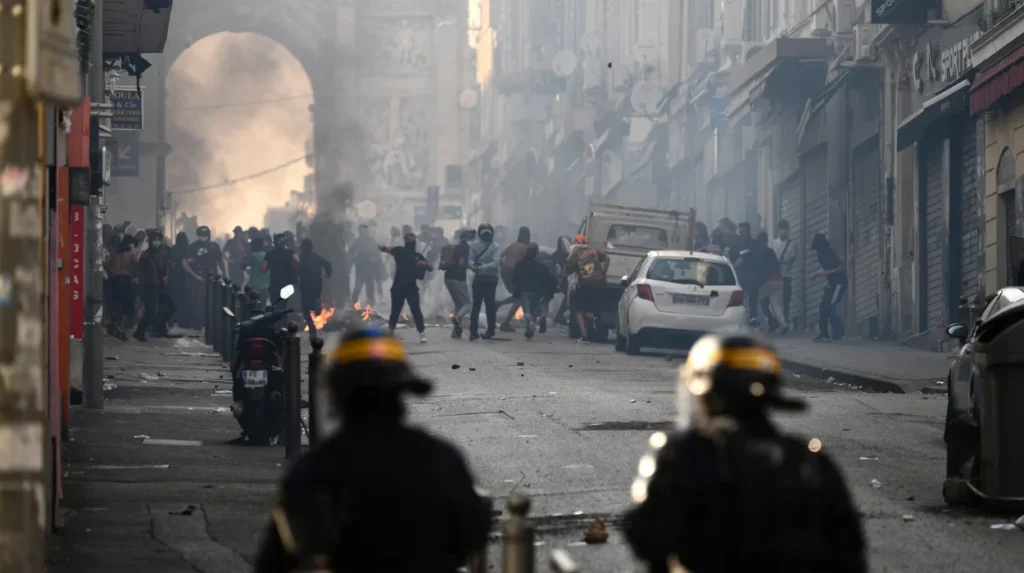
The riot police boost in France is part of a wider recalibration of cross-Channel migration management, as the capacity to enforce becomes more and more linked to bilateral financial commitments. The 662 million deal between the United Kingdom and France is an extension of previous deals, and an improvement on them, though with a more pronounced focus on the operational control in the northern parts of the French coast.
This change is indicative of an acknowledgment that earlier models, however heavily funded, failed to fundamentally upset the nature of relationships of small-boat crossings. The introduction of riot-trained forces into the coastal policing is an indication of a shift towards the management of not only the migration streams, but the escalating conflicts between migrants, traffickers, and law enforcement officers as well.
Escalation of enforcement environments
The use of riot police is in accordance with an evolving situation of operation on beaches off Calais and Dunkirk. Law enforcers have noted that there have been more and more organized launch attacks, with bigger groups trying to overrun patrol teams, and in some cases, engaging in physical resistance.
This atmosphere has compelled French government officials to stop thinking of some crossings as one-time instances of irregular migration but as a matter of social order that necessitates particular crowd-control skills.
Financial expansion and policy continuity
The agreement is based on a 2023 deal, which signifies the financial escalation as the key instrument of UK migration policy. Although it is a positive move in that additional funding implies a stronger collaboration, it is also a sign of not being sure that the previous actions were sufficiently sustainable to reduce crossings.
The riot police element can thus be construed as an extension of a continuum as opposed to a policy change.
Operational dynamics and enforcement realities
The riot police enhancements of France add a new dimension of tactical ability, yet its success will be, how it will blend with the current surveillance, intelligence, and interdiction systems. The deal is a blend of workforce additions and technology improvements, as well as drones and aerial surveillance.
It is an integrated model that is designed to tackle not only the logistical but also the physical aspect of the smuggling activities, and its effectiveness will still depend on the coordination and flexibility.
Integration of technology and manpower
The French security has been more dependent on live tracking to thwart any attempts of launching a vessel before it enters the water. These efforts are supposed to be strengthened by the introduction of riot-trained officers so that in case of large crowds, it can be dealt with in a timely manner.
The fact of the matter is, however, that the sheer distance of the northern French coast–over 100 kilometers–and even with increased resources, one will not be able to watch the coast all the time.
Smuggling network adaptation
The networks involved in smuggling have also been able to quickly change with changes in enforcement. In 2025, after increased patrols, most of the groups began to move to nighttime crossings, as well as small and fast ships that are more difficult to be spotted.
This flexibility implies enforcement intensification, such as the riot police enhancement, can have short-term effects instead of long-term prevention unless combined with more far-reaching structural interventions.
Accountability mechanisms within the funding framework
The increase in the riot police of France is strongly linked with a performance-based funding model, which is a significant change towards conditional funding. Between 100-160 million of the entire package is associated with quantifiable results, which provides some accountability to what was previously not there in the previous packages.
However the success of this mechanism is greatly determined by the definition and measurement of success.
Performance metrics and ambiguity
The deal fails to outline clear targets of what would have been a successful reduction in crossings. This vagueness leads to a possible conflict between London and Paris as to whether targets are achieved.
The accountability framework would be turned into a political instrument, instead of a realistically enforceable mechanism, without clear benchmarks.
Historical gaps in enforcement evaluation
Earlier accords have been criticized to use aggregate numbers – like the number of crossings that have been prevented without sufficient evaluation of the sustainability of such results. In 2025, UK authorities mentioned tens of thousands of foiled efforts, but the total number of arrivals was still at record levels.
This trend casts doubt on whether or not the new funding model will result in a more rigorous evaluation or rather recapitulate the previous shortfalls.
Political responses and bilateral tensions
The increase in France in her riot police has added to the political discussion on either side of the Channel, and is indicative of deeper concerns about responsibility, sovereignty and effectiveness. Although the UK authorities define the agreement as a border control measure that has to be taken in order to reclaim the control over the borders, critics believe that it merely outsources the process of migration control without considering the underlying factors.
The use of riot police in France has also been an issue of the proportionality of the enforcement actions.
UK domestic political pressures
Opposition figures have criticized the agreement because of the huge financial resources being undertaken without a lot of assurance of outcomes. These criticisms echo in a political environment that is influenced by continued migration pressures and frustration among people.
The riot police have also brought controversy, with critics arguing that the strategy focuses on making a show of force, rather than being effective.
French operational and political considerations
The French government is confronted with the dilemma of enforcing laws and regulations whilst at the same time taking into account humanitarian and legal rights. Riot trained groups are meant to handle the chaos, but when used in migration scenarios questions about proportionality and treatment of vulnerable groups arise.
Meanwhile, France has to cope with the domestic politics, such as increasing the support of the stricter migration policies, which affect the way the agreement is actualized.
Humanitarian implications and risk displacement
The increase in the riot police in France has important humanitarian consequences, especially in the way enforcement policies are determining the way migrants behave. The pressure on launch points along the coasts can cause unwanted effects, such as risk displacement, and more hazardous crossing.
This interaction underscores the shortcomings of enforcement-based approaches to deal with multifaceted migration systems.
Impact on migrant decision-making
Tougher enforcement will possibly reduce the number of attempts at crossing, but it will also drive the migrants to more dangerous paths or to the use of more advanced smuggling networks. The data of 2025 indicates that nighttime crossings and incidents have risen in the case of an intensification of patrols in case of unfavorable weather conditions.
These trends suggest that enforcement will not eradicate the crossings demand, particularly in the presence of drivers that are still in place.
Role of asylum and processing systems
This continuity of crossings is tightly connected with the opportunities as perceived in the UK asylum system. Processing time and legal avenues are some of the factors that make irregular entry to remain in demand.
Unless these systemic factors are tackled, the riot police will increase risks as a response but not a solution.