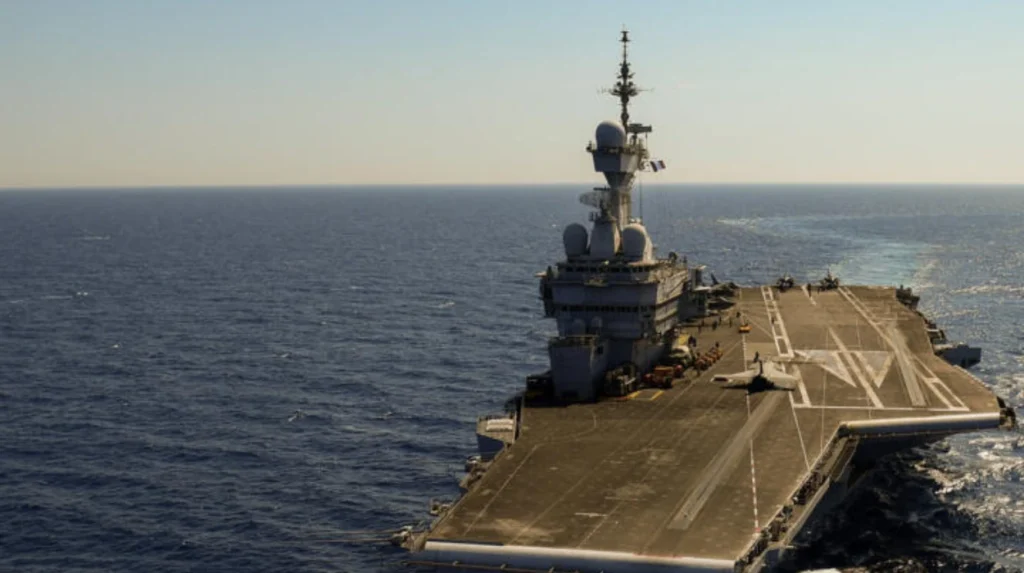
The move by France to put a big naval fleet to the eastern Mediterranean is one of the most apparent European military reactions to the growing threat between Iran and its Western allies. The repositioning of the warship Charles de Gaulle and its escorting warships is a strategic move to stabilize sealanes and console the partners in Europe as the situation went beyond the Persian Gulf.
The attack follows Iranian acts of retaliation against U.S and Israeli attacks during the previous months of 2026. Drones attacks, missile threats, and the interruption of shipping in the sea have caused apprehension that the conflict may extend to the wider Europe region waters that pose a threat to the security of the south. The French authorities justified the deployment by a defensive operation that would safeguard shipping lanes and allied infrastructure as well as European nationals who resided in the region.
President Emmanuel Macron confirmed repositioning of naval resources, visiting Cyprus and noted that the mission is done to secure without increasing hostilities. The date is indicative of a mounting apprehension in Europe of the possibility of instability in the Middle East to rapidly impact on the Mediterranean shipping routes, energy supplies, and the stability in the region.
Strategic redeployment of the Charles de Gaulle carrier group
The center of the France naval offensive is the nuclear-powered aircraft carrier Charles de Gaulle, the flagship of the French Navy. With its entry into the eastern Mediterranean, it begins to shift the previous NATO operations in north waters to a more crisis-focused response.
Carrier capabilities and strike aviation presence
The Charles de Gaulle is armed with Rafale fighter jets which can be used in air defense, reconnaissance operation and precision strike missions. The aircraft is supported by E-2C Hawkeye early warning planes which give it coverage over large portions of the airspace.
Combined, the capabilities enable the carrier group to track any potential missile launch, drone activity, as well as any threat in the water along the Mediterranean and in the surrounding routes of the Gulf. Naval strategists perceive the presence of the carrier as a defensive ring and a great deterrent.
The launch of the carrier also highlights the capacity of France to have air force power without the use of land bases. Carrier aviation allows flexibility in the long-term work in the conditions when regional airports or military bases are a target of attack.
Escort vessels and layered naval defense
The carrier group is escorted by a fleet of support ships, such as sophisticated multi-mission vessels and air-defense frigates. The networks of warships like Alsace, Chevalier Paul, and L’Amiral Ronarc h create a network of protection that is designed to block missiles, drones, and other aerial attacks.
Such vessels have advanced radar and missile interceptors that can pick up any incoming threats at a great distance. Having them increases the defensive zone of the carrier and also allows patrols to be conducted in strategic sea routes.
According to French naval leaders, the formation can ensure continuous sea patrol which is a key aspect since airspace blockages and military action in the region make traditional surveillance techniques challenging.
Expansion of naval patrols across strategic maritime routes
The carrier group alone, France has extended its efforts in patrol operations in a number of different maritime theaters related to the overall conflict. Other frigates have also been deployed in waters that extend to the eastern part of Mediterranean to the red sea and approaches the strait of Hormuz.
Frigates securing shipping corridors
A number of French multi-mission frigates are now working at the points where the delivery of energy and commercial traffic are especially subject to interference. These ships track routes of the tankers and coordinate with global security operations in the oceans.
The frigate Languedoc was stationed off Cyprus on the indications of a drone attack on bases of the region. Its use shows how fast naval forces are able to manoeuvre to counter arising threats.
Securing commercial shipping has turned into one of the primary missions. The European economies have been reliant on the energy movements in the Middle East by sea, and any disruption would soon have an impact on the world oil markets.
Amphibious ships supporting regional flexibility
France has also sent amphibious vessels which can carry troops, helicopters and emergency supplies. The carrier Tonnerre of the Mistral-class gives some extra flexibility in the operations of humanitarian evacuations or reinforcement efforts.
These ships can be used to quickly move staff to the coastal bases in case the security situation worsens. They are also able to aid civilian evacuation in the case where commercial travel cannot be made possible.
Amphibious capabilities thus enhance the defensive mission of the carrier group which offers them the logistical depth and alternative options of contingency planning.
Integration with European security initiatives
The naval onslaught of France does not work alone. The operation is coincidental with wider European security operations aimed at protecting seaways that are endangered by local tensions.
Connection to EU maritime mission Aspides
In 2024, the European Union launched a naval operation named Operation Aspides involving two French frigates to defend ships based on attacks by regional proxy groups. The mission initially aimed at threats at the Red Sea, but it has grown with instability spreading.
Participating in Aspides, France enhances a maritime security framework of Europe and does not lose national control over the carrier group.
Military analysts consider such a dual structure as the example of the changing defense coordination in Europe. National forces are able to react fast to crises even as they assist in multinational security policies.
Cooperation with regional partners
The naval presence of France also entails collaboration with the partners in the Mediterranean and the Gulf regions. Cyprus has enhanced radar surveillance through the help of the French and the military bases in the region offer logistical support during aircraft and surveillance missions.
Jordan and the United Arab Emirates have even collaborated with the French defense planners at the initial phases of the war. This kind of cooperation signifies existing long-standing security relationships between France and some of the states in the Middle East.
In the case of Paris, these alliances are used to stabilize the region and in the process ensure that no European forces lose operational access to strategic infrastructure.
Balancing NATO obligations and strategic autonomy
The relocation of activities on the exercises of the north of Europe underlines the attempt of France to reconcile NATO obligations with the independent strategic stance. The carrier group had already been involved in allied training operations off the Baltic Sea but later moved south to the Mediterranean crisis area.
Strategic autonomy in French defense policy
France has traditionally stressed the idea of a strategic autonomy, the ability to react to any crisis without having to use foreign assistance fully. This is demonstrated by the naval surge.
Although the deployment aligns broadly with Western security concerns, French officials have avoided framing the mission as part of a coordinated military campaign against Iran. Instead, they emphasize protection of maritime stability and allied territories.
This approach allows Paris to support European partners while maintaining diplomatic channels that could prove useful in future de-escalation efforts.
Operational pressures on the French navy
Sustaining such a large deployment places significant demands on the French Navy. Long-distance operations require logistical support ships, rotating crews, and constant coordination with allied fleets.
The presence of supply vessels such as the Jacques Chevallier replenishment tanker enables the fleet to remain operational for extended periods. These logistical assets are essential for maintaining a continuous maritime presence.
However, defense analysts note that prolonged operations could stretch naval resources if the conflict persists or expands into additional theaters.
Geopolitical signals conveyed by the naval deployment
The scale of France’s naval surge sends multiple signals to actors across the region. On one level, it reassures European allies and commercial partners that maritime security remains a priority. On another, it communicates deterrence toward actors considering further attacks on shipping or regional bases.
The eastern Mediterranean has historically served as a strategic crossroads linking Europe, North Africa, and the Middle East. By positioning its carrier group there, France places a powerful symbol of European military capability within reach of several potential flashpoints.
Iranian officials have framed Western naval deployments as evidence of escalating militarization in the region. Yet French leaders continue to stress that their forces operate in international waters and maintain a defensive posture.
The broader geopolitical impact may depend on how the conflict evolves. Naval presence can deter immediate threats, but it also reflects the growing entanglement of European security interests with Middle Eastern instability.
As the Charles de Gaulle patrols Mediterranean waters and its aircraft scan skies increasingly crowded with surveillance drones and defense systems, the deployment raises a strategic question about Europe’s role in a rapidly shifting regional balance. Whether the naval surge ultimately stabilizes trade routes or merely contains the early stages of a wider confrontation may shape how European powers approach maritime security long after the current crisis subsides.