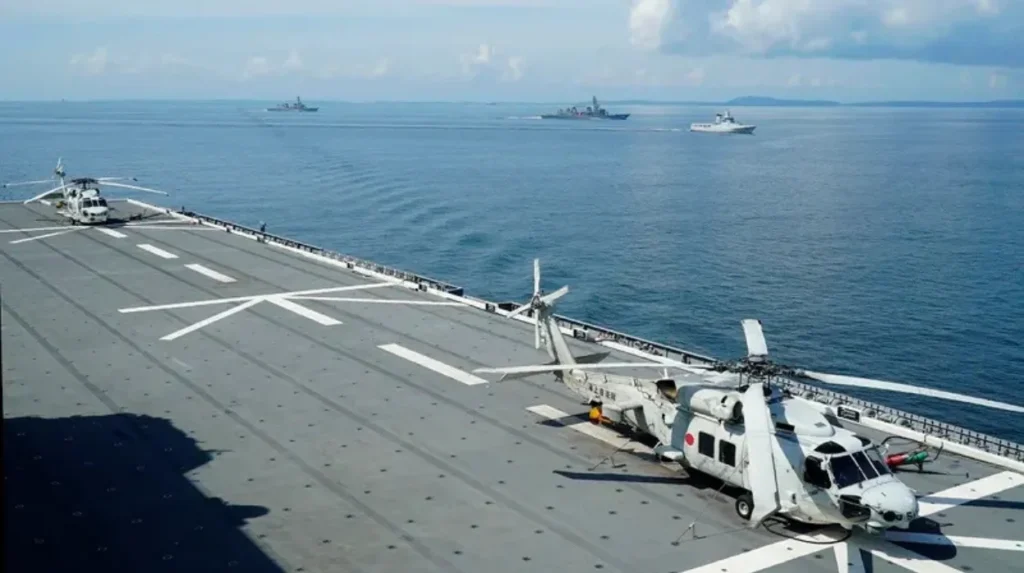
The Naval Surge of France has attracted international interest following the deployment of large naval forces to the Eastern Mediterranean by Paris in the growing tensions in the region in the early part of 2026. On March 6, the amphibious helicopter carrier French ship Tonnerre (L9014) was sent to support an already growing French naval presence, which also includes the aircraft carrier French aircraft carrier Charles de Gaulle (R91). Emmanuel Macron ordered the deployment when violence escalated in the Middle East.
The French military reasoned the action as a defensive act and not offensive. Nevertheless, the excess of high value naval forces in the areas of conflict is bound to bring concerns on the intentions of the buildup. This is timed with a turbulent time due to the Israeli military operations in Lebanon, Iranian proxy and an escalation of the tension against US-Iran conflicts in the earlier part of the year in 2026.
The French decision is based on centuries old doctrine of operational preparedness in the Mediterranean, the place the European security calculations have traditionally considered as a center.
2025 Foundations Of France’s Regional Posture
The current deployment of France is based on the operational ground in 2025. The same year witnessed massive military operations like ORION 26 which was aimed at testing expeditionary operations and joint operations in high intensity conflict conditions.
The group of Charles de Gaulle carriers strike also worked on the Lebanese coast in times of increased Israel-Hezbollah friction in 2025. The deployed exercises practiced evacuation operations and maritime security missions, which provided viable guidelines on how to react to unforeseen crises that impacted the European citizens in foreign countries.
These drills showed a larger strategic trend: Paris is growing more and more dependent on flexible naval power as a means of dealing with military deterrence and humanitarian contingencies.
Regional Triggers For The Current Deployment
Increasing violence in Lebanon and the rest of the Middle East made the decision-making process of France quicker. Accounts of the high death tolls of Israeli attacks and retaliatory drone attacks against Western bases have helped in giving the impression that the situation in the region was continuing to worsen.
The French officials also forcefully enhanced air service to Gulf allies, such as security schemes of Rafale fighter planes in the United Arab Emirates. The naval outburst is thus an extension of a wider position undertaken by the protection of the French nationals, military bases, and business in the region.
Operational Capabilities Of The Tonnerre Deployment
With the introduction of the Tonnerre, it is possible to have a versatile platform of operation that can be used to support many types of missions. Planned to serve as a multipurpose amphibious assault vessel, it can also serve to act as a base of logistics and a command centre in case of a crisis.
Its proximity and the Charles de Gaulle strike group is very much sighted in increasing the capability of France in undertaking quick response operations in unstable settings.
Amphibious And Humanitarian Capacity
Under emergencies, the Tonnerre can transport up to 1,500 evacuees, helicopters, landing craft, armored vehicles and landing craft. It has onboard medical capabilities and therefore injured civil populations or soldiers can be treated during evacuation missions.
These features are especially applicable in areas where it is unpredictable that access to the airport will be possible because of conflict. In the case of airways disputes or blockage, maritime evacuation offers a suitable resort.
This type of platform has been used by France in the past to rescue its citizens in the unsafe areas during coordination of humanitarian aid.
Integration With Carrier Strike Operations
The strategic aspect of the deployment of the tonnerre is the strategic value of combining this deployment with the Charles de Gaulle carrier group. The two create a strong maritime force that has the capability of maintaining air operations, surveillance missions, and amphibious operations.
The Rafale fighters that are carrier based have the effect of encompassing large areas of sea with air defense in addition to the supporting frigates protecting sea routes and offering missile defense. This stratified system enables the French Navy to alternate quickly between deterring and evacuation missions. This is what the maritime strategy of France is all about.
Escalation Concerns And Strategic Signaling
The Naval Surge conducted by France cannot help but relay some form of geopolitical message in spite of its declared humanitarian agenda. Such large-scale military deployments can also have a message to the allies and the enemies alike, that they are ready and willing.
Although Paris maintains that the mission is defensive in nature, the pulling of the European naval power towards the areas of active conflict can be seen as a means of deterrence.
Deterrence Toward Regional Armed Groups
The French authorities have pointed out the necessity to safeguard the local stability and guarantee sea security. The availability of high-tech naval equipment is a strong reminder to non-state agents and local militants that any attempts to assault the Western interests may lead to a highly organized response.
The signaling of such has precedent. In past crises in the Mediterranean, the naval presence of the European powers was used to deter problems by showing that they could respond quickly to any threat.
There is however risk involved with deterrence. Installation of military resources near areas of instability raises the chances of false estimation or unintentional conflict.
European Strategic Autonomy
The leadership position in this deployment indicates that France is more ambitious in increasing strategic independence in Europe. As much as the coordination with the NATO allies is done, Paris has severally pointed out that Europe must have its own crisis response capabilities.
The naval onslaught consequently has a dual symbolism, on the one hand, getting in touch with the Western allies and, on the other hand, the power of France to act as a guarantor of security in the Mediterranean basin.
The method has been popular in recent years, as European governments reconsider their role in defense in the face of power politics in the international system.
Evacuation Planning And Civilian Protection
On top of strategic signaling, humanitarian concerns are still key to the decision of France. Over 100,000 French nationals live in the Middle East with a big population of Lebanon and Gulf states.
When the infrastructure is downed or the airports are shut down, it is almost certain that the most effective means of extracting people quickly is through naval evacuation in case of a crisis.
Lessons From Past Evacuation Missions
In recent decades, France has had several evacuation exercises including massive repatriation efforts in regional conflicts. The use of a naval platform became very instrumental in removing civilians in cases where there was disruption of the commercial transport networks.
The battle experience in these operations has informed how France goes about crisis-response planning. The amphibious vessels such as the tonnerre are now commonly included in evacuation plans.
These preparations are an indication of a realization that humanitarian goals have to be reinforced by military means in the event that geopolitical instability endangers the lives of civilians.
Logistical Coordination Across The Mediterranean
Cyprus has also become a major logistical centre in the evacuation planning because it is close to Lebanon and other hotspots in the Eastern Mediterranean. The presence of French naval ships off the island could make the shuttle operations between the conflict zones and safe reception zones fast.
The presence of frigates and air patrols will make sure that evacuation routes are not used due to the drone threats or due to the missiles. This multifaceted solution can be worked out to respond flexibly to the development of a crisis.
The Mediterranean geography which was the center of European defense planning again emerges as a significant crisis management theater.
Strategic Implications For Europe And The Middle East
France’s Naval Surge reflects broader transformations in regional security dynamics. European powers increasingly find themselves balancing humanitarian responsibilities, alliance commitments, and geopolitical competition.
The deployment also highlights the interconnected nature of Middle Eastern conflicts and European security interests.
Economic considerations further complicate the picture. Energy flows, shipping routes, and defense partnerships link European economies to stability in the Mediterranean and Gulf regions. Naval presence therefore serves not only military objectives but also economic security.
As the Tonnerre and the Charles de Gaulle move deeper into operational zones, the distinction between precautionary positioning and strategic escalation becomes increasingly difficult to define. Naval deployments intended for evacuation readiness can quickly evolve into deterrence missions if hostilities expand. Whether France’s posture ultimately proves to be a stabilizing buffer or a prelude to broader international involvement may depend less on Paris’s intentions than on how rapidly the surrounding conflicts continue to unfold.