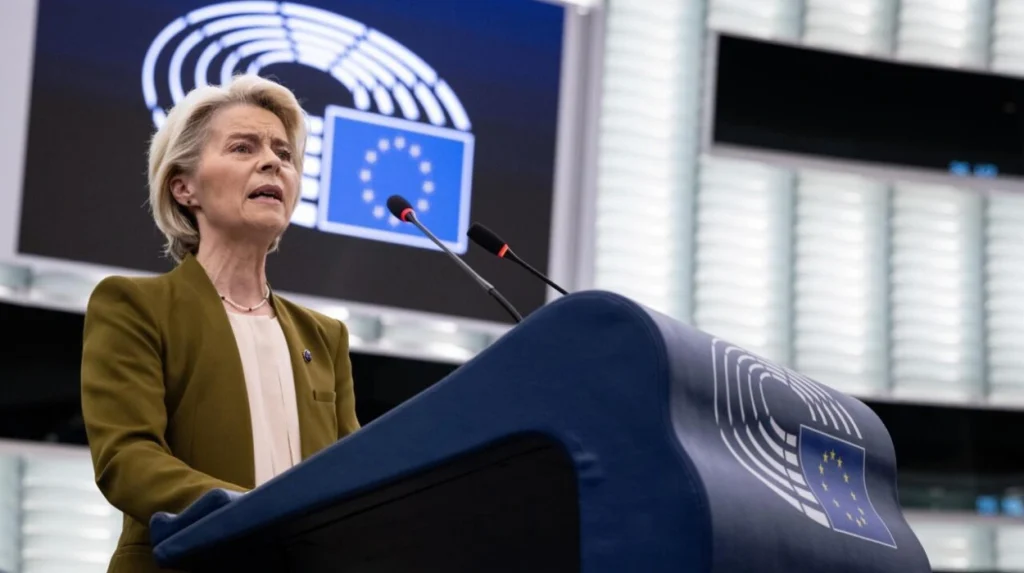
European Commission President Ursula von der Leyen has warned the European Union that it must shed its “traditional caution” and speed up its efforts to build a stronger economy and military in the face of growing global instability. Speaking to the European Parliament, she said that the international order is moving towards a world where “raw power” will be the only rule.
The comments from Von der Leyen come as US President Donald Trump is set to attend the World Economic Forum in Davos, Switzerland, where he is likely to ramp up his rhetoric and threats, including tariffs, against European allies. The warning from the Commission president is a reflection of the concern in Brussels about a number of geopolitical hotspots, ranging from Greenland to the Ukraine conflict and the Middle East and Indo-Pacific regions.
“The shift in the international order is not only seismic, but it is permanent,”
von der Leyen told lawmakers. She said the EU must prepare for a world where power is expressed through economic pressure, military strength, and technological dominance.
“We will need a departure from Europe’s traditional caution,”
she said.
“We now live in a world defined by raw power—whether economic or military, technological or geopolitical. And while many of us may not like it, we must deal with the world as it is now.”
Tariffs and Transatlantic Tensions: A Growing Threat to EU Stability
Von der Leyen called Trump’s tariff threat against European allies “simply wrong,” saying that a “downward spiral between allies” would only serve to further Russia and China’s interests.
“If we are now plunging into a dangerous downward spiral between allies, this would only embolden the very adversaries we are both so committed to keeping out of the strategic landscape,”
she said.
The concerns of the European Commission are rooted in the potential economic damage that the tariffs could inflict. The EU and the US are each other’s largest trading partners, and their trade in goods and services is in excess of €1.2 trillion ($1.3 trillion) in 2023. The tariffs could impact the supply chains that extend from both sides of the Atlantic, including industries such as aerospace, automotive, agricultural, and technology. Economists have indicated that a severe transatlantic tariff dispute could lower EU GDP growth by as much as 0.5 percentage points.
Europe’s Defense Spending Still Falls Short of NATO Targets
The call for accelerated defense buildup by Von der Leyen is made in the context of continued concerns about the level of Europe’s defense spending compared to the NATO targets. According to the NATO defense guidelines, NATO member countries are expected to allocate a minimum of 2% of their GDP to defense spending, with 20% of the allocated funds going to major equipment and modernization. As of 2024, only 10 of the 31 member countries of NATO have been able to allocate 2% of their GDP to defense spending, with Germany allocating 1.6%, Italy 1.4%, and Spain 1.3%.
The EU has been attempting to improve the cooperation of defense through the European Defence Fund (EDF), which aims to coordinate spending on defense and improve joint procurement. The budget allocated to the EDF for the period 2021-2027 is €8 billion, which will be used to support research and development in military capabilities. Nevertheless, some critics have argued that Europe lacks the necessary industrial base and strategic vision to effectively deter Russia and China.
Greenland, Ukraine, and the Indo-Pacific: A Multi-Front Challenge
Von der Leyen cited the case of Greenland as one of the most recent examples of the geopolitical challenges faced by the EU in its closest relationship. The attempt by Trump to get the mineral-rich Arctic landmass from Denmark has led to a diplomatic crisis among European leaders. The significance of Greenland is that it is located between North America and Europe, and therefore it is of great importance in terms of early warning systems, Arctic defense, and new shipping lanes. Greenland also has large reserves of minerals like rare earth.
The European Union has also been actively engaged in helping Ukraine in its fight against Russia. Since 2022, the European Union has committed more than €80 billion to support Ukraine financially and militarily. Apart from this, the European countries have also committed billions of euros to Ukraine in bilateral military assistance. The conflict in Ukraine has led to the death of tens of thousands of people and has left millions displaced, as estimated by the United Nations.
At the same time, the situation in the Middle East and the Indo-Pacific has further emphasized the EU’s need to enhance its strategic autonomy. The European Union has come to regard China as a systemic rival and Russia as a strategic threat, and the United States’ policies have increasingly called into question the reliability of transatlantic security commitments.
A Strategic Shift: Europe’s Search for Independence
The appeal by Von der Leyen to unity, urgency, and determination reflects a paradigm shift in the strategic thinking of Europe. The EU is attempting to minimize its reliance on external actors in core sectors such as energy, defense, and technology. This is evident in the initiatives taken by Europe to diversify energy sources, enhance semiconductor production, and promote defense cooperation.
The EU’s strategic autonomy agenda has recently picked up speed in the wake of Russia’s invasion of Ukraine, as the EU seeks to ensure its supply chains and develop its own industrial base. Nevertheless, experts state that Europe still has a number of challenges in developing a unified strategy on defense.