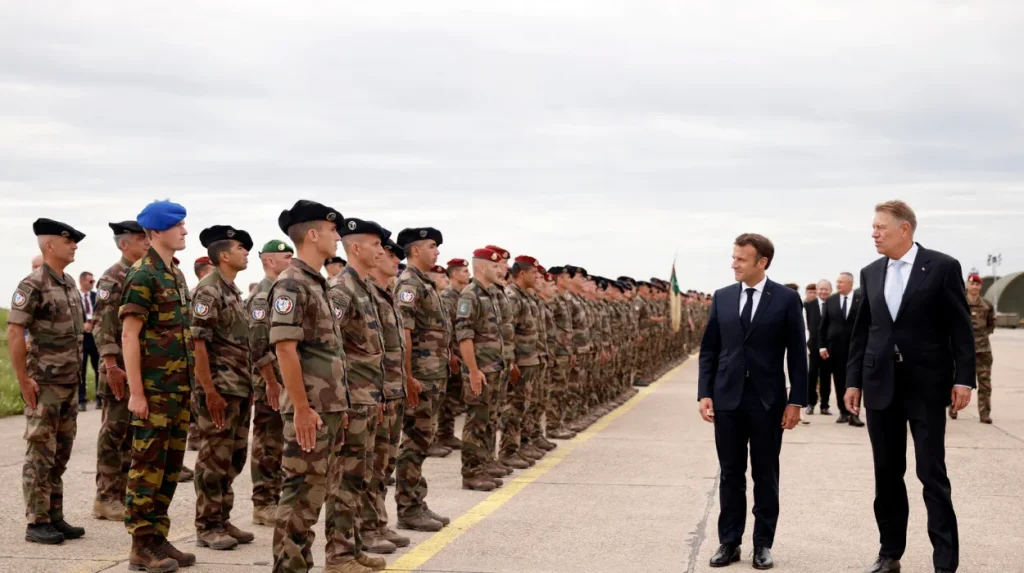
On Thursday, French President Emmanuel Macron presented a detailed plan to key political leaders outlining the deployment of several thousand French soldiers to Ukraine, contingent on the conclusion of a peace agreement with Russia.
The announcement prompted cautious and critical reactions, particularly concerning the reliability of US support for these troops.
“We shouldn’t be naive about Trump’s words; his fickleness is remarkable,”
said Marine Tondelier, leader of the Green Party, following the meeting.
La réunion de Paris acte une unité sans précédent entre la Coalition des volontaires, I'Ukraine et les États-Unis sur la dimension centrale des garanties de sécurité pour une paix juste et durable en Ukraine. pic.twitter.com/n1DxjGP0cU
— Emmanuel Macron (@EmmanuelMacron) January 6, 2026
What is the scale of the planned French deployment?
According to officials, the proposed multinational force would consist of two brigades totaling around 10,000 troops, including 6,000 French soldiers. Leaders warned that this represents “an enormous commitment” and stressed that operational details, including types of equipment and command structure, have already been drafted and centralized at Mont-Valérien near Paris.
Mathilde Panot, leader of the France Unbowed (LFI) deputies, said her party opposes deployment under current conditions and insists that any French troops sent abroad should operate under a UN mandate.
“There is no reason to trust President Trump, especially given his aggressive actions in Latin America, including Venezuela,”
Panot added, criticizing Macron for a delayed response to violations of international law.
How reliable are US guarantees for European security?
Macron welcomed the US support for European security guarantees, highlighting the role of ground forces as a deterrent against further Russian aggression. However, opposition leaders and analysts remain skeptical about Washington’s long-term commitment.
Together, we are building a robust security architecture for Ukraine.
— Emmanuel Macron (@EmmanuelMacron) January 6, 2026
Ensemble, nous bâtissons une architecture de sécurité robuste pour l’Ukraine.
Разом ми будуємо надійну безпекову архітектуру для України.
🇺🇦🇫🇷 pic.twitter.com/PY673mHTWP
“Allow us to doubt the sincerity and stability of these advances,”
Tondelier remarked, emphasizing the uncertainties of relying on an administration with a history of abrupt foreign policy shifts.
Fabien Roussel of the Communist Party added:
“We do not trust President Putin or President Trump. Deploying French troops risks escalating the conflict across Europe, rather than containing it.”
What are the political reactions in France?
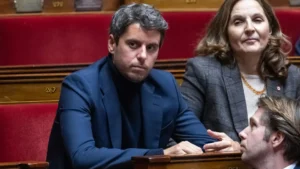
The announcement sparked muted responses in parliament. Many leaders, including Jordan Bardella and Marine Le Pen of the National Rally, Bruno Retailleau for The Republicans, and Gabriel Attal for Renaissance, left the closed-door meeting without comment. Edouard Philippe (Horizons) was absent due to a red storm alert.
Cédric Perrin, president of the Senate’s Foreign Affairs and Defense Committee, confirmed that Macron outlined precise operational charts and stressed that the Ukrainian forces would remain on the front line, with the multinational contingent operating far from direct combat zones.
A parliamentary debate on the deployment is expected within 15 days to three weeks, per Article 50-1 of the French Constitution, with or without a vote.
How has Russia responded to the proposed force?
Russia has condemned the multinational force plan, warning that any Western military presence on Ukrainian soil would be considered a “legitimate target.” This escalates tensions and raises the stakes for deployed troops. Analysts note that even distant deployments carry strategic and political risks, as the multinational force could be drawn into clashes if the ceasefire fails.
Are there risks of escalating the war?
Critics warn that the deployment may unintentionally broaden the conflict beyond Ukraine, particularly if the US or European allies fail to maintain credible guarantees. The presence of thousands of foreign troops in Ukraine could be used by Russia to justify retaliatory actions, potentially destabilizing the region.
Experts also question the feasibility of coordinating multinational troops with different rules of engagement, equipment, and command structures, highlighting logistical and political challenges.
What next for France and Europe?
Macron stressed that Europe must safeguard its interests while ensuring any troop deployment is structured, legally sanctioned, and accountable. He also emphasized the need to coordinate closely with parliament and allies.
The outcome depends not only on diplomatic agreements but also on the reliability of partners, the evolution of the Ukraine-Russia conflict, and the willingness of European nations to commit forces without escalating tensions.
Observers suggest that France faces a delicate balancing act: projecting strength and solidarity with Ukraine while avoiding entanglement in a wider war, especially amid uncertainty over US and Russian intentions.
- The scale of the French commitment (6,000 troops) is historically significant, comparable to France’s largest post-Cold War foreign deployments.
- The timing of the deployment, contingent on a peace deal that may be months or years away, increases uncertainty for force planning and budgetary allocations.
- Critics warn that Macron’s plan could politicize the military, forcing France to navigate internal parliamentary divisions and public skepticism.
- Analysts caution that the US-led monitoring mechanism for the ceasefire has limited credibility, given past instances of inconsistent US enforcement of international agreements.