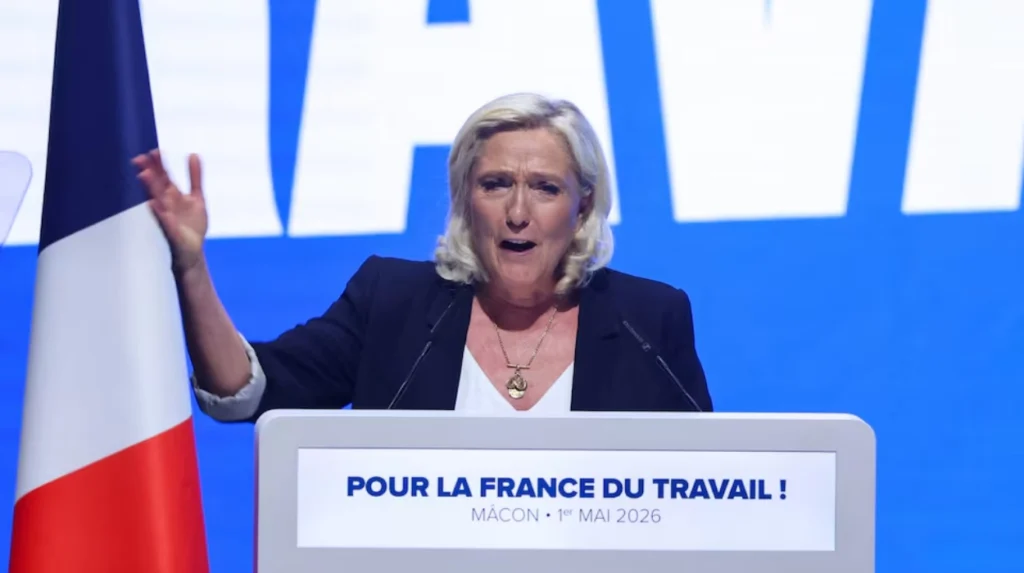
Once again, the controversial French far-right leader Marine Le Pen has raised the debate surrounding the position of France in the military command structures of NATO, claiming that the country must leave NATO’s integrated military command structure, yet remain part of the organization. In a string of recent speeches and interviews held in May 2026, Le Pen made the case that such a decision is required to regain French independence and reduce reliance on American influence over decisions in the transatlantic alliance. Her stance comes at a time when there are ongoing negotiations in Brussels and Ottawa on burden sharing and U.S. involvement in NATO.
However, Le Pen’s idea is nothing new; it gains relevance amid the current disputes regarding the Ukraine crisis, European spending on defense, and the role of NATO in the future. She argues that France would be able to protect its interests as well as engage in collective defense without becoming subservient to NATO’s military structure.
In her words:
“France must regain full control over its defense decisions while continuing to cooperate with allies when our interests align.”
The statement encapsulates her long‑running narrative that national sovereignty should trump supranational or U.S.‑led command arrangements, even as it risks straining long‑standing Franco‑American and intra‑European defense ties.
What Le Pen Specifically Proposes
The central tenet of Marine Le Pen’s position in the present day is a well-articulated yet balanced stance: France will continue to belong to NATO both politically and in terms of its defense, but it will no longer be a participant in the organization’s system of integrated military commands. Such an approach derives directly from Le Pen’s previous promise – made in her other campaigns for president, including in 2022 – that in case of winning, she would take France out of NATO’s integrated military command and develop an independent policy of national defense. According to supporters of the idea, an advanced country like France is able to make its own security decisions independently of NATO.
According to her recent statement, Le Pen’s withdrawal from the alliance does not equate to abandonment of its allies or non-cooperation with them in matters of military activities. Rather, what she is advocating is the formation of a system where the French will conduct military activities, exchange intelligence and coordinate deployments based on individual cases rather than being integrated into NATO command structure. It was also connected to the call for full military independence of the country.
In her own framing:
“Our soldiers must answer to French strategy, not to a foreign command center.”
That language underscores a long‑standing nationalist thread in her foreign‑policy thinking, which treats operational independence as a prerequisite for genuine sovereignty.
Historical Precedent: France’s 1966 Withdrawal
The request that Le Pen makes regarding France leaving the command structure of NATO brings back memories of another very significant event in the Cold War era when General Charles De Gaulle withdrew France from the NATO integrated command structure but remained part of NATO politically in 1966. At the time, De Gaulle intended to ensure that France retained its independence from American control and protect its nuclear arsenal and strategy from decision-making within the United States. This meant that the NATO command structure was moved from Paris, but it did not result in France leaving NATO.
Le Pen’s advisors and allied commentators now frequently invoke this precedent, arguing that France can once again shield its sovereignty without breaking with NATO itself. One senior analyst close to the far‑right camp remarked that
“what de Gaulle did in 1966 was to preserve our nuclear independence; what we propose today is to restore full political control over our military engagements.”
The historical parallel is not lost on French officials from other parties, many of whom warn that conditions in 2026 are far more complex than during the Cold War, with a more integrated NATO command, shared intelligence systems, and highly interdependent European defense industries.
How Le Pen Justifies the Move
According to Marine Le Pen and her associates, there are sovereignty and strategy considerations involved in the proposition, along with skepticism about the current decision-making processes within NATO. One of the key elements in the discourse is the fact that France’s army can only be utilized where national interests are concerned, but NATO’s command structure makes the lines blurred.
She has repeatedly criticized what she describes as “automatic subordination” of French forces to decisions taken predominantly in Washington, arguing that this undermines democratic accountability at home.
In addition, she has cited the conflict in Ukraine and the broader shift in European security to back up her claims. According to her, the current situation has demonstrated that Europe is forced to shoulder more of the responsibility of defending itself, rather than depending on NATO and the U.S. to dictate the course of action. Le Pen believes that France needs to build strong relations with other European nations who share common goals with it regarding security issues in the Mediterranean and Africa.
In one recent interview, she asserted:
“NATO must be a tool for France, not the other way around; we will decide when and how we deploy our forces.”
This framing resonates with a segment of the French electorate that distrusts foreign influence in domestic affairs and views NATO as an institution that sometimes drags France into conflicts that do not directly serve its core interests. Opinion polls over recent years have shown fluctuating but persistent support for a more independent French defense posture, especially among voters who favor national sovereignty over deeper European integration.
Reactions From French Officials and Allies
The idea of France leaving NATO’s integrated command has drawn mixed but largely critical reactions from French officials, European partners, and Washington. French government spokespeople have warned that such a step could complicate interoperability, intelligence sharing, and joint planning, all of which depend on common command structures, doctrines, and communications systems. A senior defense official in Paris told reporters that
“you cannot pick and choose which parts of the alliance work for you; the system is designed to function as a whole.”
Allies across Europe, especially the Eastern Europeans who depend heavily on the NATO guarantee of collective defense, fear that a possible French exit from the unified command would lead to division within the military organization when global politics is getting more competitive. Polish and Baltic leaders have been especially critical of the possibility of splitting the NATO command system, which could be misinterpreted by Russia as a signal of a loss of Atlanticist commitment.
U.S. policymakers have shown caution in their statements, although there have been reports in closed meetings that the American leadership sees the French initiative as posing a threat to the existing balance of power within the alliance.
One senior NATO diplomat, speaking on condition of anonymity, summed up the concern by saying:
“If France steps back from the command structure, it sends a signal that some members are no longer willing to fully integrate their forces, and that undermines the credibility of the entire deterrence framework.”
Political and Electoral Implications
The revived attention to NATO among the other issues in the sphere of foreign policy is also politically relevant for Le Pen in a domestic context. In the highly polarized political atmosphere of contemporary France, Le Pen’s position on the matter of defense and independence will help distinguish her from centrist and mainstream parties that usually support closer cooperation within NATO and in European defense projects. Survey results show that although a large share of the French electorate remains supportive towards the NATO affiliation of their country, a relatively sizable part of the electorate would not mind reconsidering the involvement of France in NATO’s command structure in case it brings more independence for France.
As far as Le Pen herself is concerned, this problem serves as one of the instruments that she uses to promote a broader agenda of revival and opposition towards the internationalized elite. On the other hand, there are numerous criticisms of the way she tries to utilize NATO and defense issues in order to instill fear in people.
One center‑left lawmaker remarked that
“her rhetoric sounds strong, but it lacks a concrete plan for how France would actually coordinate with allies in a crisis outside the NATO command.”
Potential Impact on European Defense
Beyond Franco‑American relations, Le Pen’s proposal raises difficult questions about the future of European defense architecture. If France were to leave NATO’s integrated command, it would likely intensify debates about whether Europe needs a more autonomous defense structure, potentially separate from NATO’s existing framework. Some French strategists aligned with her camp argue that such a shift could accelerate the creation of a genuinely European defense pillar, combining national forces with a more flexible, sovereignty‑respecting command.
However, military planners and security experts warn that duplicating command structures or creating parallel systems could dilute resources and complicate coordination. Many officers stress that common command arrangements are what make rapid joint deployments, integrated air defenses, and large‑scale exercises possible. A senior European defense analyst noted that
“the beauty of the current system is that it allows forces from different countries to plug into the same network; if France walks away from that, it risks creating a gap that no one can easily fill.”
How This Fits Into Le Pen’s Broader Foreign‑Policy Vision
Le Pen’s NATO stance is best understood as part of a broader foreign‑policy agenda that emphasizes sovereignty, national interest, and skepticism toward supranational institutions. She has consistently argued for a more cautious French approach to international interventions, a withdrawal from certain overseas military engagements, and a reorientation of defense priorities toward homeland security and regional stability. In this context, exiting NATO’s integrated command fits neatly into a worldview that treats foreign commitments as optional rather than automatic.
At the same time, her rhetoric has evolved over the past decade. While she once expressed skepticism about NATO’s purpose altogether, she now insists that France’s place in the alliance remains important; the issue is about how that membership is structured, not the alliance itself. In one of her more recent speeches, she stated:
“I will defend France’s membership in NATO, but I will never accept that our armed forces are placed under the permanent authority of a foreign command.”
That nuance reflects an effort to reassure voters that she is not seeking isolation but rather a recalibrated form of cooperation.