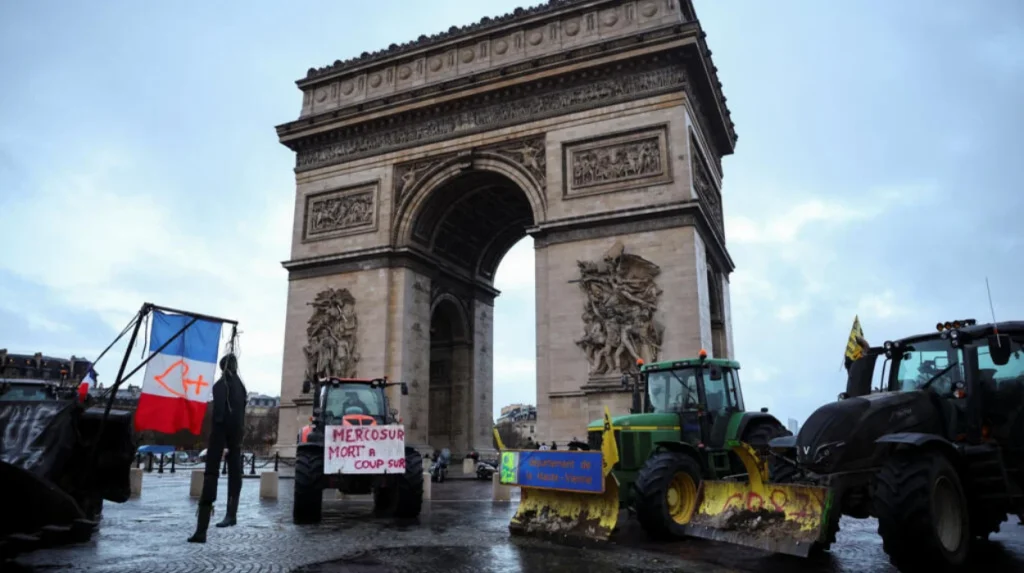
French farmers marched through the heart of Paris Thursday, reaching as far as the Eiffel Tower, in a show of opposition to a free trade agreement between the European Union and the South American Mercosur group of countries. The protests are linked to further frustration with the government related to an outbreak of a devastating cattle disease.
The European Union vote to ratify the deal has been pushed back by France. The deal with Mercosur, a group of South American countries, took a year to conclude and has been 25 years in the making. This deal will allow Europe to export goods to South America to protect them from tariffs imposed by the U.S. and also from competition from Chinese goods. Farmers from Europe, however, are afraid that lower agricultural and environmental standards will jeopardize their jobs.
What exactly does the EU-Mercosur trade deal include?
This would be the largest free-trade agreement Brussels has ever sealed in terms of tariff relief, pending ratification from all sides, between the European and South American blocs. Long in the making, negotiations started in 1999 but hit several snags, as diverse interests clashed: EU farmers were concerned about cheap imports, while environmentalists were up in arms against Amazon deforestation.
The agreement aims at a reduction in tariffs and the increase of trade opportunities, where the EU would export automobile, machinery, and wines to the nations of Mercosur, while South America would enjoy fair trade opportunities through the importation of beef, sugar, soybeans, and rice. Presently, the Mercosur group charges a tariff of up to 35% on all EU products, while the EU charges a tariff of about 15% on the agricultural products of the nations of South America. The agreement will see the elimination of all tariffs with a specified timeline, apart from the major agricultural products.
The EU is the second-biggest trading partner of Mercosur, exporting 57 billion euros (67bn USD) in 2024, along with being its biggest foreign investor, putting in 390 billion euros (458bn USD) as of 2023. European Commission President Ursula von der Leyen will soon visit Brazil to sign the pact, which will establish a global free-trade area.
Why is France trying to delay ratification?
The biggest agricultural producer in the EU, France, is trying to mobilize other member countries in order to come up with a blocking minority. The French government wants better protection for agricultural producers before it adopts the agreement. As many as 10,000 farmers will protest in Brussels during the EU leaders summit.
The European Commission also proposed actions such as halting imports if numbers increase by 10% and/or price cuts of the same percentage. However, these safeguards are deemed “incomplete” by countries such as France. Economy Minister Roland Lescure stated, “The treaty is simply not acceptable,” and Prime Minister Sebastien Lecornu asked for a delay in the vote even before von der Leyen’s visit to Brazil on Dec 20.
The push to delay also coincides with domestic challenges, including a parliamentary vote on the budget and ongoing protests over the lumpy skin disease outbreak, which has triggered cattle culls. Opposition to the deal spans France’s political spectrum, with far-right and far-left parties criticizing the government for yielding to Brussels.
France has set three conditions for approval:
- Safeguards to halt imports in cases of dumping
- “Mirror clauses” ensuring Mercosur products comply with EU pesticide rules
- Tighter food safety inspections
If unmet, France could attempt to block the deal entirely.
How could France block the trade agreement?
A blocking minority requires at least four EU member states representing 35% of the population. Alongside France, Ireland, Poland, Hungary, and Austria have openly opposed the deal. Denmark, which currently holds the EU presidency, must decide whether to proceed with the vote. If it ignores dissenting countries, the agreement could fail.
What positions are other EU member states taking?
Poland, Hungary, Austria, and Ireland have lined up in support of the France’s, with Polish Agriculture Minister Stefan Krajewski declaring, “Any postponement is a very good signal.” The Dutch have not yet made a statement.
The European Commission emphasizes that signing is very important from an economic, diplomatic, and geopolitical point of view. Commission spokesperson Olof Gill declared,
“In the view of the Commission, signing the deal now is a matter of crucial importance,… and credibility on the global stage.”
This is shared by a representative of business in Germany, Volker Treier.
Are there environmental concerns about the deal?
Many EU members oppose the agreement over Brazil’s failure to curb Amazon deforestation. Critics warn that increased beef exports could accelerate forest clearing. At the 2019 G7 summit in Biarritz, then-European Commission President Donald Tusk warned that ratification would be difficult “as long as the Brazilian government allows for the destruction of the green lungs of Planet Earth.”
What are the key challenges for ratifying the Mercosur deal?
The EU-Mercosur trade deal faces overlapping challenges:
- Economic concerns from EU farmers about cheap imports
- Environmental opposition regarding Amazon deforestation
- Political resistance from member states like France, Poland, Hungary, Austria, and Ireland
- Domestic crises in France, including protests over livestock disease and pension reforms
Resolving these issues will test the EU’s unity and credibility as a global trade actor.