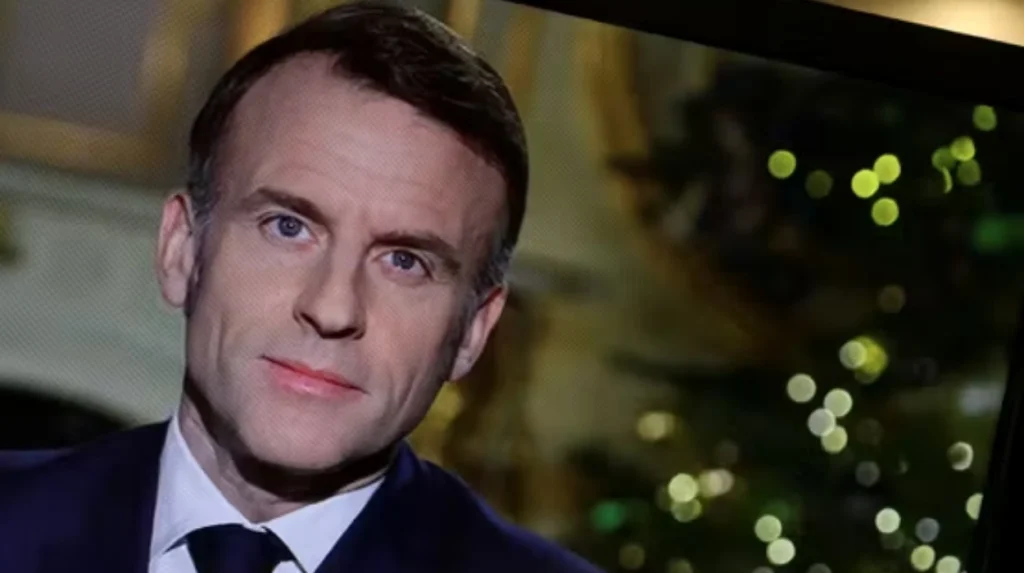
In a New Year’s address for 2026, French President Emmanuel Macron promised to “work till the very last second” of his presidency in a politically paralysed France, grappling with falling levels of support and uncertainties regarding the way forward.
Macron delivered a surprisingly brief speech, which lasted less than 10 minutes, the shortest since he came to power in 2017. This can be attributed to the fatigue level the Macron government has reached after being in power for almost a decade, as well as the unprecedented turmoil being experienced by the French Republic.
Macron gave this speech while standing in the Salon des Ambassadeurs in the Élysée Palace, which had a Christmas tree and some lighting.
“I will be at work until the very last second, striving each day to live up to the mandate you entrusted to me,”
Macron said, as France heads into his final full year in office.
Why is Macron governing amid political deadlock?
The comments were made while France is still under a centrist coalition leadership, despite not having a majority in Parliament, following a series of snap elections held in 2024 that polarized the National Assembly. This is already the third budget crisis that has toppled a government since then.
Just last week, the legislature passed a budget to extend the provision of funding to January to ensure a smooth running process, the precarious nature of governance. The president acknowledged a budget agreement in the first half of 2026 to be “essential” to satisfy the divided parliament and the increasingly dubious population.
His approval ratings are now at their lowest point since his first election, with critics accusing him of being disconnected from rising living costs, social anger and political fatigue.
Can France avoid a turbulent 2027 presidential election?
As the next presidential election is scheduled for April 2027, and no candidate is permitted to run for the third consecutive term according to the country’s constitution, Macron stated that
“one of the things he cares about is defending the democratic process.”
“I will do everything I can to ensure that the presidential election takes place as smoothly as possible, especially without foreign meddling,”
he added.
Recent polling suggests the far right is well positioned to win the next vote, raising concerns in Paris and Brussels about France’s future role in Europe. While Macron cannot run again in 2027, he has not ruled out a political return later, keeping speculation alive about his longer-term ambitions.
How does Macron frame France’s security challenges?
With regard to defence and security issues, the president stated that the French government always has to spend money on the military and public services irrespective of the financial situation in France. The president related the stability within the French economy and society to global instability.
“We are witnessing the return of empires, the questioning of the international order,”
he said.
“The law of the strongest is attempting to prevail, and our Europe is being assailed on all sides.”
Macron pointed specifically to the wars in Ukraine and the Middle East, describing them as interconnected crises in a volatile global environment marked by authoritarian assertiveness and weakened multilateral norms.
What is France’s position on Ukraine and global conflicts?
Talking on the war in Ukraine, which has now been ongoing for the fifth year since the Russian full-scale invasion began in February 2022, President Macron reiterated France’s support for Ukraine. This support includes support for the Ukrainian forces with SCALP missiles and training programs for their troops.
The conflict was additionally linked to other global events by the writer, such as the Israel-Hamas conflict and the Red Sea transport disruptions that resulted from the attacks by the Houthi rebels. The writer believes that these challenges the European Union’s strategic autonomy.
However, the strategic Europe that President Emmanuel Macron envisions involves more defence cooperation on the continent, greater defence spending aimed at 2.5% GDP by 2026, and less dependence on the United States—but especially with the new Trump administration.
Is Macron still pushing reforms at home?
Though he has refrained from making bold announcements, some of the key agenda points that he has laid down for the year 2026 include:
Tougher regulation for social media firms would be enforced to safeguard children against the addictive nature of their algorithms and content, drawing on the EU’s Digital Service Act. Another promise regarded increased support for a new voluntary national service scheme for those aged 16-25 years, with incentives for civic, environmental, and defence services.
On a deeply divisive issue, Macron said progress would continue toward legislation on end-of-life care, including tightly regulated assisted dying, following months of national consultation.
Can Macron still govern effectively without a majority?
Recognizing the limits of his powers, Macron made an appeal for bipartisanship, asserting a hung parliament did not mean a paralyzed politics. He dismissed rumors about entering a caretaker phase of the French presidency, despite the mounting perception of an “end-of-term presidency.”
In economic terms, he highlighted the fact that there has been some stability, citing 1.1% GDP growth for 2025, close to 73% levels of employment, and investments of €20 billion in the process of reindustrialization within the France 2030 plan, which has already produced 300,000 jobs in green technologies, semiconductors, and batteries.
Is Macron preparing his legacy or simply managing decline?
Notably, Macron avoided reflecting on his eight years in power or attempting to define “Macronism” as a finished chapter. He also refrained from launching major new reforms, a sign of caution in an era of political volatility.
“He really is in an inextricable situation,” one senior minister commented privately. “His image is very damaged, and the end-of-term effect is real.”
Now that France embarks upon the year 2026, Macron would seem to find himself trapped in the cycle of both wanting to stay active and growingly restricted in the realm of politics. Whether the final year of his presidency will offer the nation a stable path or merely see it through the course of decline remains one of the most intriguing questions the nation will soon have to answer.