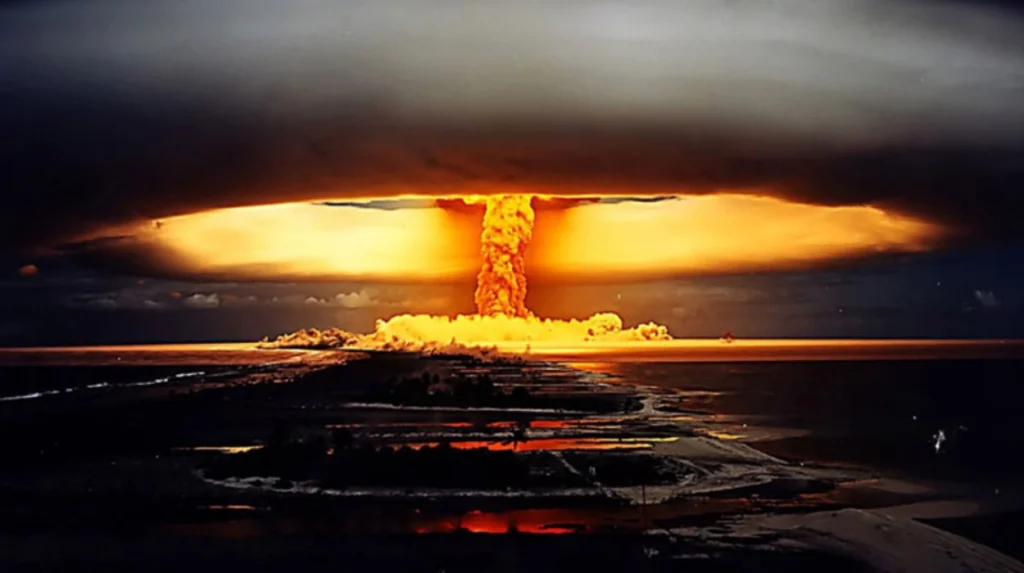
France joined the nuclear club in 1960 when Gerboise Bleue was detonated in the Algerian Sahara as France entered the nuclear era with a vision that was founded on sovereignty and strategic deterrence. The incident ushered in a 30-plus-year nuclear testing program that resulted in a mixed record of environmental and human devastation. France conducted 210 nuclear experiments between 1960 and 1996, first in Algeria and then in French Polynesia in the South Pacific.
The French relocated their testing results to the atolls of Moruroa and Fangataufa following Algeria‘s independence in 1962. Between the years 1966 and 1996, the region was turned into the hub of atmospheric and underground nuclear experiments. These tests became central to the purpose of France to construct and perfect an autonomous nuclear deterrent throughout the Cold War and later, and these tests became a central pillar in the French strategic doctrine, a posture that continues to influence national security choices even in 2025 in the context of the continuous geopolitical doubt.
The heritage of this program has now been under the new question of scrutiny since environmental and human impacts are now more evident. The convergence of scientific achievements and legal inquiry and the emergence of climate-oriented and justice-oriented political rhetoric have all added pressure on the French state to be more transparent and accountable.
Environmental Consequences And Ongoing Contamination
France nuclear testing has environmental effects that have been lasting. Radioactive isotopes were spewed in the atmosphere and underground explosions into the air and water and the ground. In French Polynesia, there were 187 tests and resulted in massive changes in ecology. The coral reefs were injured by shockwaves and chemical pollution. The biodiversity in the marine ecosystem was also affected as radioactive substances found their way into the ocean food chains, which influenced fish population which was used by the local communities.
Surveillance operations have nevertheless ensured that radionuclides like cesium-137 and strontium-90 are still evident in soil and biological samples decades after the last test. French nuclear bodies, such as the IRSN (Institute of Radiological Protection and Nuclear Safety) are still reporting low yet constant artificial radioactivity rates over test areas. Although levels are not usually regarded to be hazardous within current thresholds, there are still risks of long-term exposure and bioaccumulation, which scientists and local residents worry about.
Patterns of atmospheric dispersal in the Cold War period permitted the radioactive materials to be dispersed way past Polynesia and North Africa. The facts show that the traces of fallout were observed in mainland France and other European locations, which demonstrated the international scope of the environment in terms of the France nuclear legacy.
Health Impacts On Populations
Residents of the vicinity of the test locations such as military, local laborers, and the indigenous people have long complained of higher rates of cancer, respiratory diseases, and reproductive health problems. A University of Tahiti study of the same year (2023) referenced an association between the proximity to test sites and incidence of leukemia and thyroid cancer. Although not every case of it can be directly related to testing, there are some patterns of epidemiology which indicate a major dependence between exposure and chronic disease.
In 2010 the French government passed the Morin Law to compensate nuclear test victims. Nevertheless, the critics claim that the process has been inhibitive and bureaucratically opaque. A lot of claims have been denied on the ground of strict proof-of-causality provisions, leaving many victims and descendants unrecognized or neglected.
Chronic health problems are also reported by military veterans who engaged in nuclear test operations and many of whom operated under severe and unconducive conditions. Advocacy groups are also putting pressure on complete medical coverage and declassified documentation to determine the level of exposure and risk.
Political And Social Dimensions Of France’s Nuclear Legacy
France has always ensured minimal transparency in relation to its nuclear programme. As it has been found out in investigative reports, over the decades the government was underreporting radiation levels and concealing information on environmental impact of the tests. One declassified document of 1998 revealed that the military and scientific authorities tried to quash public alarm on radioactive contamination in French Polynesia.
Evidence of disinformation campaigns to cover up the truth of the safety of French nuclear operations has been revealed by independent agencies like the Greenpeace and the Observatoire des armements. In 2021, investigative journalists found the government had been using resources to undermine scientists and activists who were concerned about the long-term effects of the tests.
Criticism has been raised by both domestic and international players with regard to this defensive posture. The lack of transparency destroys any attempt to reconcile and further scientific study that can inform the remediation and compensation programs. The communities that have been affected, especially the Polynesians and Algerians are still insisting on formal recognition of damages and historical responsibility.
International And Regional Implications
The nuclear legacy in France helps expand debates on nuclear disarmament, environmental justice, and the long-term effects of the policies of the colonial era, in general. On August 29 each year the International Day Against Nuclear Tests has begun to focus attention on the French record as it serves as a reminder of the world need to stop causing nuclear damage.
The nature of the relations between France and the territories such as French Polynesia can be explained by the nuclear past of this country. Although Paris continues to have administrative authority, the local people have demanded increased autonomy and environmental justice. In 2025, the Polynesian Assembly voted a resolution asking the French government to pay more money and issue an apology- the third in five years.
Historical memory intersects with decolonization and national identity in North Africa where the initial tests by France were organized. Algerian officials have occasionally insisted on reparations and access to detailed environmental statistics on the grounds that radiation contamination is an unresolved problem in the impacted areas, e.g., Reggane and In Ekker.
France’s Ongoing Nuclear Stance And Strategic Recalibration
France continues to stick to nuclear deterrence despite criticism in history. In June 2025, President Emmanuel Macron reiterated that:
“Our nuclear arsenal remains the foundation of France’s strategic autonomy and European security.”
His position was that nuclear capabilities would act as a deterrent in the military and be a stabilizing aspect in a disintegrated international order.
France is also undertaking a modernization exercise of its nuclear capabilities such as the building of a new breed of submarines and missiles. Those efforts co-exist with the proclamations of intentions to control arms and non-proliferation, which highlights the incompatibility between defense policy and environmental stewardship.
Macron has additionally justified the existence of a civilian nuclear energy program in France as a low-carbon solution to climate change. Though the positions are presented as future oriented, they are under growing scrutiny by voices that believe that reconciliation with the past is the key to building the future. Left-wing environmental NGOs and left-wing political parties have proposed complete declassification of nuclear archives and a special truth commission.
This person has spoken on the topic, highlighting the enduring contradictions in France’s nuclear approach and the pressing need for comprehensive reconciliation with its nuclear past and environmental future:
In 1960, France conducted nuclear tests in Algeria, over sixty years later, Algerians have one of the highest risks of cancer and birth defects, their environment polluted. The colonizer of yesterday is the same today.
— Ademọ́lá. (@OgbeniDemola) July 26, 2025
The remarks emphasized that while nuclear deterrence remains a pillar of national policy, unresolved legacies must be addressed through transparent governance and equitable remediation.
Reconciling Strategic Power With Environmental Responsibility
France’s nuclear legacy encapsulates a wider dilemma facing many advanced states: how to reconcile national security imperatives with historical accountability and environmental sustainability. As the geopolitical climate intensifies in 2025, the pressure to reinforce strategic autonomy grows—but so too does the demand to confront unresolved environmental and human consequences of past policies.
The trajectory of France’s nuclear legacy environmental impact policy will likely influence international norms on how nuclear states account for their historical actions. Whether France moves toward full transparency and reparative justice, or continues to prioritize strategic silence, remains a test not just of policy but of principle—one that future generations will judge with the weight of both memory and consequence.