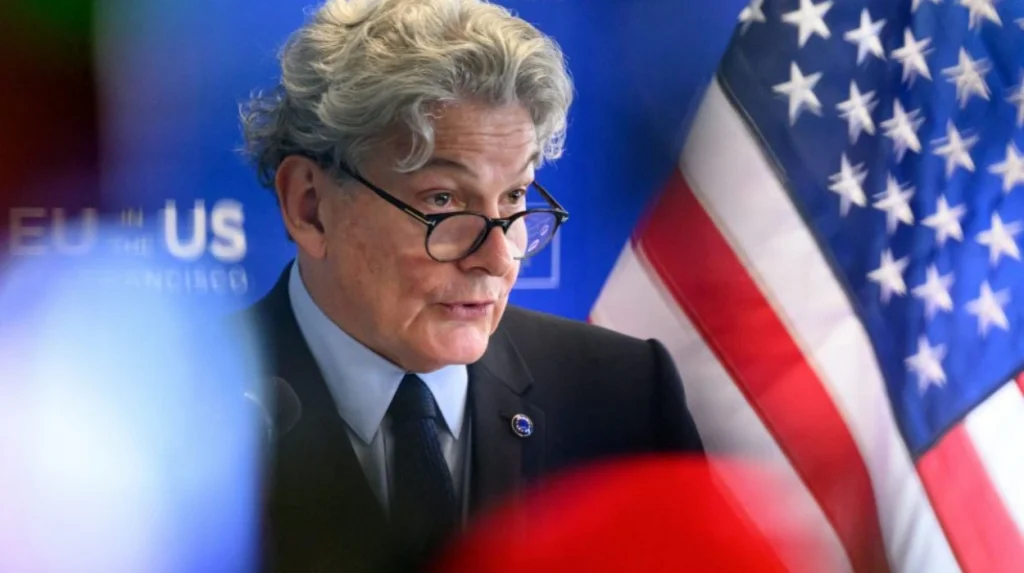
A new fault line has emerged in transatlantic relations, which connects free speech issues with technology regulation and global platform power distribution to sovereign governments. Washington has taken an extraordinary step in its fight against foreign interference in American online speech by banning the visas of five European nationals, including former European Commissioner Thierry Breton.
The conflict goes beyond the basic requirements of visas and personal matters. The matter involves three main points about digital public square control and free speech definition, and regulatory power becoming a tool for international competition.
Why did the United States impose visa bans on Europeans?
Under the Immigration and Nationality Act, Secretary of State Marco Rubio imposed visa restrictions against five Europeans because he believed they led organized efforts to make American platforms censor and demonetize, and suppress American viewpoints.
The Trump administration chose immigration law as an alternative to trade tools and sanctions, which allows Washington to take quick action and deliver a strong symbolic message. People who are subject to this policy will face entry denial at borders, and the government will start deportation procedures against all foreign nationals who remain in the country.
WE’VE SANCTIONED: Thierry Breton, a mastermind of the Digital Services Act. In August 2024, while serving as European Commissioner for Internal Markets and Digital Services, he published a letter using the DSA to threaten @elonmusk ahead of his livestream interview with President…
— Under Secretary of State Sarah B. Rogers (@UnderSecPD) December 23, 2025
The people on X were later identified by Under Secretary of Public Diplomacy Sarah Rogers, who portrayed them as masterminds of a foreign-led censorship campaign that targeted American businesses and speakers.
This strategy, which views digital regulation as a national security issue linked to sovereignty and ideological influence rather than as a technical policy dispute, reflects a larger change in U.S. strategy.
How did Thierry Breton become central to the dispute?
Thierry Breton is one of the sanctioned. One of the most influential designers of the EU’s digital regulatory framework was Breton, who served as European Commissioner for the Internal Market from 2019 to 2024. The Digital Services Act (DSA), the Digital Markets Act (DMA), and Europe’s more general industrial and technological policy were all under his purview.
Breton is portrayed in Washington as the “mastermind” of the DSA, a law that American officials claim unfairly targets American tech companies and endangers free speech. He is regarded by many in Europe as a champion of democratic control over platforms that have enormous influence over the flow of information.
Breton responded sharply on X, invoking historical parallels that resonated deeply in Europe:
@ThierryBreton:
“Is McCarthy’s witch hunt back? To our American friends: censorship is not where you think it is.”
Is McCarthy’s witch hunt back? 🧹
— Thierry Breton (@ThierryBreton) December 23, 2025
As a reminder: 90% of the European Parliament — our democratically elected body — and all 27 Member States unanimously voted the DSA 🇪🇺
To our American friends: “Censorship isn’t where you think it is.”
By invoking McCarthyism, Breton framed the visa ban not as a legal matter, but as an ideological crackdown—one that punishes dissenting regulatory philosophies rather than unlawful conduct.
What is the Digital Services Act really regulating?
The EU’s Digital Services Act is at the center of the conflict. In addition to imposing transparency requirements and fines for non-compliance, the DSA mandates that platforms address illegal content, systemic risks, and algorithmic amplification of harmful material.
According to European officials, the law governs behavior rather than speech, particularly how platforms handle content that is already prohibited by European law.
Is the DSA a threat to free speech or platform power?
Washington, however, has a different perspective on the DSA. Officials from the Trump administration claim that European regulators are putting pressure on American platforms to stifle legitimate political speech, especially conservative or anti-immigration opinions, and enforcing compliance fees that act as indirect trade barriers.
The administration’s most recent National Security Strategy, which highlights how deeply ideological this conflict has become, specifically accused European leaders of stifling dissent and censoring speech in ways that run the risk of “civilizational erasure.”
HateAid leaders Anna-Lena von Hodenberg and Josephine Ballon, Clare Melford of the Global Disinformation Index (GDI), and Imran Ahmed of the Centre for Countering Digital Hate are among the other sanctioned individuals who represent a network of non-governmental organizations that fight online hate and disinformation.
Their work has long been controversial in the United States, especially among conservatives who contend that programs aimed at “harmful content” are used to financially pressure dissenting voices and blacklist media outlets.
Melford previously stated that GDI’s goal was to
“break the business model of harmful online content”
by steering advertising away from polarising outlets—language that critics cite as evidence of economic censorship.
How is Europe responding to U.S. accusations and sanctions?
European leaders responded with rare unity. The European Commission “strongly condemned” the visa bans and demanded explanations, warning that Brussels would respond “swiftly and decisively” if necessary.
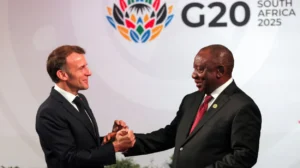
French President Emmanuel Macron framed the decision as an assault, saying these measures amount to intimidation and coercion aimed at undermining Europe’s digital sovereignty.
France condemns the visa restriction measures taken by the United States against Thierry Breton and four other European figures.
— Emmanuel Macron (@EmmanuelMacron) December 24, 2025
These measures amount to intimidation and coercion aimed at undermining European digital sovereignty.…
For Paris and Brussels, the issue is existential. If Washington can punish European regulators and civil society actors for enforcing EU law, it raises questions about whether Europe’s regulatory autonomy can be sustained in an era dominated by U.S.-based tech giants.
Are visa bans becoming a new geopolitical pressure tool?
The decision to employ visa prohibitions is especially important. The majority of Europeans use the Visa Waiver Program to enter the United States, but they still need to obtain electronic authorization from American authorities. A silent blacklist, which functions without formal sanctions procedures or judicial review, is essentially created when people are flagged in DHS systems.
By using this strategy, Washington can apply pressure without engaging in legal disputes over international law or trade. It also establishes a precedent: disagreements over regulations can now have an impact on an individual.
What precedent does this set for future regulators?
In the global battle over digital governance, the visa restrictions imposed on Thierry Breton and other European leaders represent a sea change. What started out as a policy dispute over platform regulation has developed into a conflict over legitimacy, sovereignty, and the future of free speech.
The action supports the American narrative of protecting speech from foreign censorship. It validates concerns about direct political attacks on regulatory autonomy in Europe.
The risk is in the escalation. Global tech governance will split along ideological lines if immigration restrictions become a standard reaction to regulatory disputes.