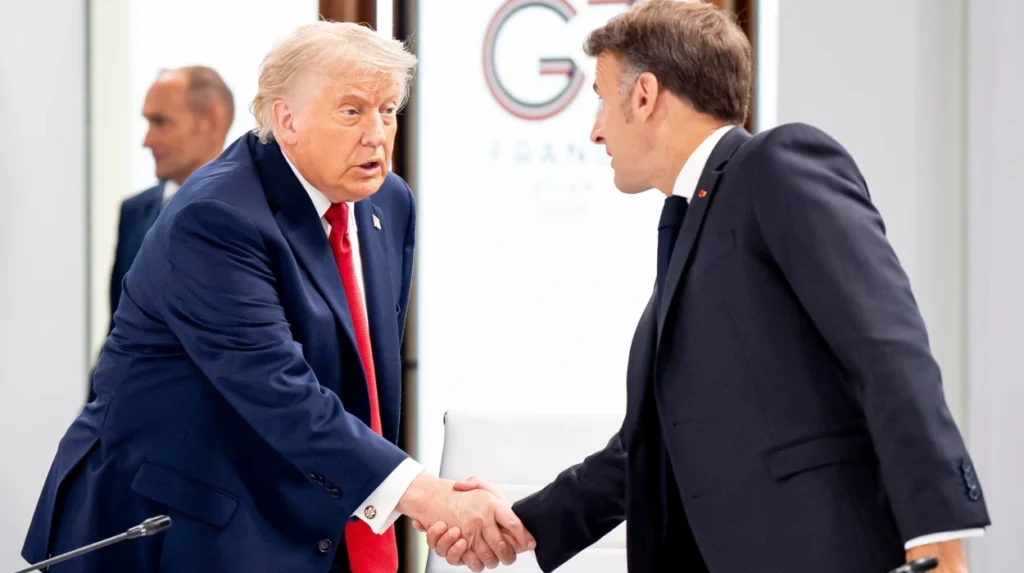
In a diplomatic performance that has created a divide in France regarding political sentiments, US President Donald Trump is expected to attend an elaborate dinner ceremony today at the Palace of Versailles. The ceremony, set to take place on Wednesday, June 17, 2026, comes after President Emmanuel Macron of France finishes his diplomatic engagements at the G7 summit in Évian. The French leftists have been highly critical of what they consider the humiliating approach the French president has taken while trying to please the American president.
Dinner is not only a matter of etiquette. Dinner has become part of a historical story that celebrates the 250th anniversary of independence from Great Britain, with the White House interpreting the event as recognition of friendship between the French and Americans because of French aid provided to the former in their revolution. However, hidden under such an interpretation is a bitter argument regarding whether Macron overstepped and excessively praised a president who is viewed unfavorably by many Europeans.
Historical Context and Diplomatic Rationale
In terms of its historical significance in French diplomatic tradition, the Palace of Versailles, where Louis XIV, the iconic Sun King, resided in the past, followed by Louis XVI, represents a unique symbol of grandeur. With the gesture of having Trump dine in the room occupied once by Louis XVI, Macron has raised the entire affair to the status of royalty, which is a step that Trump has readily accepted.
The justification offered by Macron is that of historical remembrance. The fact of the matter is that France helped the American colonies immensely during its fight for independence against British rule, and therefore there is nothing wrong with commemorating the event as they mark 250 years since that period. In fact, the French government has stressed that the dinner is about strengthening transatlantic relations and not endorsing Trump’s policies in any way whatsoever.
Évian was the venue from which Macron extended his invitation. At this meeting, both the leaders held a one-on-one luncheon meeting where Trump supposedly agreed to have the dinner offered by Macron in the Palace of Versailles. The timing implies that Macron has seized this opportunity to build up a personal connection before any international diplomacy starts taking place. On Macron’s part, despite having known each other for decades, he failed to sway Trump in important matters related to international politics.
Trump’s Enthusiastic Acceptance and Public Statements
Trump’s response to the invite has been wholly positive, as is consistent with his longstanding preference for symbols of grandeur and monarchy. Trump sees himself as a king-like figure when it comes to his public image, and it seems that the location of the palace is one that rings true with his perception of himself. Indeed, upon receiving the invite, Trump extended his stay in France.
During remarks about the dinner, Trump praised the palace with unmistakable enthusiasm.
“The president, happens to be a very man, invited me to dinner at Versailles,”
Trump said, framing the invitation as a personal honour from a fellow leader. His language suggests he views Macron not merely as a diplomatic counterpart but as someone willingly offering deference. This interpretation aligns with Trump’s broader tendency to interpret diplomatic courtesies as personal validation of his authority.
Trump’s most quoted statement about the venue has become a defining moment of the announcement. “It’s the real deal,” Trump declared when describing Versailles, repeating the phrase for emphasis. “The real deal.” This colloquial endorsement, delivered with characteristic simplicity, underscores Trump’s genuine admiration for the palace’s historical grandeur. The statement has since been widely circulated in French media, with critics using it to highlight what they see as Trump’s superficial appreciation of French culture divorced from substantive diplomatic engagement.
His decision not to return sooner from his travels shows Trump’s readiness to give precedence to the meal rather than to follow the normal process. This is a sign that one of the goals of Macron’s courtship approach is accomplished by having Trump’s personal participation outside of his normal G7 meetings schedule. Considering Trump as someone who does things for pleasure rather than for diplomatic purposes, his presence is a sign of seriousness.
Macron’s Strategic Courtship and Diplomatic Calculations
Emmanuel Macron’s approach to Trump has long been characterised by a strategy of personal flattery aimed at influencing American foreign policy. Since taking office in 2017, Macron has cultivated a close personal relationship with Trump, frequently engaging in warm public exchanges and private meetings designed to build rapport. However, experts have consistently noted that this approach has failed to produce meaningful policy shifts.
“Macron has developed a close personal relationship with Trump since taking office, he has failed to influence his American counterpart on major foreign policy,”
analysts observed in 2018, a pattern that appears to continue despite years of diplomatic effort.
This is yet another incarnation of the same failing strategy. The Macron administration has made it clear that this occasion holds historical significance, but the motivation behind it is obvious: whereas diplomacy can take you only so far, charm can do wonders to achieve the impossible. It is particularly important for Macron, who had been criticized domestically for being too soft internationally, to get Trump’s support on NATO, Iran, and climate change issues.
The strategy employed by Macron goes beyond the immediate benefits for his policies. The President of France is under increasing pressure domestically because of people criticizing Trump as an individual posing a danger to democracy and world peace. Through his involvement with Trump, he aims at showing the capacity of France to act as a mediator in matters of transatlantic politics despite the differences prevailing.
Yet Macron’s approach has become increasingly controversial. Recent public clashes between the two leaders have exposed the fragility of their relationship. In April 2026, Trump mocked Macron during a private lunch in Washington, putting on a French accent and making comments about Macron’s marriage. The incident sparked anger in France, with Macron publicly condemning Trump’s behaviour. “Not up to standard,” Macron said when criticising Trump’s comments, marking one of the most direct rebukes of the American president by a European leader.
French Left’s Sharp Criticism and Political Opposition
The left wing in France has reacted to the dinner hosted by Versailles in an unprecedented manner, branding Macron with abandoning any sense of diplomatic integrity in favor of excessive adulation. The criticism is based on the fact that giving a visit to Trump in such an important venue amounts to compromising their own moral high ground.
The most direct criticism came from leftist political figures who described Macron’s approach as “very naive.” This charge encapsulates the left’s broader argument: that Macron’s courtship strategy is not merely ineffective but morally compromised. By treating Trump as a worthy guest of honour at Versailles, Macron appears to legitimise a leader whose policies on climate, immigration, and international alliances contradict French values.
Political rivals have gone further, accusing Macron of “grovelling” after inviting Trump to Louis XIV’s palace. The term suggests servility rather than diplomacy, implying that Macron has sacrificed French dignity in pursuit of personal rapport with Trump. This criticism resonates with voters who view Trump as a threat to global stability and believe France should maintain principled distance rather than attempt flattery.
The accusation that Macron is “going too far in attempts to flatter him” has become a rallying point for opposition critics. This phrase captures the essence of the left’s grievance: that Macron’s diplomatic strategy has crossed from legitimate engagement into excessive deference. Critics argue that France should not elevate Trump to royal status at Versailles when his policies undermine the very international cooperation France seeks to promote.
The criticism extends beyond left-wing factions. Some mainstream political observers have questioned whether Macron’s approach is strategically sound. Experts note that past flattery efforts have failed to produce policy gains, suggesting that the Versailles dinner may be another costly investment with little return. The concern is that Macron is prioritising personal relationships over substantive diplomatic achievements, a pattern that could weaken France’s international standing.