Islam Allouch, commonly known as Majdi Nema, had just a few months to spend in France. The Syrian was visiting the southern region of the nation as part of an exchange program at the Institute of Research and Study on the Arab and Islamic Worlds at Aix-Marseille University. But around two months after arriving, in January 2020, he was taken into custody.
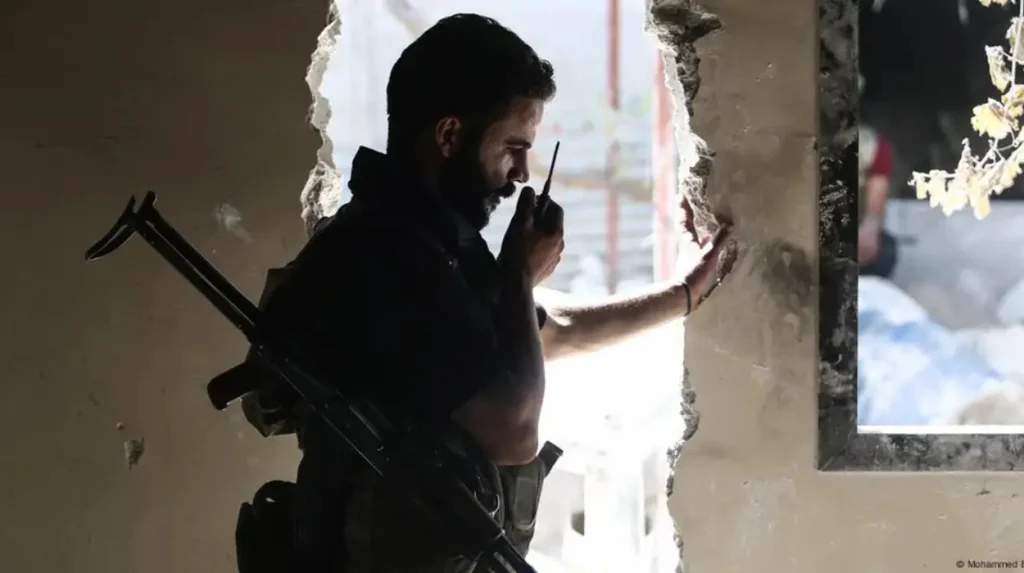
The former member is charged with “complicity in the war crime of enlisting minors and for participating in a group formed to prepare war crimes.” Jaysh al-Islam, often known as the “Army of Islam” or JAI for short, is a coalition of rebel organizations in Syria. Nema served as JAI’s spokesman from 2013 until 2016.
The trial of Nema, which starts on April 29, will be the first to look at the alleged crimes that JAI committed at the 2011 start of the Syrian civil war. At its height, JAI is thought to have had 15,000 members. The Syrian capital Damascus and eastern Ghouta served as its main operational bases in the fight against Syrian tyrant Bashar Assad.
It is accused of using civilians as human shields and abducting, torturing, and killing individuals throughout its war against the Assad regime. Last December, another Syrian rebel organization, Hayat Tahrir al-Sham (HTS), launched an attack that resulted in the removal of Assad. It is currently believed that the tyrant and his family are in Russia.
The fundamental clauses of the Rome Statute of the International Criminal Court were incorporated into France’s own national law code in 2010. This enables it to adjudicate international crimes, such as war crimes and genocide, even when they were perpetrated outside of France. The accused, who typically resides in Turkey, was thought to have a strong enough relationship to France because he was residing there at the time of his detention, which makes the case against Nema viable.
International law may be affected by the case, according to Marc Bailly, one of the attorneys representing the civil parties. “Even if these trials are still exceptions, they are necessary to prevent the impunity of tomorrow’s war criminals,” he stated. The Syrian Center for Media and Freedom of Expression, the Paris-based League of Human Rights, and five people who allege they were the victims of war crimes perpetrated by JAI are among the civil parties in addition to the FIDH.
However, Nema’s attorneys contest that he was a significant player. “He served as JAI’s spokesperson without any military or strategic authority. Attorneys Romain Ruiz and Raphael Kempf stated that he had no plans for any procedures and only learned about them after the event.
“At the end of 2023, the [Paris] Court of Appeal already withdrew charges against him, including his suspected role in the disappearance of four persons. “The rest of the charges will also prove his innocence,” they said.
Nema, who is currently 37, stated that he started working with JAI in early 2013. He claimed that he began operating from Turkey in May of that year and remained there until traveling to France. “I studied political science there,” he replied. He says that because he departed Syria in 2013, he could only have had a little part to play.
Nonetheless, the Paris Court of Appeal claims that in 2014 and 2015, witnesses observed Nema in eastern Ghouta. Additionally, because only state actors and organizations may be prosecuted with the crime of forced disappearance, the court dismissed the allegations against the people involved. This is in accordance with the French view of international law. JAI was neither an actor nor a state group.
According to the plaintiffs, JAI was complicit in the kidnapping of four human rights advocates.
Such an approach, according to human rights expert Jeremy Sarkin, a law professor at Nova University in Lisbon, Portugal, is overly constrictive. “France is a signatory to the UN Convention [for the Protection of All Persons from] Enforced Disappearance and must enforce its provisions against non-state actors too,” he stated.
However, he acknowledged that it was a good thing that the issue was now in court. “China and Russia prevented the UN Security Council from establishing an ad hoc international tribunal on Syria. In order to combat impunity, courts in France, Germany, Sweden, and Switzerland are essential.