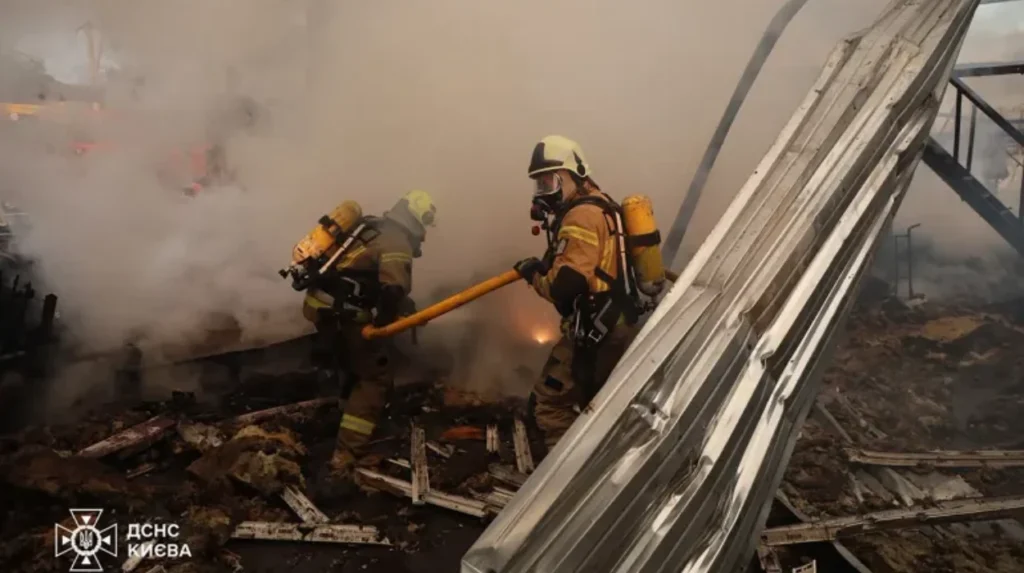
A Russian missile and drone barrage has once again pushed Ukraine’s capital into crisis, killing two people and injuring 19 in the latest overnight attack that underscores how the war continues to evolve through relentless aerial assaults. The strike, which hit Kyiv during the night, also triggered rescue operations as emergency crews searched through damaged buildings and debris for any trapped survivors. What initially emerged as a casualty report has become another reminder that each new wave of Russian attacks can quickly rewrite the human toll as first responders uncover more victims and assess the scale of destruction.
The assault takes place at a moment in time when the country of Ukraine is being hit by repeated attacks that are meant to overwhelm air defenses and exert pressure not only upon military assets but civilian assets as well. In this case, the death count of two and 19 wounded individuals was a sobering glimpse of the short-term impact, although the larger picture that can be drawn from the event is that the Russian Federation continues to use massive waves of drones and missiles as one of the main pillars of their military strategy.
A familiar pattern of escalation
The bombing of Kyiv is a part of an emerging trend of increased bombings in Ukraine’s cities conducted by Russia. The use of missiles and drones is becoming a trademark of this war, with Russian army constantly sending salvos of projectiles at Ukrainian towns and cities with the aim to overwhelm their air defense systems. Attacks are usually done in salvos, thus creating additional difficulties for the defenders and putting civilians in danger. In the case of Kyiv, the damage was not restricted to one point of explosion, since there were reported incidents of destruction in residential areas, with rescue workers being sent to check whether buildings had collapsed.
It is important to note that the attack was not just another military action but a bombing of another area of civilian life in the city. Indeed, the risks for civilians are not restricted to explosions but also include fires, broken glass, building collapses, loss of electricity supply and potentially victims underneath the rubble.
The timing of the attack also reflects a war that has increasingly blurred the line between front line and home front. Russia’s aerial campaign has continued even as fighting on the ground remains fierce, making cities like Kyiv an extension of the battlefield. Each new barrage sends the same message: the capital is not immune, and the war can reach deep into areas far from the immediate front.
Casualties and rescue work
The latest confirmed figures showed two people killed and 19 wounded, but casualty numbers in major strikes are often provisional in the first hours after an attack. As emergency workers move through damaged buildings, additional victims are sometimes found later, meaning the final toll can rise. That is one reason official statements in the immediate aftermath are often cautious, even when the destruction is already visible.
The rescue mission in Kyiv was key to the whole procedure. Crews were digging through wreckage and destroyed buildings trying to find out if there are still people inside. At the same time, this mission shows the scope of the damage that has been done: the fact that the work of emergency services has to continue means that the attack had caused not just some visible destructions, but has made a secondary emergency situation in terms of the stability of buildings, danger of fires, and possibilities of collapsing. Every wounded person is not only the statistic number for media in war zones. In each case, there are consequences related to medical treatment, psychological effects, financial losses, and other factors. Casualties are a necessary component of the reporting in war zones. However, casualties do not show the full impact on people’s lives in wartime. It is particularly true for such large and densely populated cities as Kyiv.
What officials say
Ukrainian officials described the attack as part of Russia’s continuing campaign against the country’s cities and civilian population. Their response has consistently emphasized two themes: the deliberate nature of the strikes and the need for stronger air defense support. In the language of Ukrainian authorities, these are not random wartime incidents but calculated attacks designed to terrorize, destabilize, and exhaust the country.
A Ukrainian emergency-service account said search-and-rescue crews remained on site after the initial strike, a statement that reinforced the seriousness of the destruction. The practical message behind such updates is that the danger has not ended when the missiles stop falling. It continues as long as workers are digging through debris, checking apartments, and trying to locate survivors or the dead.
Russia, for its part, routinely denies targeting civilians, but the pattern of damage reported across Ukrainian cities has repeatedly drawn international condemnation. In this case, as in many previous strikes, the evidence on the ground—damaged homes, wounded civilians, and rescue operations in residential districts—feeds the wider debate over the nature of Moscow’s military campaign. The contrast between official denials and the visible effects of the attack remains one of the central tensions in wartime coverage.
Why this attack matters
This barrage matters because it is not an isolated event but part of a sustained strategy that has reshaped the nature of the war. Russia’s use of missiles and drones in coordinated waves has allowed it to continue striking Ukraine at long range while forcing Ukrainian air defenses to remain under constant pressure. That means even when major ground advances stall, the war continues to inflict new damage through the air.
The significance of this incident also lies within politics. Each new big strike against Kyiv adds more and more pressure upon the allies of Ukraine to supply even more anti-aircraft defense weapons and assistance in emergencies. Moreover, it proves the position of Ukraine’s leadership according to which there is no way that Russia will stop its attacks against Ukrainian civil objects. Thus, the constant strikes against housing areas become another argument in favor of the idea that the war of attrition is being waged by Russia not only against the Ukrainian army but also against the ability of the government to operate normally. Finally, one should note a psychological effect of the attack.
Kyiv is not just any city – it is the capital and an important symbol of Ukraine’s strength. The fact that the Russian missiles and drones are able to penetrate the city’s defense has the psychological meaning as well. However, the fact that people keep coming to rescue those who were struck shows how society has already adapted to war environment.
The bigger war picture
Recent months have shown that Russia’s air campaign remains one of the most dangerous elements of the conflict. Large strikes have repeatedly caused mass casualties across Ukraine, with some attacks leaving many more dead and wounded than the latest barrage on Kyiv. That broader context is important because it shows how quickly a single overnight assault can blend into a pattern of escalating violence.
Ukraine has repeatedly sought stronger Western support to intercept drones and missiles before they reach populated areas. The effectiveness of this defense is crucial not only for saving lives but also for protecting energy infrastructure, hospitals, apartment blocks, and transportation networks. The challenge for Ukraine is that such attacks can come in high volume, forcing defense systems to make difficult choices about what to intercept first.
At the same time, the persistence of these attacks demonstrates the limits of current protection. Even with improved air defense, Russian barrages continue to break through, causing casualties and damage. That reality shapes the war’s next phase: Ukraine can defend, rescue, and recover, but it still must absorb repeated blows. The latest attack in Kyiv fits that pattern precisely.
Civilian cost of the war
One of the critical features of this attack is not only how many missiles or drones were used in it, but also the civilian toll that was left. The injury of a woman or a man will eventually heal up, but the greater trauma caused by it will stay with them for a long time. Every attack means sleepless nights, fear in children, destruction of neighborhoods, and weakening of the safety feeling in the whole city when the sirens go off, and explosions follow. And that is why every next attack becomes a political act. It helps to form sympathy in the international community, influence decisions about financial help, and also emphasizes that the war is conducted in a way where civilians are endangered everyday.
What makes the latest strike especially significant is the way it combines immediate tragedy with strategic intent. Russia’s use of missile and drone barrages is not accidental. It is designed to force Ukraine into constant defensive mode, drain resources, and create fear. Yet the response from Kyiv—rescue crews, local officials, and emergency services moving quickly into action—shows a city still operating under pressure rather than collapsing under it.
The latest numbers may change as more information becomes available, but the core story is already clear: two people are dead, 19 are wounded, and another Russian aerial assault has again brought war directly into the heart of Ukraine’s capital. The attack is a reminder that the conflict remains brutally dynamic, with civilians continuing to pay the highest price.