Marine Tondelier’s 2027 presidential bid has become a landmark moment in French politics, not only for her party’s ecological platform but for the simple, unprecedented fact that she is campaigning while pregnant. As the national secretary of Europe Écologie–Les Verts (EELV), the 39-year-old Greens leader is the first woman in France to run for the Élysée while expecting a child, a reality that has thrust issues of infertility, assisted reproduction, and motherhood into the heart of the campaign conversation. Her journey, marked by miscarriage, multiple failed IVF cycles, and a “miracle baby” conceived after pre‑implantation genetic testing in Belgium, is now inseparable from her political message.
A historic first in French presidential politics
There have been instances in France of pregnant women occupying high-ranking positions before now. Some of these include Ségolène Royal, who held the ministerial position back in 1992; Rachida Dati, who occupied the same position in 2009; Nathalie Kosciusko-Morizet, also minister of the government in 2009; and Olivia Grégoire, minister in 2021. However, these politicians were not running for president during their pregnancies. Tondelier’s running for the presidential election as a pregnant woman is a bold move that takes away the last barrier between motherhood and politics, making her pregnancy an issue of information and politics. It is very remarkable how this announcement has come at this particular time since she was announced to be running for presidency while pregnant in March 2026, just three months after conception and therefore expected to deliver by September 2026, when the period of pre-campaigning begins for the elections in 2027.
From infertility to “miracle baby”: the personal story behind the campaign
Tondelier’s narrative is deeply personal. She is already a mother to a son, but had long wanted another child. That desire collided with the harsh realities of infertility. She has spoken about a miscarriage and several unsuccessful cycles of medically assisted reproduction (PMA/IVF), experiences that led her to put plans for a second child on hold.
The pregnancy she is now carrying was unplanned. She described learning the news as a “dizzy” moment, emotionally overwhelming after years of disappointment. Yet she insists that continuing the campaign was never in doubt. “A campaign while pregnant is athletic,” Tondelier told TV5Monde, recalling episodes of having to vomit in TGV toilets while traveling to support Green candidates across the country.
Her medical journey also exposed gaps in French law. After repeated IVF failures, she turned to pre‑implantation genetic testing (DPI‑A) in Belgium, where the procedure is permitted, because it remains restricted in France. That cross‑border search for care now underpins part of her policy pitch: broader access to reproductive technologies and stronger support for couples facing infertility.
Campaigning under physical strain: heat, smoke, and seven months pregnant
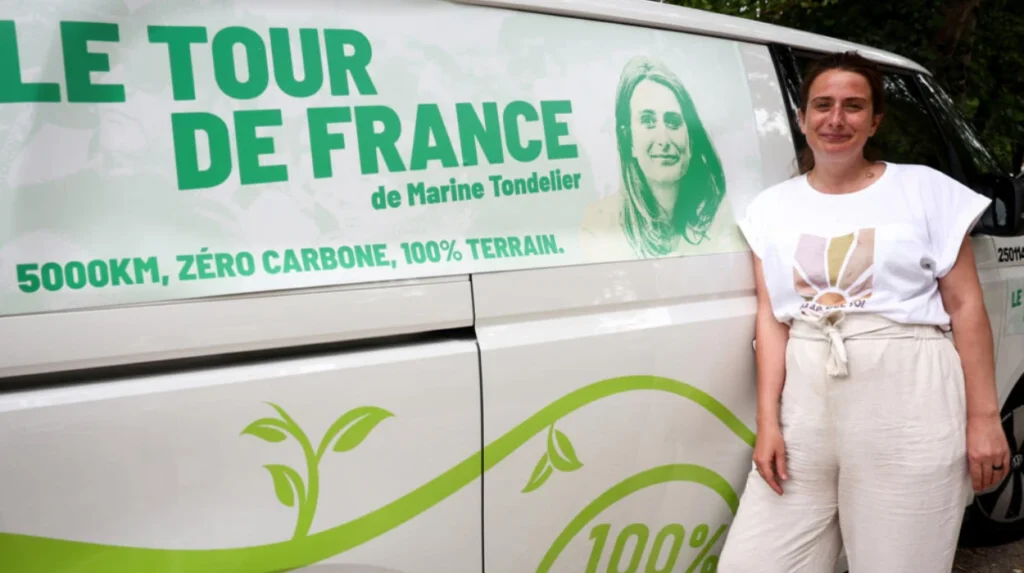
By mid-2026, Tondelier’s pregnancy had become quite visible but she remained as busy as ever. In July, she took to the roads again in an electric van for what she called a “Tour de France.” At the time, she had been trying to spread her environmental message through town and city in her country. However, at seven months pregnant, the effects of her activities were becoming quite apparent. She ended two days of her van tour in Gironde at the end of July owing to the forest fires there and the pollution from the smoke. Pregnant women are advised not to be exposed to this kind of pollution according to health guidelines, and thus, her team acted responsibly.
While speaking to the press, she made no attempt to disguise the challenges. “I’m exhausted,” she confessed in an interview, though she quipped that “it’s less than in Paris,” where talks of forming a leftist primary with the Socialists had failed. Her team has taken practical steps regarding safety issues. As part of party summer events in Grenoble, she and her team have located clinics within a distance of seven minutes and the hospital with maternity wards within fifteen minutes. A midwife who is herself a Green activist is at hand, along with transport in case of any emergency.
“I will adapt”: balancing motherhood and a presidential bid
Tondelier has been clear that she will not pretend the campaign is easy. In an interview with La Tribune, she said plainly:
“I won’t tell you it’s all rest.”
Yet she also emphasizes agency and planning.
“I am well monitored and, as long as it’s reasonable, I will continue to campaign…”
she explained, linking her personal situation to broader issues of women’s health, reproductive rights, infertility, and access to PMA and DPI‑A.
When asked how she will manage the final stretch, including delivery and early motherhood, her answer was pragmatic.
“I will adapt. To the baby’s health and to my own. There are priorities. Even in a presidential campaign.”
She has not fixed exact dates for her maternity pause, but says a solid team will cover her duties in the interim, ensuring continuity while she focuses on health and family.
This stance resonates with many voters, particularly women who have navigated fertility treatments or juggle careers and motherhood. On the ground, she says people have responded positively, with some thanking her and sharing their own IVF stories. In that sense, her body on the campaign trail becomes a living argument for policy change.
Turning private struggle into public policy
The pregnancy of Tondelier cannot be considered simply as a biographical note but as a political program. In her campaign, the candidate has connected her presidential ambitions to increasing access to reproductive and fertility services in France. Women’s health and, particularly, reproductive health have become major issues of the candidate’s program, with her presenting it as an issue of social justice and equality.
The candidate is appealing for a struggle against infertility and help to couples suffering from infertility both psychological, medical, and financial. Tondelier supports wider access to PMA and DPI-A services, which are still partially restricted in France and which Tondelier herself had to receive abroad. The demands of Tondelier about reproductive rights and sex education have been included into the EELV program along with other feminist claims such as providing better access to sex education and birth control and decreasing the “motherhood penalty” in the workforce.
Political positioning and the state of the Greens
Tondelier was put forward as the Green party candidate in December 2025, which Tondelier regards as a challenge and an obligation. She defines herself as a candidate of ecology and unity, attempting to unite the left-wing community to provide an alternative option to the centrist party and far-right. It is planned to conduct negotiations with all left-wing parties already eight months before the election in order to find common points of views or avoid splitting the votes. However, attempts to agree with the Socialist Party on running together in the primaries did not succeed, and therefore the Greens continue their way separately. The Green Party has always had a difficult position due to internal conflicts and losses in elections, which is reflected in low ratings of Tondelier who stands below single digits. As for the upcoming elections, it is highly likely that in 2027 there will be a choice between the far-right and either a centrist or right-wing party, since the left-wing coalition may not even have one candidate.
A symbol for women in politics—and beyond
Tondelier’s candidacy arrives amid a global trend of women in politics normalizing fertility and motherhood issues. Jacinda Ardern in New Zealand became one of the few heads of government to give birth in office in 2018, while figures like Alexandria Ocasio‑Cortez in the United States have publicly discussed egg‑freezing and the pressures of balancing career and family. In France, Tondelier’s pregnancy brings those conversations into the highest electoral arena.
Her visibility challenges lingering assumptions that motherhood and high‑level political ambition are incompatible. It also exposes the structural gaps that force women to choose between career and family, or to seek medical care abroad. By refusing to hide her condition, she forces parties, media, and voters to confront questions they might otherwise avoid: How should campaigns accommodate pregnant candidates? What support should the state provide to those facing infertility? How can political institutions become more compatible with family life?
Risks, criticisms, and the road ahead
Tondelier’s pregnancy is not seen positively by everyone. Indeed, some commentators see her pregnancy as nothing more than a distraction from politics or an attempt to manipulate voters with an emotional appeal. It has been asked whether a woman who is so pregnant can be trusted to handle a campaign on national scale, knowing the necessity of traveling and constant presence in the media space.
Tondelier understands the risks, but she rejects the idea of her inability to run due to the condition. She mentions practical measures her campaign takes into account and insists that first of all it is about her health and her baby’s. Besides, the voters understand and support her situation, seeing her case in line with their own experience. The way to 2027 is hard, given the single-digit ratings and splintered left, and Tondelier won’t probably get into the runoff stage of the election. Nevertheless, she has already achieved one thing: made issues of infertility, reproduction and motherhood become key themes of presidential election campaign in France for the first time.