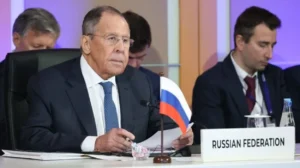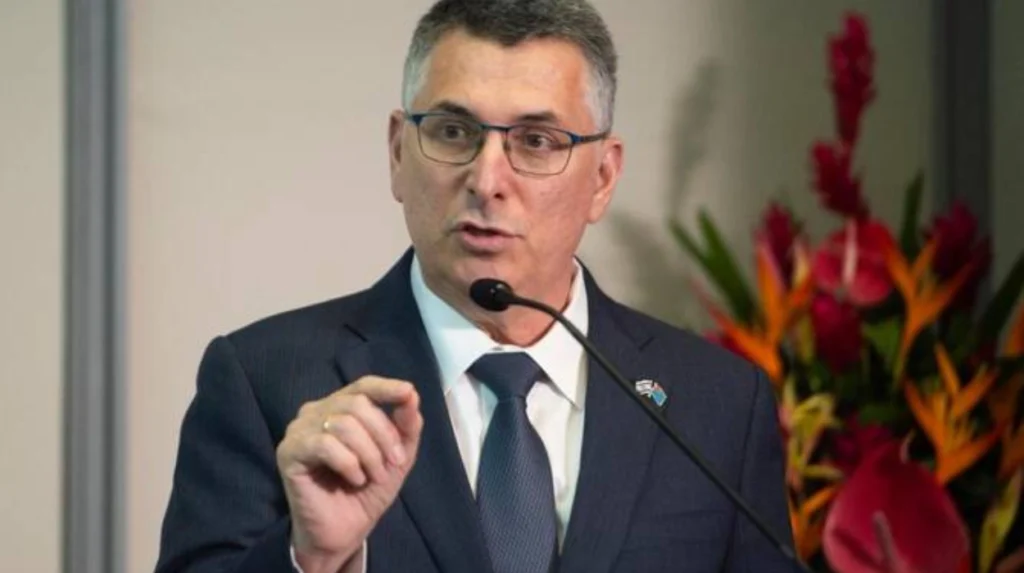
A major diplomatic rift emerged on Wednesday, June 18, 2026, when the Israeli foreign minister Gideon Sa’ar severed ties with the European Union foreign affairs head, Kaja Kallas. This is as a result of allegations that Kallas equated the Israeli treatment of Palestinians with apartheid practices in South Africa, which has led to the continued isolation of Israel from its former closest allies.
The statement by Kallas was described by the foreign minister of Israel as a “gross act of unfairness” and he stated that there would be no contact between both entities until she withdraws her blood libel against the Jewish state. It can safely be said that this is one of the harshest diplomatic reactions of Israel towards EU and will have much more implications than those concerning just Israeli-EU relations.
The Apartheid Remarks: Where and When They Were Made
The conflict began during a visit by Kaja Kallas in her capacity as the High Representative of the European Union for Foreign Affairs and Security Policy, which was made from May 20 to 22, 2026 to Mexico. According to various sources from the EU affairs web portal EURACTIV and Jewish News Service, the highest-ranking official in the EU compared Israel’s policy toward Palestinians in Gaza, Judea, and Samaria (the West Bank) to that of apartheid South Africa.
Apartheid in South Africa was an oppressive system of segregation and discrimination that existed until the early 1990s following years of domestic unrest and external political pressure. With this reference, Kallas referred to what has become one of the most contentious expressions in international politics today relating to Israel-Palestine relations. While the apartheid designation has been used by some human rights groups, including Gaza’s Hamas authorities, and even by some Israelis, it continues to be extremely controversial as used by government officials.
Crucially, the statements were made during Kallas’s official trip to Mexico while she was representing the European Union in her capacity as High Representative for Foreign Affairs and Security Policy. This positioning of the remarks as official EU representation rather than personal opinion has intensified the diplomatic fallout and complicated the EU’s response to Israel’s demands.
Sa’ar’s Formal Declaration: The Full Statement and Demands
Israeli Foreign Minister Gideon Sa’ar announced his decision through a statement posted on X, formerly known as Twitter, delivering a comprehensive rebuke of Kallas’s conduct and positioning. Sa’ar wrote:
“Ms. Kaja Kallas, the EU’s High Representative for Foreign Affairs and Security Policy, has for some time been acting obsessively and with blatant unfairness toward the State of Israel”.
Madam,
— Gideon Sa'ar | גדעון סער (@gidonsaar) June 18, 2026
With all due respect, even in your remarks here you refrain from denying or condemning what has been attributed to you and published publicly. That speaks for itself.
To the best of my knowledge, the statements attributed to you regarding “apartheid” do not reflect the… https://t.co/kETNPXTZK8
The Israeli foreign minister continued by detailing the specific incident that triggered his response:
“It has recently been made public that during her visit to Mexico, she compared Israel to the racist apartheid regime that existed in South Africa”.
Sa’ar emphasized the absence of any response from Kallas, stating:
“To date, no denial, clarification or response has been issued by her regarding this severe statement”.
Sa’ar’s declaration included his explicit conditions for resuming diplomatic contact:
“I have no choice but to sever all contact with Ms. Kallas until she retracts the blood libel she directed at the world’s only Jewish state, which is also the only democracy in the Middle East”.
He repeated this demand in slightly different language:
“Therefore, as the Foreign Minister of the State of Israel, I have no choice but to sever all contact with Ms. Kallas until she retracts the blood libel she has leveled at the only Jewish state”.
It is worth noting, however, that the language used by the Israeli foreign minister was especially harsh. The term he used in this context is that of “blood libel,” an especially loaded phrase used for allegations made against Jews, which had been known throughout history to incite physical violence against Jewish communities.
Kallas’s Response and the Absence of Direct Clarification
In the wake of Sa’ar’s statement, European Union Foreign Policy Chief Kaja Kallas reacted, not so much with what she said, but more with what she did not say. While expressing her preference for “dialogue and engagement” with Israel, Kallas did not even make reference to her alleged apartheid remark. The conspicuous silence on the matter was seen by Israelis and their sympathizers as either confirming her assertion or at least showing her refusal to refute it.
The absence of clarification has proven particularly problematic for Israeli officials. As The Jerusalem Post reported,
“to date, Kallas has not denied, clarified, or responded, which prompted the foreign minister’s decision”.
This silence has allowed Sa’ar to maintain that Kallas’s remarks remain unchallenged and therefore unrepudiated, strengthening his position that diplomatic contact must remain suspended.
European diplomatic circles have expressed concern over the situation. One EU diplomat commented:
“It is a big problem if she is making these kinds of statements while officially representing the E.U. on the world stage”.
This internal criticism suggests that even within the EU apparatus, there are concerns about the appropriateness and timing of Kallas’s remarks, particularly given her official capacity.
The EU’s Official Position and Attempted Distance
The European Union quickly issued an official statement attempting to distance the organization from Kallas’s alleged remarks while maintaining its general criticism of Israeli policies. The EU stated:
“The EU is critical of Israel and supports a two-state solution. The comparison with apartheid is unacceptable and not EU policy”.
Such a statement can be seen as a diplomatic balance because, by rejecting the accusation of the apartheid comparison while agreeing to continue with the EU’s criticism of Israel, the EU managed to keep their position without backing Kallas’s personal comments. “Not EU policy” can imply that the EU did not consider Kallas’s comments to be officially sanctioned by the Union even though that point may not be satisfying to Israeli diplomats.
The EU’s response has been characterized by some analysts as insufficient given the circumstances. The fact that Kallas made the remarks during official EU representation creates complications for the EU’s attempt to distance itself from her words. An EU diplomat’s comment that
“it is a big problem if she is making these kinds of statements while officially representing the E.U.”
underscores the difficulty of the situation.
Broader Implications: Israel’s Isolation and EU Foreign Policy Crisis
Bloomberg characterized Sa’ar’s decision as underscoring
“the Jewish state’s growing isolation from many of its closest allies”.
This framing suggests that the diplomatic rupture with the EU represents not an isolated incident but rather part of a broader pattern of Israel’s deteriorating relations with traditional Western partners. The apartheid comparison, when made by an official EU representative, adds institutional weight to criticisms that individual human rights organizations have previously articulated.
The incident has also been described as deepening “the EU’s foreign policy crisis” and exposing divisions over policy unity, messaging, and the limits of diplomatic consensus within the European Union. The reason for this crisis is that the European Union’s stance on Israel-Palestine cannot be united considering that even its own members have different standpoints ranging from being pro-Israeli to being very critical.
According to some European journalists, the situation demonstrates the existing contradictions in the policy of the EU on how to deal with the Israeli-Palestinian conflict as far as the balance between good relations with the former and human rights issues concerning the latter are concerned. Of course, referring to the former as an apartheid regime is something EU officials avoid doing officially.
Sa’ar’s Strategy and the Conditions for Resolution
It is obvious that there have been set certain stringent requirements by Gideon Sa’ar to resume diplomatic ties between both. It has been made mandatory for Kallas to withdraw the use of apartheid analogy, which cannot be fulfilled just through an explanation on the part of the foreign minister from Israel. This requirement of withdrawal makes diplomacy more difficult because here Kallas has to accept her mistake publicly.
Sa’ar’s approach seems deliberately chosen to exert maximum pressure on Kallas while preserving Israel’s stance that the apartheid analogy is entirely inappropriate. By choosing not to engage in any form of communication at all, Sa’ar has established a total diplomatic freeze that will impact several areas of EU-Israel cooperation rather than restricting certain forms of communications.
The Israeli foreign minister’s emphasis on the absence of any response from Kallas suggests that even a denial without retraction would likely be insufficient. Sa’ar’s language indicates that he views the matter as requiring full acknowledgment of error rather than mere correction of potential misunderstanding.
International Context and Historical Precedents
The diplomatic rupture echoes previous confrontations between Israel and European officials over sensitive terminology. In 2023, Israel blocked EU foreign policy chief Josep Borrell from visiting after his speech regarding
“the degradation of democracy in Israel”.
History shows that Israel has repeatedly taken strong diplomatic actions when European officials use language that Israeli officials perceive as fundamentally attacking the state’s legitimacy.
The apartheid comparison carries particular historical weight given South Africa’s transition from apartheid to democracy in the early 1990s and the global consensus that apartheid represented a grave injustice. By invoking this comparison, Kallas tapped into terminology that has become increasingly common in human rights discourse regarding Israel-Palestine but remains deeply controversial in official diplomatic contexts.