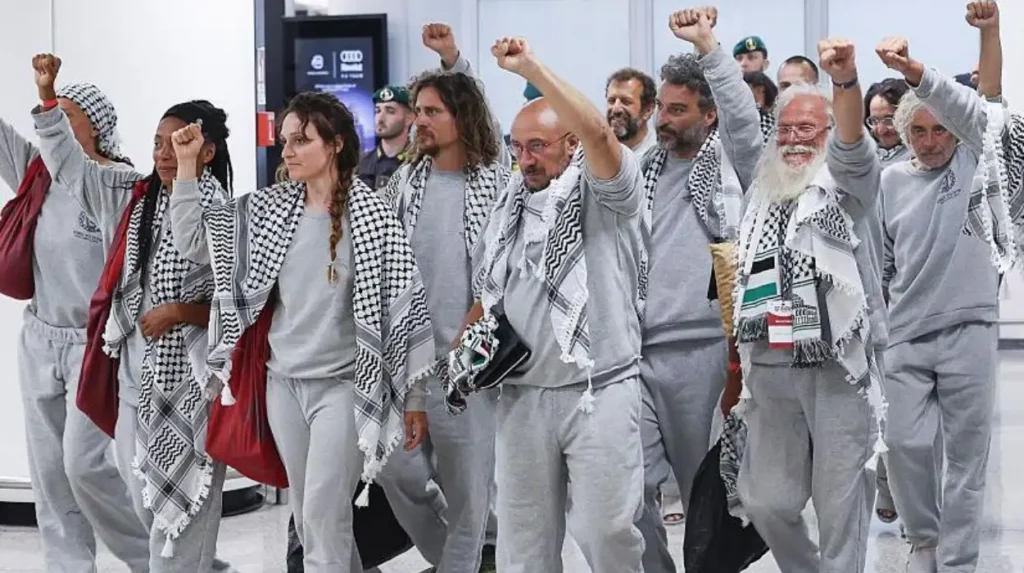
The French protesters who were recently detained by Israeli forces aboard the Gaza-bound flotilla named Sumud Flotilla are claiming that they were subjected to humiliation, abuse, and degradation by Israeli forces, thereby sparking another diplomatic and human rights crisis. The testimonies have been supported by other released activists, and it has emerged that their detention was characterized by the use of violence, verbal harassment, denying basic needs, and even rape allegations.
This situation has arisen within the context of the longstanding siege of Gaza, as well as the continuous efforts made to confront the siege through ship convoys by activists. In this particular instance, the interception of the convoy heading to Gaza, as well as the handling of the arrested individuals, has drawn international attention, including that of many European governments and organizations.
The interception and detention
The flotilla was intercepted by Israeli forces on its way to Gaza, and the people were arrested before being deported or released. It is reported that this single interception resulted in the arrest of about 175 activists, including 15 from France and 24 from Italy, in what is considered to be one of the biggest flotilla arrests in the recent past.
As per reports from the activists themselves, the act of detaining them became their biggest torture point. Not only were they tortured through the act of arrest, but even after that, the torture continued as they were reportedly blinded, zip-tied, forcibly transferred, and humiliated. While there has been no trial for these acts of torture committed on the activists, the consistency of their testimonies has attracted much attention.
Allegations of abuse
The most serious claims involve physical and sexual violence. Activists and flotilla organizers have alleged at least 15 cases of sexual assault, including rape, during detention. One of the most widely reported French accounts came from Mer Hadjal, who said she was touched inappropriately and physically mistreated during custody.
“They touched me, they slapped me, they pulled my hair, and they forced me into humiliating positions,”
Mer Hadjal said, as reported in coverage of the activists’ return.
According to other activists, the conditions in detention centers are intended to be degrading. The activists state that they had been made to kneel for hours, were not allowed to make eye contact with any of the officers, were physically threatened, and were subjected to strict monitoring while in custody. There were reports that they did not get enough to eat, drink, rest, and were deprived of medication, with some claiming it was done intentionally.
Moreover, the use of force against the activists occurred when they were intercepted and moved by officers. According to the reports, some of the activists were beaten with rubber bullets at point-blank range, while lawyers representing the activists said they were subjected to “extreme violence” and experienced “serious injuries.” At least three activists were reported to have ended up in the hospital due to injuries.
French activists’ testimonies
The testimony of the French prisoners has gained significance now that it is being considered not as individual instances of grievances but as a wider pattern of abuses. The testimonies given by a number of French activists who returned to Paris included stories about intimidation and pressure, both psychologically and mentally, which were designed to break their spirit and humiliate them.
The statements resonate with many in France, given the controversy surrounding both the Gaza war and Israel’s continued blockade. The inclusion of French citizens who were detained adds a political aspect to the incident. In addition, it makes sense why there has been so much attention garnered by the allegations from both activist groups and political circles alike.
Humiliation is one of the elements of the testimonies that stands out in particular. The activists do not simply make allegations about brutality and abuse, but also describe how humiliation techniques have been used against them through the limitation of their physical postures, inability to make eye contact, and other means of control.
Israel’s response and denial
Israel has rejected the allegations and defended the interception as a lawful security action linked to the Gaza blockade. In related flotilla cases, Israeli officials have previously called mistreatment claims “outrageous falsehoods,” and the current reporting shows no change in that posture. The Israeli position is that its forces acted to enforce blockade restrictions and prevent threats from reaching Gaza.
“These allegations are false and outrageous,”
Israeli officials have said in earlier responses to flotilla mistreatment claims.
This denial matters since it sets up the debate on familiar grounds: the activists and rights organizations characterizing the events as abuse, possibly even misconduct, and Israel arguing that it is merely executing a justified security policy. There is a great deal of difference between these two opposing positions, and for the moment the available documentation consists almost exclusively of statements made and not evidence that is verifiable.
The overall rationale behind Israel’s position is also part of the continuing struggle regarding the right to travel through Gaza. For Israel, interception of flotillas falls within the framework of national security and maintaining a siege of Gaza. For the activists, this particular flotilla constituted a challenge to that very siege.
Diplomatic pressure and European reaction
Foreign governments have now to put more pressure on the Israeli government by way of their criticism of how the activists were detained. There are reports stating that France, together with other European countries from Europe, like Spain, Britain, Ireland, and Italy, has expressed its concern about the manner in which the detainees are being treated.
The problem for France extends beyond the protection of its citizens to the legal and consular ramifications of holding its citizens hostage abroad. It will be difficult to maintain public silence should lawyers, human rights advocates, or parliamentarians take up this case against the government. Several of the individuals arrested were French citizens, making this more than a distant conflict for the country to take action over.
A broader sensitivity in Europe surrounding the Gaza war, along with the handling of civilians and protesters, has affected the European response. The flotilla incident has taken on an entirely different meaning in this context, with the detention being symbolic of the greater issues involved.
What the numbers show
The mentioned numbers help understand why the incident has picked up pace. For instance, about 175 activists were arrested during the interception, out of whom fifteen nationals from France were said to be involved. There were also twenty-four individuals from Italy who were detained. This proves that the flotilla had received international attention.
The sexual violence accusation is particularly grave since the organizers claim fifteen cases. Moreover, at least three people were reported to have been taken to hospitals. This means that the accusations were not only made but there was actually something substantial behind them. The mentioned numbers do not amount to any facts; they simply show the size of the allegations.
Numbers also matter because they shape credibility and public reaction. A small isolated allegation can be dismissed more easily; a pattern involving multiple nationalities, multiple forms of abuse, and multiple lawyers or organizations becomes harder to ignore. That is part of why the story is drawing sustained attention from media outlets and rights advocates.
Why this story matters
This episode matters for three reasons. First, it raises questions about the treatment of detainees during maritime interceptions, especially where activists say the detention was intentionally degrading. Second, it touches on the broader Gaza blockade debate, which remains one of the most politically charged issues in the region. Third, it has immediate diplomatic consequences because European nationals were involved and their governments are now under pressure to respond.
The allegation of humiliation is particularly significant because it points to the possibility of a detention strategy aimed not only at control, but at deterrence. If activists believe they will be publicly shamed, physically handled harshly, or denied basic needs, that can affect future attempts to join flotillas. In that sense, the dispute is about both past conduct and future behavior.
The story also highlights the power of testimony in conflict reporting. In fast-moving, politically charged incidents, the first public record is often built from the voices of those directly involved. That does not automatically establish legal truth, but it does create a narrative that governments must answer. Here, the activists’ narrative is strong, emotional, and detailed, while Israel’s response is categorical denial.
Legal and human rights questions
The allegations raise potential legal questions about detention standards, use of force, and treatment of civilians. If the claims of sexual assault, denial of medical care, and forced humiliation are substantiated, they could trigger serious human rights scrutiny. Even without formal findings, the accounts are enough to invite demands for independent review.
Human rights organizations typically focus on whether detainees were treated with dignity, given access to basic care, and protected from abuse. The activists’ descriptions suggest violations of those principles, but verification will depend on evidence beyond testimony, such as medical records, video, custody logs, or independent investigations. Until then, the case remains an allegation of serious misconduct rather than a legally settled finding.
The issue of accountability is also central. When detention occurs in a politically sensitive setting, transparency often becomes limited and trust collapses quickly. That is why such cases tend to generate competing versions of events, each with its own audience and political logic.